 Join WhatsApp Channel

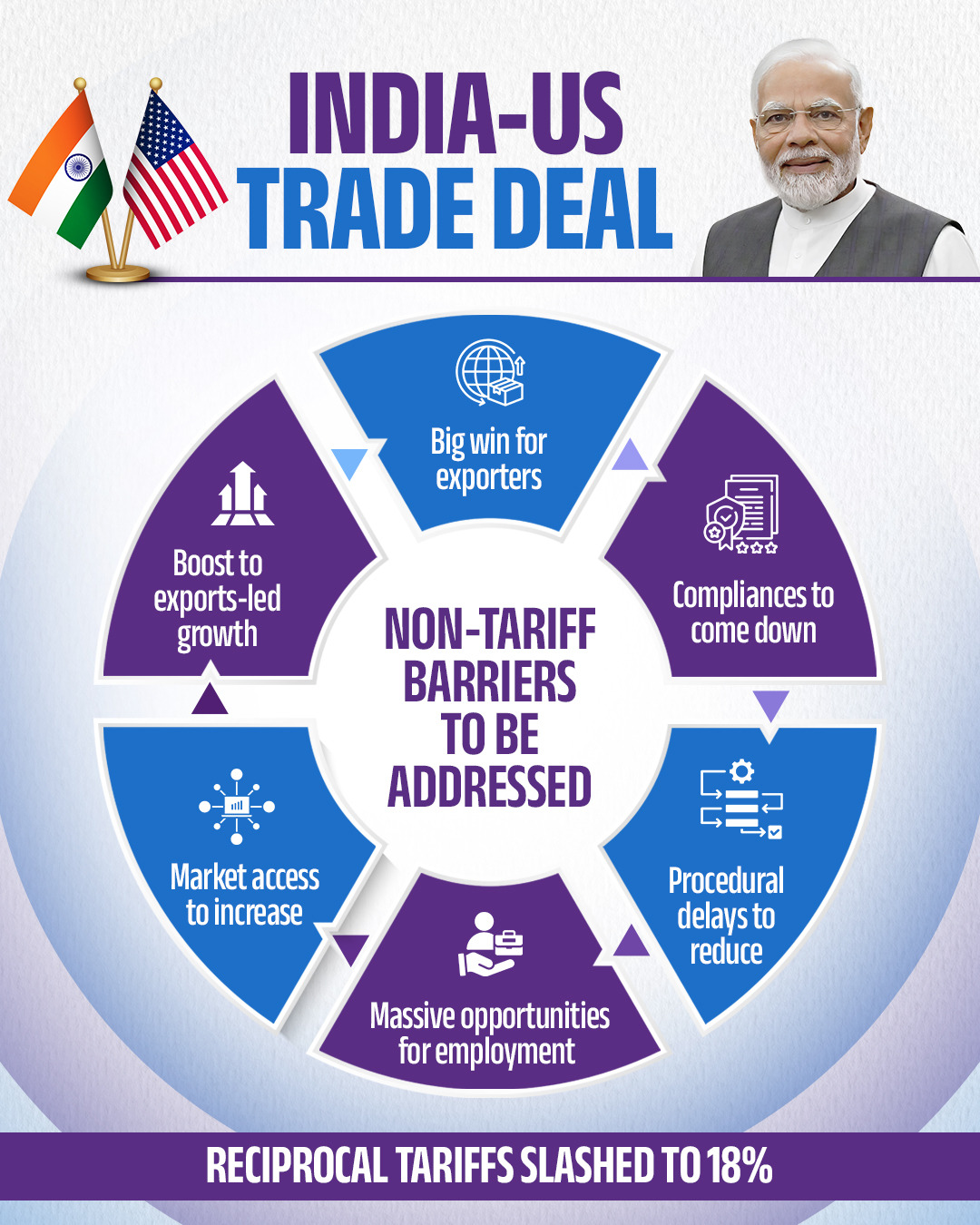
India and the United States on Friday announced a framework for an interim trade agreement that delivers immediate tariff relief for Indian exporters but commits New Delhi to sweeping concessions on market access, regulation, digital trade and economic security—prompting analysts to warn that the balance of gains tilts decisively toward Washington.
The framework, outlined in a joint statement issued late on February 6, is being positioned by both governments as a “historic milestone” and a bridge toward a full Bilateral Trade Agreement (BTA), negotiations for which were launched by U.S. President Donald Trump and Prime Minister Narendra Modi in February 2025.
“This agreement demonstrates our shared commitment to reciprocal and balanced trade based on mutual interests and concrete outcomes,” the joint statement said.
U.S. Trade Representative Jamieson Greer hailed the framework as opening India’s market to American producers. “President Trump’s leadership has delivered real results for American workers, farmers and manufacturers by unlocking market access in one of the world’s fastest-growing economies,” Greer said, thanking Commerce Minister Piyush Goyal for what he called “constructive engagement”.
Tariff cuts: relief without reciprocity
Under the framework, the United States will reduce so-called reciprocal tariffs on about 55% of Indian exports, cutting rates that had risen to as high as 50% down to 18%. These duties had weighed heavily on Indian shipments of textiles, apparel, leather goods, chemicals, machinery, gems and handicrafts.
Commerce Minister Piyush Goyal said the tariff rollback would provide immediate relief to Indian exporters. “This framework will support MSMEs, improve export competitiveness and deepen India’s integration with global supply chains,” he said.
However, Washington has not agreed to cut its most-favored-nation (MFN) tariffs on any product. Future relief—covering items such as generic pharmaceuticals, gems and diamonds, and aircraft parts—remains conditional on the successful conclusion of the interim agreement and subsequent negotiations.
In contrast, India has agreed to eliminate or sharply reduce MFN tariffs on all U.S. industrial goods and a wide range of food and agricultural products, including tree nuts, fresh and processed fruits, soybean oil, wine and spirits, dried distillers’ grains (DDGs) and animal feed sorghum.
“This is not tariff liberalization by the United States—it is tariff damage control,” said Ajay Srivastava, founder of the Global Trade Research Initiative (GTRI). “Washington is merely rolling back punitive and arguably illegal tariffs, while India is making permanent market access concessions across sensitive sectors.”
Agriculture and manufacturing risks
Economists and farm groups have flagged potential domestic fallout from the agricultural concessions.
Tariff reductions on imported fruits and soybean oil are expected to put pressure on Indian farmers, while possible duty cuts on electronics components, smartphones and solar inputs could weaken domestic manufacturing under India’s production-linked incentive (PLI) programs.
“India is opening areas that were previously protected precisely to nurture domestic capacity,” Srivastava said. “Once tariffs are eliminated, that policy space is gone.”
Section 232 relief, conditional pharma access
The agreement also provides selective relief from U.S. national security tariffs imposed under Section 232 of U.S. trade law.
The United States will remove tariffs on Indian aircraft and aircraft parts that had been covered under earlier steel, aluminum and copper proclamations. India will also receive a preferential tariff-rate quota for automotive parts affected by U.S. national security tariffs imposed in 2019.
However, outcomes for pharmaceuticals—one of India’s strongest export sectors—remain contingent on the findings of an ongoing U.S. Section 232 investigation into pharmaceutical imports.
“India’s generics industry remains exposed to future trade action,” Srivastava said. “This is relief today with uncertainty tomorrow.”
Regulatory and standards sovereignty
India has also committed to dismantling long-standing non-tariff barriers that have been a persistent U.S. complaint.
These include easing restrictions on U.S. medical devices, eliminating import licensing requirements for U.S. ICT products, and deciding within six months whether U.S. or international standards and testing requirements will be accepted for American exports in selected sectors.
Finance Minister Nirmala Sitharaman said the agreement would improve ease of doing business and regulatory cooperation. “Harmonization of standards and procedures will support trade facilitation while safeguarding national interests,” she said.
But analysts caution that such provisions could erode India’s regulatory autonomy, particularly in agriculture and health.
“These commitments mirror one-sided concessions the U.S. has extracted from smaller economies,” Srivastava said. “India risks allowing U.S. certification systems to override domestic standards without reciprocal guarantees.”
Digital trade and economic security alignment
The framework also commits both sides to address barriers to digital trade and work toward “robust and ambitious” digital trade rules under the BTA.
While details remain unspecified, analysts say Washington is likely to push India to curb digital services taxes and limit future regulation of global technology firms.
More controversially, the agreement calls for closer “economic security alignment”, including cooperation on export controls, investment screening and responses to “non-market policies of third parties”.
“This language effectively ties India’s economic policy to U.S. geopolitical priorities,” Srivastava said. “It could constrain India’s ability to trade with third countries or pursue an independent sanctions policy.”
The $500 billion commitment
India has also stated its intention to purchase $500 billion worth of U.S. goods over the next five years, spanning energy, aircraft, technology products, precious metals and coking coal.
Prime Minister Narendra Modi described the framework as “great news for India–U.S. economic ties”.
Yet analysts remain skeptical. India currently imports about $45 billion annually from the United States, and major purchases such as aircraft are commercial decisions taken by private airlines.
“Doubling imports to nearly $100 billion a year is simply unrealistic,” Srivastava said. “This is a political headline, not a credible trade projection.”
A pause, not a reset
Overall, economists view the interim agreement as a tactical truce rather than a rebalancing of trade relations.
“The U.S. has eased self-inflicted tariff pressure, but secured far-reaching commitments from India on agriculture, regulation, digital policy and strategic alignment,” Srivastava said. “These concessions go well beyond trade.”
As negotiations move toward a full BTA, the interim framework sets the baseline. Whether India can claw back policy space and rebalance concessions in future rounds remains the central question.
Related posts:
 US, India Agree on Framework for Interim Trade Agreement, Set Path Toward Broader Bilateral Deal
 India Faces High-Stakes Trade Test as U.S.-EU Pact Reshapes Global Tariff Landscape
 Beyond Tariffs: U.S.-India Trade Talks Test New Delhi’s Strategic Trade Vision
 India–NZ Trade Pact Balances Access, Protection
