Join WhatsApp Channel

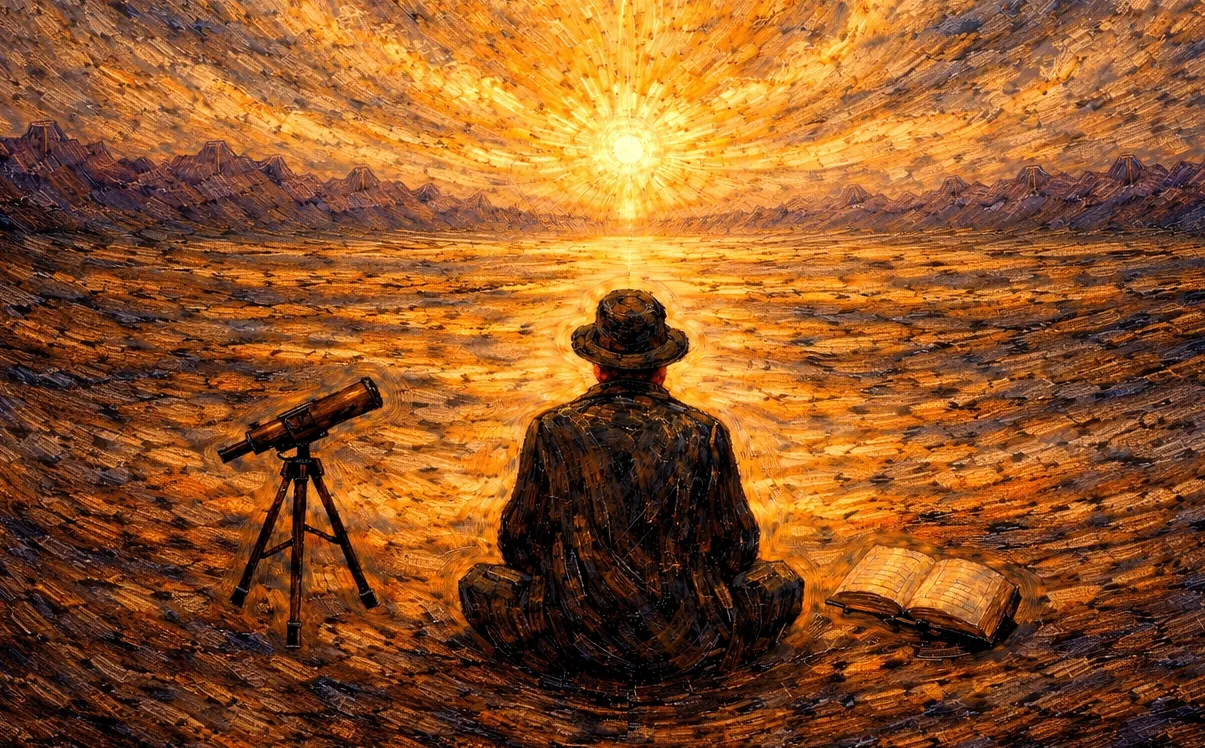
Every generation believes it is finally ready to settle the God question. Armed with better science, sharper logic, louder microphones. The debate repeats itself endlessly: one side insists that God must exist because creation demands a creator; the other insists that God cannot exist because nature explains itself. The arguments grow more sophisticated, the certainty more theatrical. And yet, nothing concludes. Perhaps not because the answers are missing, but because the question itself is wrongly framed.
A recent public debate between Javed Akhtar, a prominent atheist and a Mufti Shamail Nadwi, religious scholar was articulate and civil. It was also entirely predictable. Two positions, rehearsed for decades, performing intellectual symmetry. One defended belief. The other defended disbelief. Both assumed that the truth must sit at one of these poles.
Why do we insist that there can be only two answers?
The Problem of the False Binary
Human civilization has a deep affection for binaries. True or false. Sacred or profane. Believer or atheist. Every God debate eventually turns into a courtroom drama, with one side prosecuting and the other defending.
There is an old story of a judge who listens patiently to the prosecutor and says, “You are right.” Then he listens to the defense and says, “You are also right.” When an observer objects that both cannot be right, the judge replies, “You are right too.”
The story unsettles us because it exposes a flaw we resist admitting.
The most stubborn questions survive not because they lack answers, but because we refuse to question the frame that produces them.
Different civilizations recognized this dilemma long before modern debates tried to resolve it.
In Advaita Vedānta, this intellectual humility is formalized through the method of neti neti — not this, not that. Every description is rejected, not because reality is empty, but because it is too vast to be contained by concepts. Whatever you say reality is, it is not that — and not its opposite either.
Zen expresses the same insight through mu: a refusal to answer a malformed question. Mu is not uncertainty; it is precision. It does not say yes. It does not say no. It says the question itself rests on a false assumption.
In both traditions, wisdom does not come from choosing sides, but from recognizing the limits of the frame within which the choice is demanded.
The Limits of Our Maps
Science, religion, philosophy, and art are not maps of the whole. They are partial readings of an immeasurable text.
Imagine landing in New Delhi and wanting to go to India Gate, but being handed a map that is actually of Mumbai — except it is printed as “Delhi.” Someone else carries a Bengaluru map, also labeled “Delhi.” Another holds a Kolkata map with the same confident heading. Each traveler trusts their map because it claims to represent the territory they are standing in. Each argues fiercely with the others, armed with logic, measurements, and internal consistency. And yet, none of them can reach India Gate.
The problem is not the absence of maps. Everyone has one. The problem is mistaking a representation for the territory itself. A map is never the territory, but when it is mislabeled as such, it creates the illusion of total knowledge. The more passionately one defends the map, the further one may drift from the ground beneath one’s feet.
Much of the God debate unfolds in exactly this way.
Creation, Creator, and Misplaced Certainty
We often argue as if creation automatically implies a manufacturer, importing human ideas of fabrication into a universe that may not operate that way at all. Did a filmmaker create a film from nothing, or did they assemble images, memories, sounds, and emotions that already existed, rearranging them into something that feels new?
Physics tells us that nothing appears from nothing in the way our language suggests. Energy transforms. Matter rearranges. Forms arise and dissolve. What we call creation may be closer to manifestation than manufacture. The separation between creator and creation may be linguistic, not ontological.
Spinoza hinted at this centuries ago when he wrote:
“God is not separate from Nature. God is Nature.”
This is not theology masquerading as science. It is an attempt to dissolve a false separation created by language.
To insist on certainty here — either way — is to mistake conviction for knowledge.
Knowledge, Perception, and the Illusion of Totality
What we call existence is filtered through perception. An ant’s reality is not a tiger’s reality. A blind person inhabits a different world from one who can see. Even among humans, wealth, trauma, health, and culture fracture reality into radically different experiences.
Science excels at mapping patterns. Religion excels at meaning-making. Philosophy excels at questioning assumptions. Art excels at expressing the inexpressible. None of them, alone, capture the whole.
The Upanishads acknowledged this long before modern epistemology:
“Yato vāco nivartante, aprāpya manasā saha.”
From which words return, along with the mind, unable to reach it.
Nietzsche, often invoked triumphantly by atheists, was far more cautious than his popular reputation suggests:
“There are no facts, only interpretations.”
Fear, Curiosity, and the God Question
There is an uncomfortable question we rarely ask honestly.
If human beings did not die, would God matter as much? Would religion exist in its present form?
This is not an accusation against faith. It is an inquiry into motivation. How much of our God-seeking is driven by curiosity, and how much by fear? How much disbelief arises from rigorous investigation, and how much from frustration with religious institutions, moral hypocrisy, or historical violence?
Often, the fight is not with the idea of a creator, but with those who claimed exclusive access to the creator.
Even Richard Dawkins, one of the most articulate critics of religion, concedes something important, though it is rarely quoted:
“The universe we observe has precisely the properties we should expect if there is, at bottom, no design… nothing but blind, pitiless indifference.”
Notice the language. Expectation. Interpretation. Not proof.
The Third Argument
This leads to the third argument — one that neither affirms nor denies God in the conventional sense.
The third argument says this: any position that claims final knowledge about God is intellectually dishonest.
This is not indecision. It is epistemic humility.
Socrates called wisdom the knowledge of one’s ignorance. Wittgenstein warned that where language reaches its limits, silence begins. Christian mystic Meister Eckhart prayed:
“I ask God to rid me of God.”
Not a rejection of the divine, but a rejection of human projections masquerading as divine truth.
Advaita Vedānta goes further. It suggests that the very separation between observer and observed is an illusion. When that illusion dissolves, what remains is Brahman — not a being, not a deity, not an object of belief, but pure being itself.
At that point, the question “Does God exist?” does not receive an answer.
It disappears.
Beyond Belief and Disbelief
Perhaps this is where the debate truly ends.
When one fights for the correctness of one’s own map without the slightest acknowledgement that it may be incomplete, mislabeled, or provisional, atheism becomes as dogmatic and closed as the theism it seeks to oppose. At that point, the disagreement is no longer about God, but about certainty. Belief and disbelief harden into identical postures, differing only in vocabulary.
Saints and sinners are no longer opposites. They are merely exchanging notes, each convinced that their map is the territory itself.
The tragedy is not that we disagree about God, but that we cling so tightly to our answers that we forget how to ask.
Disclaimer: The opinions and views expressed in this article/column are those of the author(s) and do not necessarily reflect the views or positions of South Asian Herald.