Join WhatsApp Channel

The intensifying geoeconomic rivalry between the United States and China is reshaping global supply chains, technology access, and trade norms and is pushing Washington to treat India less as a “potential” partner and more as a necessary pillar in trusted supply chains. But turning that strategic logic into manufacturing reality will depend on two questions — what structural constraints continue to hold India back, and what the U.S. can do to better align India to stay ahead of China.
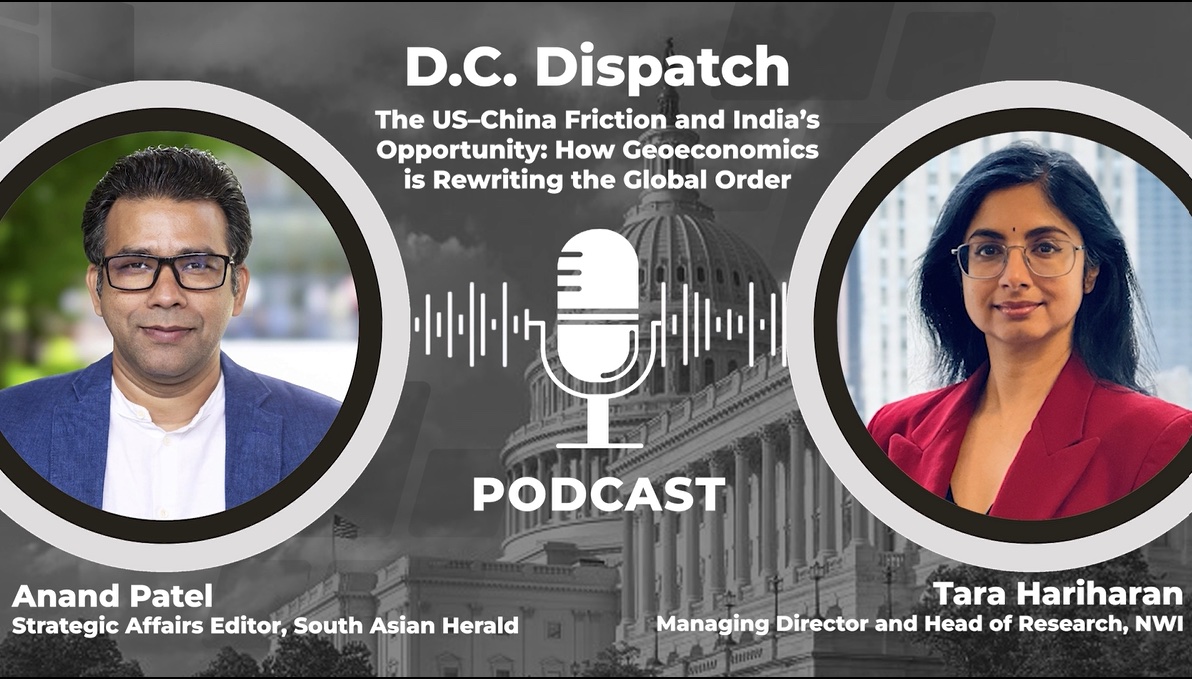
In this exclusive conversation with D.C. Dispatch, South Asian Herald’s special podcast, Tara Hariharan, Managing Director and Head of Research at New York–based global macro hedge fund NWI, argued the world is moving away from seamless globalization toward a fragmented system organized around rival blocs, Washington and New Delhi face a narrow window to convert alignment into lasting economic advantage.
Technology and Supply Chains at the Center of Power Competition
Hariharan said the technology stack is now politically contested end-to-end. China retains leverage over upstream inputs and rare earth processing, while the United States remains dominant in chip design and critical equipment, creating a world where market access is increasingly conditioned by national security priorities.
“The era of pure globalization in technology supply chains is over,” Hariharan said, adding that nations are increasingly being pushed to align with one sphere or another as U.S.–China competition intensifies.
From Trade War to Structural Rewiring
The discussion traced the evolution of U.S. trade policy from Trump-era tariffs to the Biden administration’s industrial policy and friend-shoring initiatives, arguing that the changes amount to a structural shift rather than a temporary trade dispute.
“We are no longer in a trade war,” Hariharan said. “We are in a fundamental rewiring of how the U.S. thinks about economic security and global value chains.”
Rather than a retreat from international trade, she described the current phase as “re-globalization,” a fragmentation of globalization into rival, alliance-based economic systems. Companies increasingly operate dual or parallel supply chains to hedge geopolitical risk, even as overall global trade volumes remain resilient.
China-Plus-One Strategies and India’s Position
As multinational firms seek to reduce exposure to China, “China-plus-one” strategies have gained traction. However, Hariharan cautioned that diversification is not driven solely by labor costs but by political risk mitigation, regulatory predictability, infrastructure reliability, and workforce scale.
“China-plus-one doesn’t mean one thing,” she said. “Different locations offer different value propositions depending on what you’re making.”
Southeast Asian economies have captured gains in labor-intensive manufacturing such as textiles and basic electronics, while Mexico has benefited from proximity to the U.S. market. India, she argued, offers a distinct combination of scale, technical talent, and a large domestic consumer base, making it an increasingly viable alternative in select sectors.
India’s Rise and Its Persistent Bottlenecks
India’s growing strategic and economic weight is increasingly reflected in global indices and diplomatic engagement. Hariharan pointed to India’s elevation to major power status in the Lowy Asia Power Index as evidence of its expanding geoeconomic and geopolitical relevance.
However, she emphasized that India’s ability to convert this standing into sustained manufacturing leadership remains constrained by structural bottlenecks. These include infrastructure gaps, regulatory complexity, uneven skill quality, power reliability, and policy inconsistency across states.
“India’s rise is extremely significant,” she said, “but translating that into geoeconomic leadership is a much harder task.”
Reforms Needed to Unlock India’s Potential
According to Hariharan, realizing India’s manufacturing and supply-chain ambitions will require faster regulatory approvals, expanded industrial corridors, intense vocational and technical training, stable tax regimes, and stronger intellectual property protection.
“India’s massive potential can only be actualized through speedy, and often uncomfortable domestic reforms,” she said.
She identified pharmaceuticals, biotechnology, semiconductor assembly and testing, electronics manufacturing, solar panels, and electric vehicles as sectors where India has near- to medium-term advantages. More capital-intensive ambitions, such as mature-node semiconductor fabrication, critical minerals processing, and aerospace and defense manufacturing, remain longer-term prospects contingent on infrastructure and technology transfer.
What the United States Can Do
Hariharan also argued that U.S. policy will be decisive in determining whether India can emerge as a credible geoeconomic partner in counterbalancing China. She called for deeper trade engagement, tariff exemptions for strategic Indian-made goods, accelerated technology transfer, joint investment vehicles, and smoother mobility for skilled Indian talent.
“The U.S. needs to create positive incentives to invest in India,” she said, “not just disincentives around pulling manufacturing away from China.”
A Defining Moment for the Global South
As geoeconomics reshapes U.S.–China relations, the discussion highlighted that countries like India face a narrow but consequential window, not merely to hedge between rival powers, but to build durable economic resilience and strategic autonomy in an increasingly fragmented global order.
Related posts:
 Experts at Capitol Hill Hearing Underscore India’s Importance in Staying Ahead of China in the Indo-Pacific
 U.S. FORGE Initiative Targets China’s Critical Minerals Dominance, India Joins Bloc
 America Knows India for Tech; It’s Missing What Comes Next
 India Tweaks China Investment Curbs but Core Press Note 3 Framework Remains Intact