Join WhatsApp Channel

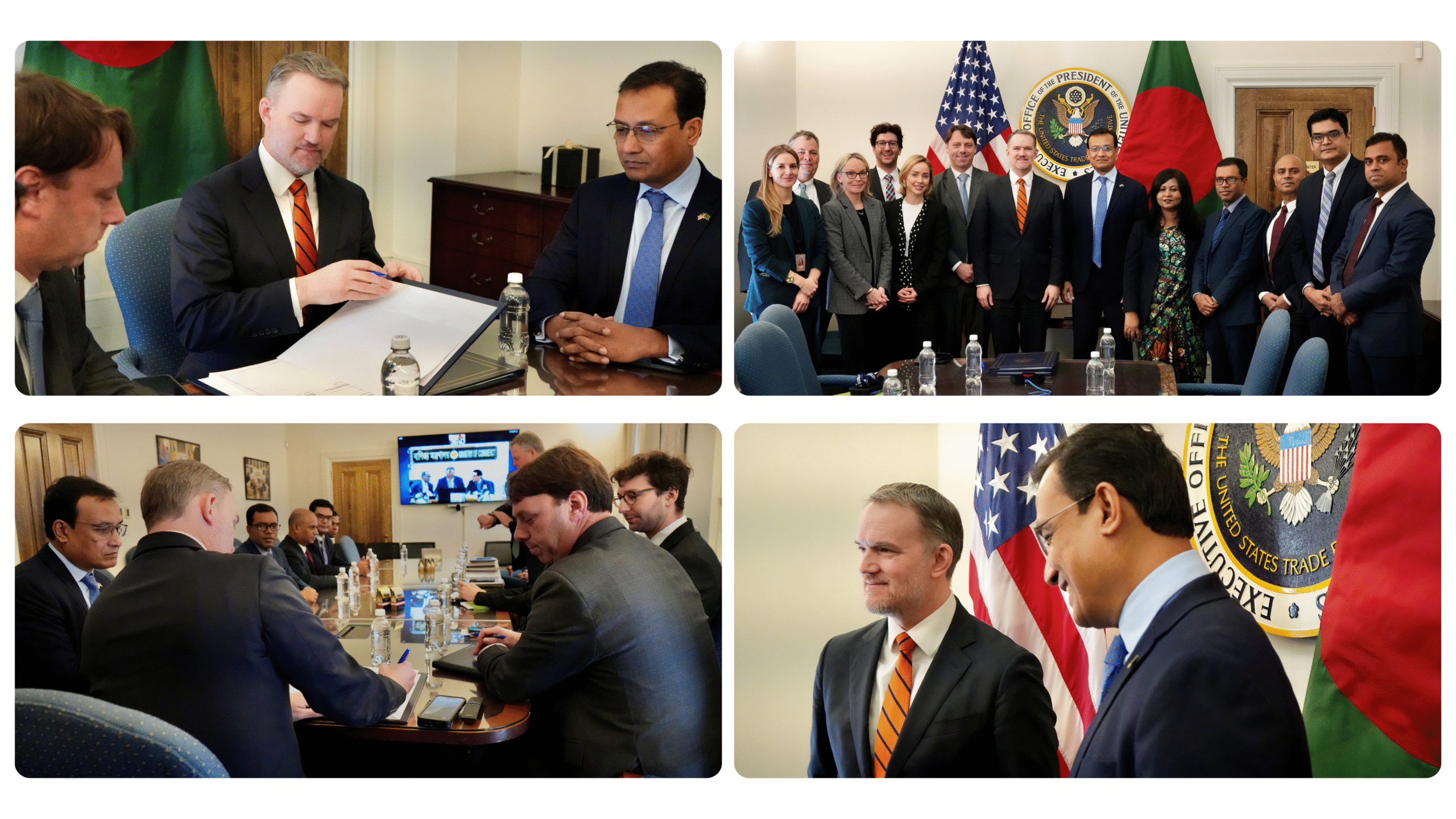
The United States and the People’s Republic of Bangladesh on February 9, 2026, signed an Agreement on Reciprocal Trade aimed at strengthening bilateral economic ties and expanding access to each other’s markets.
Under the agreement, the United States will further reduce the reciprocal tariff on Bangladeshi goods to 19 percent from 20 percent, which had been in effect since August 2025. The original tariff level for Bangladesh had been set at 37 percent.
According to a joint statement issued on February 9, the agreement is expected to provide U.S. and Bangladeshi exporters with expanded access to both markets and build on the two countries’ long-standing economic relationship, including the U.S.–Bangladesh Trade and Investment Cooperation Forum Agreement signed in 2013.
The agreement was signed in Dhaka by Bangladesh Commerce Advisor Sheikh Bashir Uddin and National Security Advisor Khalilur Rahman, while the U.S. side was represented by U.S. Trade Representative Ambassador Jamieson Greer. Bangladesh Commerce Secretary Mahbubur Rahman and Assistant U.S. Trade Representative Brendan Lynch were also present at the ceremony.
Negotiations for the agreement took place over nine months, beginning in April 2025.
Ambassador Greer praised Chief Adviser Muhammad Yunus for his leadership of the negotiations and commended the Bangladeshi negotiating team for its “incredible efforts.” He said, “This agreement will fit Bangladesh on US trade policy.”
Following the signing, Commerce Advisor Uddin described the agreement as marking a new chapter in bilateral economic relations. “It will provide substantially enhanced access of Bangladesh and the US to each other’s respective markets,” he said.
As part of the deal, the United States committed to establishing a mechanism that would allow certain Bangladeshi textile and apparel exports using U.S.-produced cotton and man-made fibers to enter the U.S. market at a zero reciprocal tariff.
National Security Advisor Rahman, who served as Bangladesh’s chief negotiator, said the tariff reductions would benefit exporters and provide a boost to the garments sector. “The reduction of reciprocal tariff will grant further advantage to our exporters, while zero reciprocal tariff on specific textile and apparel exports from Bangladesh using US inputs will give substantial added impetus to our garments sector,” he said.
Ambassador Greer said the agreement aligns with Washington’s broader trade policy priorities. “Under President Trump’s leadership, the United States is pursuing a trade policy that delivers real results for American workers and businesses, strengthening our economic and security partnerships abroad,” he said. He added that the agreement is the first of its kind in South Asia and “marks a meaningful step forward in opening markets, addressing trade barriers, and creating new opportunities for American exporters.”
The agreement was approved by Bangladesh’s Council of Advisers on February 9 and will become operational once the two sides issue the necessary notifications.
In a detailed joint statement released by the White House the same day, Bangladesh committed to providing preferential market access for a wide range of U.S. industrial and agricultural products, including chemicals, medical devices, machinery, motor vehicles and parts, information and communications technology equipment, energy products, soy, dairy products, beef, poultry, tree nuts, and fruit.
The statement noted that the United States will reduce the reciprocal tariff rate on Bangladeshi goods to 19 percent, as outlined under relevant executive orders, and will identify specific products eligible for a zero percent reciprocal tariff. It also confirmed that a special mechanism will be created to allow a defined volume of Bangladeshi apparel and textile exports to enter the U.S. market duty-free, linked to the use of U.S. textile inputs.
The two countries also agreed to address non-tariff barriers affecting trade and investment. Bangladesh committed to measures including recognizing U.S. vehicle safety and emissions standards, accepting U.S. Food and Drug Administration certifications for medical devices and pharmaceuticals, and removing import restrictions on U.S. remanufactured goods.
Additional commitments by Bangladesh include permitting the free transfer of data across trusted borders, supporting a permanent moratorium on customs duties on electronic transmissions at the World Trade Organization, adopting science-based processes for agricultural imports, removing insurance market barriers, digitalizing customs procedures, and strengthening regulatory practices.
The joint statement also highlighted commitments by Bangladesh to protect internationally recognized labor rights, enhance environmental protections, improve customs and trade facilitation, strengthen intellectual property protection, and enforce comprehensive anti-corruption laws.
Both countries reaffirmed their intention to strengthen economic and national security alignment to enhance supply chain resilience and address unfair trade practices. The United States said it would work through institutions such as the Export-Import Bank of the United States and the U.S. International Development Finance Corporation, where eligible, to consider supporting investment financing in critical sectors in Bangladesh.
The statement also noted recent and forthcoming commercial deals in agriculture, energy, and technology, including aircraft procurement, purchases of approximately $3.5 billion in U.S. agricultural products, and energy purchases estimated at $15 billion over 15 years.
The United States and Bangladesh said they will complete domestic formalities promptly so the Agreement on Reciprocal Trade can enter into force.
Related posts:
 US, India Agree on Framework for Interim Trade Agreement, Set Path Toward Broader Bilateral Deal
 Trump Announces Sweeping Tariffs on Imports, Citing Trade Disparities with South Asia and Beyond
 India–US Interim Trade Pact Brings Tariff Relief but Locks India into Deeper Market and Strategic Concessions
 India Pins Hopes on Early U.S. Tariff Rollback, But Exporters Brace for Deeper Pain