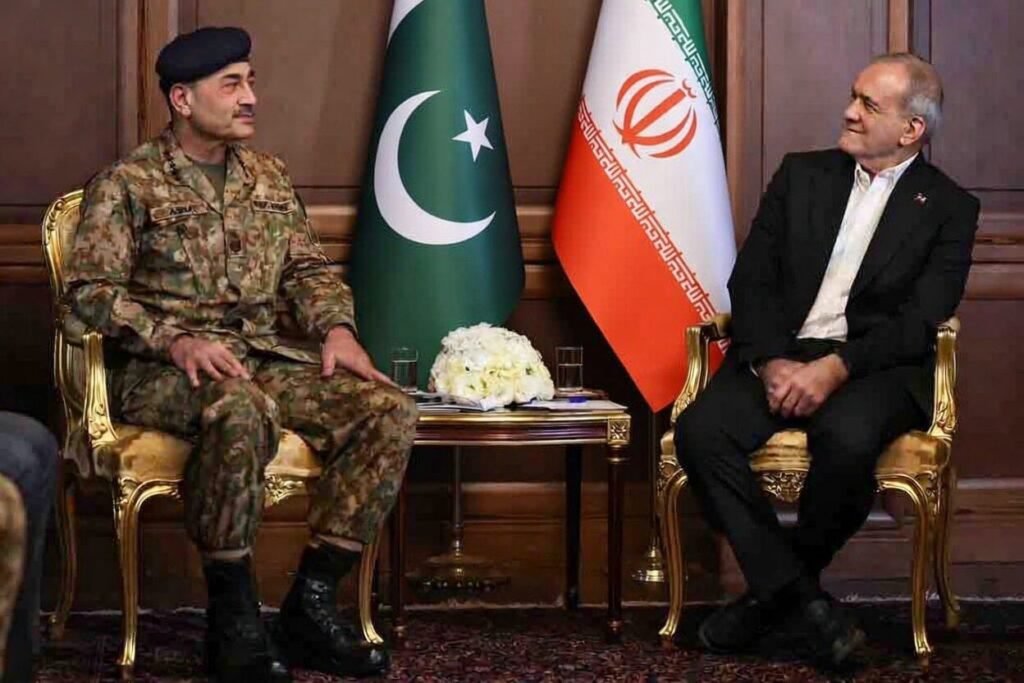
Pakistan’s Army Chief, Field Marshal Asim Munir will visit Tehran on Monday leading an official delegation as part of efforts to promote peace and security in the region, Iran’s Foreign Ministry spokesman Esmaeil Baqaei said.
In a social media post on X, the Iranian government said the visit will focus on bolstering Iran-Pakistan relations and supporting efforts to enhance peace and security in the region. Pakistan has been mediating between Iran and the United States aimed at ending the war that began with US and Israeli strikes on Iran in February.
The discussions are also expected to address US President Donald Trump’s threat of imposing tougher sanctions on Iran.
Munir’s visit comes amid heightened tensions, with Iran warning of a military response to US plans for additional sanctions that could place further pressure on the Islamic Republic’s struggling economy.
Advertisement
Baqaei strongly criticized the new US sanctions, describing them as an extension of what he called Washington’s “economic warfare” against Iran.
“The United States’ declaration of new economic sanctions on Iran is far more than continued unlawful ‘economic warfare’ against a single country. It is an assertion of extraterritorial sovereignty over every independent Member State of the United Nations. No State may lawfully compel foreign banks, enterprises, or airports – each subject to the exclusive jurisdiction of its own sovereign – to renounce lawful commerce with a third State,” he said.
The Iranian spokesman also cited the International Court of Justice’s ruling in the Nicaragua case, arguing that economic pressure aimed at forcing a sovereign state to change its policies could constitute an internationally wrongful act.
Baqaei further linked the sanctions to what he described as a naval blockade amounting to military aggression, warning that such measures could undermine the sovereignty of states within the UN system.
Baqaei argued that secondary sanctions targeting foreign banks, businesses and airports amounted to an assertion of US authority beyond its own territory. He said such measures had no basis in international law and violated the principle of sovereign equality under Article 2(1) of the UN Charter.
“Such secondary sanctions find no foundation in international law. They violate the principle of sovereign equality enshrined in Article 2(1) of the UN Charter and breach the customary prohibition on intervention affirmed by the International Court of Justice in the Nicaragua case. Economic coercion designed to force a sovereign State to alter its lawful policy choices constitutes an outright internationally wrongful act,’ he said.
he said when combined with a naval blockade amounting to military aggression, “these demands reduce the sovereignty of all other States to something provisional, conditional, and revocable at the whim of another power.” “Compliance purchases no immunity or respect; it merely concedes that one’s banks, enterprises, and airports operate only under a foreign license.”
He said the action amounted to the “complete erosion of sovereignty as the foundational basis of the UN-based inter-State system, and a recipe for an abysmal return to full-scale classic colonialism.”