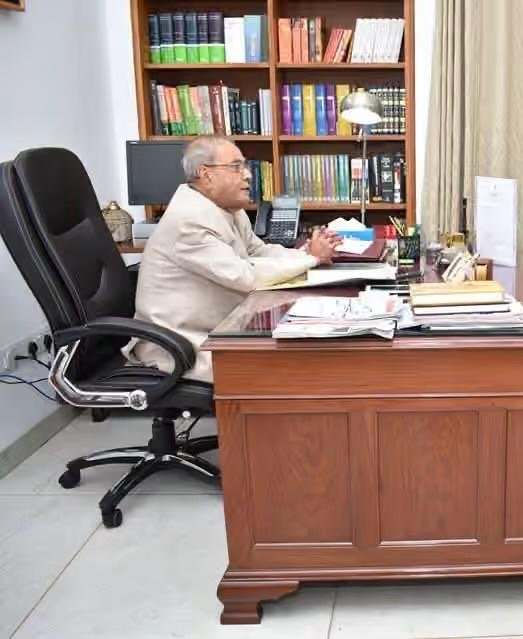
India’s 13th President Pranab Mukherjee will probably always be remembered as the man who could have been India’s Prime Minister.
Pranab babu as most politicians called him was however perhaps never destined to attain that high office and which is why he eventually decided to live on top of the Raisina Hill as the country’s first citizen.
Mukherjee was an accomplished economist, a masterful diplomat who like Matternich could balance both Soviet Russia and the US as he jostled to fly India’s flag abroad and of course a seasoned back-room politician adept at striking deals to smoothen out politics in the national purchase interests and if need be even buy up political loyalty where needed.
Congress chief Sonia Gandhi’s recently released memoir, ‘Belonging: A Journey of Love’, has once again focused public glare on his political career with experts delving into “what if” analysis.
Advertisement
Gandhi has recalled a conversation with Mukherjee midway into UPA-II’s second term, where Mukherjee appeared to suggest that it might be time for a change at the top, a possible broad hint that was read as a suggestion that Dr Manmohan Singh should be replaced with him taking over the reigns.
This was the time when opinion polls voiced showed an anti-Congress mood was speaking across the country as India’s top industrialists were speaking of “policy paralysis” affecting the functioning of the Manmohan Singh government.
Few Indian politicians possessed Mukherjee’s breadth of experience. His political journey spanned the Indira Gandhi era, the turbulent transition under Rajiv Gandhi, the coalition politics of the 1990s and the decade of United Progressive Alliance governments under Manmohan Singh. He had served as finance minister, defense minister, external affairs minister and commerce minister, often at moments when the country faced difficult domestic and foreign affairs choices.
Mukherjee understood the levers of power better than any in the Indian Parliament, how political coalitions could be assembled or broken up, how bureaucracies functioned and how competing political interests could be brought together.
In an era when Indian politics increasingly rewards mass mobilization, television visibility and personal charisma, Mukherjee represented the ultimate institutional politician, whose authority rested on knowledge, memory, negotiation and an intimate understanding of the machinery of the state.
The day the then Prime Minister Indira Gandhi was killed in October 1984, Mukherjee probably made a bid for power when he told newspersons at Kolkata airport, after her death was announced, that the Congress Legislative Party would meet soon to elect a new PM.
Rajiv Gandhi was sworn in soon afterwards without much ado and Mukherjee slowly eased out of power and the Congress party. Pranab Mukherjee went into the wilderness as he stated a small political party and returned to New Delhi’s power corridors only when his old friend PV Narasimha Rao became Prime Minister after Rajiv Gandhi’s assassination.
In 2004, when the Congress came back after two coalitions led by Janata Dal and BJP respectively had their chance in office. According to Mukherjee’s own memoir – The Coalition Years – after Sonia Gandhi declined the top job, he had expected to be the replacement choice. But history and the Congress party decided otherwise.
Then came 2010, when many in the Congress thought there was need a crying need to “rejuvenate the Congress brand”, by a change at the top. However, as Sonia Gandhi’s memoirs reveal, this too was not to be.
He was instead promoted to be the President of India, in 2012, which solved Congress’s need for a globally recognizable face at the top, but at the same time perhaps weakened the party domestically.
Devoid of the backroom political management which Mukherjee understood better than any, the Congress leadership made one blunder after another in handling coalition partners, in managing state leaders and managed to jump from policy crisis to yet another.
If he had been given the top job, would Congress have managed to rule for another five or perhaps even ten years? Would it have managed to reverse its history of being wiped out from most north and western Indian states?
These are indeed difficult questions for any political or economic analyst to delve into. And will surely remain unanswered questions which will dog India’s and the Congress party’s political history as do questions on whether India would have remained united if Subhas Bose had remained Congress President.
The Pranab Mukherjee story will remain a reflection on the possibilities that Indian democracy sometimes leaves unexplored when political succession is determined as much by the architecture of power as by the qualifications of those who seek it. (UNI)