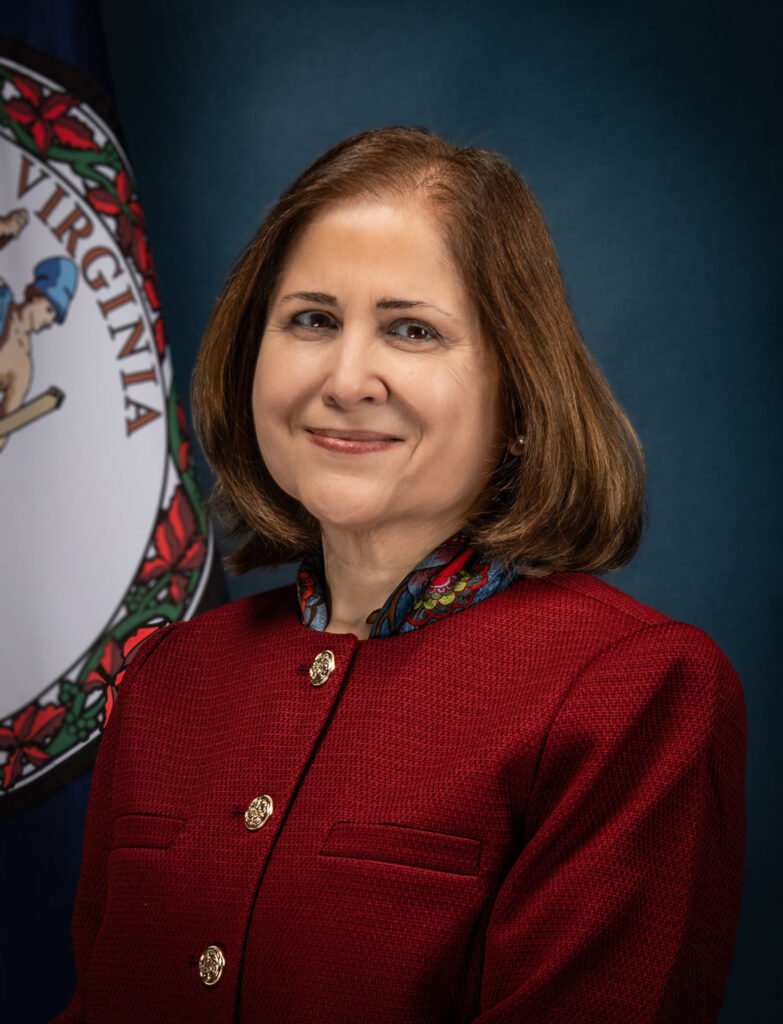
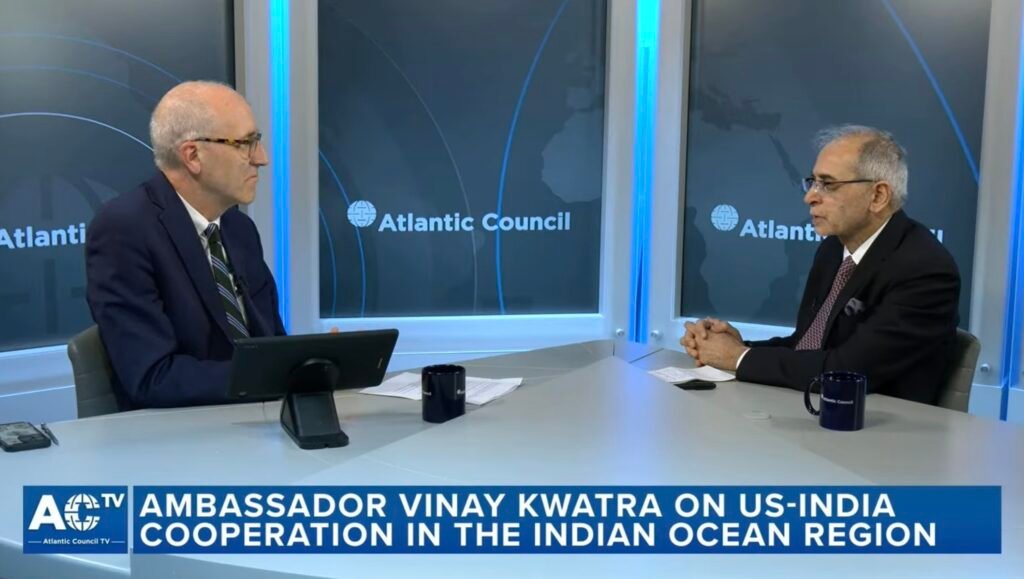
Smaller Indian Ocean countries need more development choices, with transparent agreements, sustainable financing and respect for their sovereignty, India’s Ambassador to the United States Vinay Mohan Kwatra said on November 17, emphasizing that India’s approach was guided by the needs of regional partners rather than competition between major powers.
Speaking at a virtual discussion hosted by the Atlantic Council on the future of the Indian Ocean region, Kwatra said India preferred to focus on what individual countries needed rather than view development partnerships through the lens of geopolitical competition.
“So I would rather look at it from the perspective of those countries as to what do they need rather than more as a competitive template in which to shape it,” he said. The discussion was moderated by NBC News national security and global affairs reporter Dan De Luce.
Asked how India and the US could offer an alternative to Chinese state-backed investments without forcing smaller countries to choose sides, Kwatra said regional partners wanted clear agreements, sustainable financing and projects that served their own priorities. He warned that some investments might appear inexpensive initially but create heavy financial burdens over time, leaving countries “mortgaging” their infrastructure.
Advertisement
Kwatra said India’s approach focused on projects that strengthened local economies, built domestic capacity and avoided unsustainable debt. “I would rather look at it from the perspective of those countries as to what do they need rather than more as a competitive template in which to shape it,” he said.
His remarks came as India and the US continue discussions on infrastructure and maritime security projects in Sri Lanka, the Maldives and Mauritius under their Indian Ocean Strategic Venture, announced by Prime Minister Narendra Modi and President Donald Trump in February 2025.
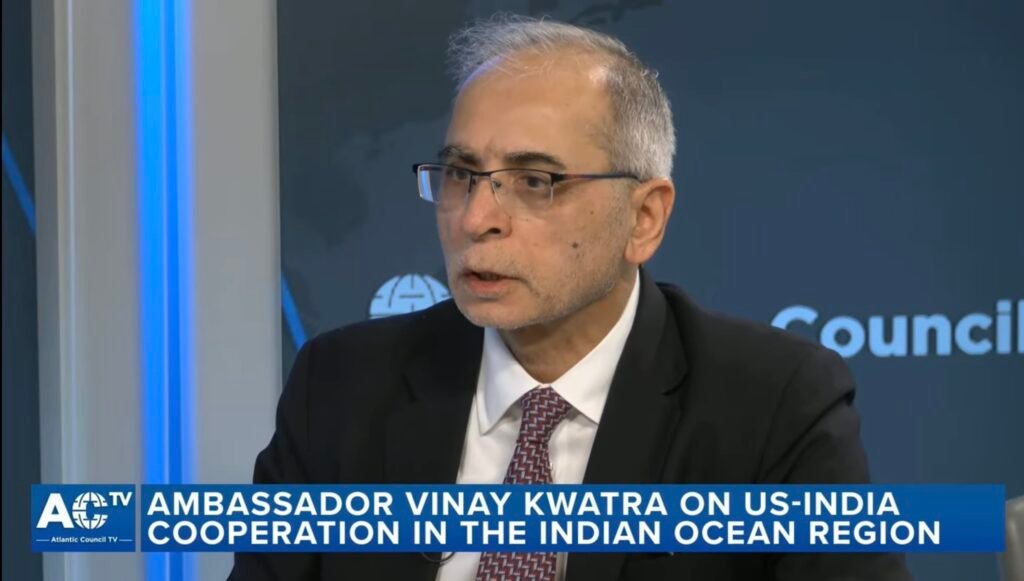
“Discussions are going on with regard to three countries, Sri Lanka, the Maldives and Mauritius,” Kwatra said. While offering no timelines, he said the first projects would be “practical” and “visible,” with transparent terms and a focus on strengthening local economies. Ports, digital infrastructure, investment and maritime security would be among the main areas of cooperation.
The ambassador also addressed concerns raised by the moderator over China’s expanding civilian maritime fleet and the possible use of commercial vessels for surveillance and military purposes. Asked how India was responding, Kwatra said New Delhi monitored all types of vessels operating in the Indian Ocean, including those whose movements or activities were not fully accounted for.
“We don’t take a segmented approach to it to look at one kind of vessels and ignore other kinds of vessels,” he said. India, he added, closely watched conventional shipping as well as gray shipping and so-called dark vessels.
“We do follow that the vessel is doing what the vessel is supposed to do as per its stated objective,” Kwatra said, adding that India remained “constantly watchful” of maritime activities that could affect its national, economic and political security.
Kwatra said maritime surveillance and information sharing were important parts of India-US defense cooperation. He pointed to the Quad’s Indo-Pacific Maritime Domain Awareness initiative, under which member countries pool resources to track activities at sea and share information with countries in the region.
He said India and the US were also working to improve real-time information sharing, increase naval exercises and strengthen their ability to respond to maritime emergencies. These efforts form part of the renewed 10-year defense cooperation framework, which covers military platforms, operations at sea and underwater, and responses to crises.
Kwatra cited recent military exchanges, including the visit of US Indo-Pacific Command chief Admiral Samuel Paparo to India. He also noted that the Indian Navy completed its first command of Combined Task Force 154, based in Manama, Bahrain, in October. The two countries also cooperate on anti-piracy operations, counter-narcotics efforts and disaster relief.
The ambassador said India would continue to act as a first responder during emergencies in the Indian Ocean region. He recalled India’s assistance after the 2004 tsunami, vaccine deliveries during the COVID-19 pandemic and financial support to Sri Lanka during its economic crisis.
He linked these efforts to Modi’s SAGAR vision, introduced in 2015, which stands for Security and Growth for All in the Region. The approach was expanded into MAHASAGAR in 2025, with a wider focus on shared development, security and cooperation across regions.
Turning to trade tensions between India and the US, Kwatra said both governments remained in intensive talks and hoped to conclude a bilateral trade agreement soon. “We are working full speed on that,” he said.
He also reaffirmed the Mission 500 target set by Modi and Trump in February 2025 to raise bilateral trade to $500 billion by 2030. Despite disagreements over tariffs, Kwatra said the two countries continued to work closely on defense, technology, critical minerals, investment and other areas.
He highlighted cooperation on critical mineral supply chains and India’s participation in Pax Silica, while describing legal mobility and ties between the Indian diaspora and the US as important parts of the relationship.