 Join WhatsApp Channel


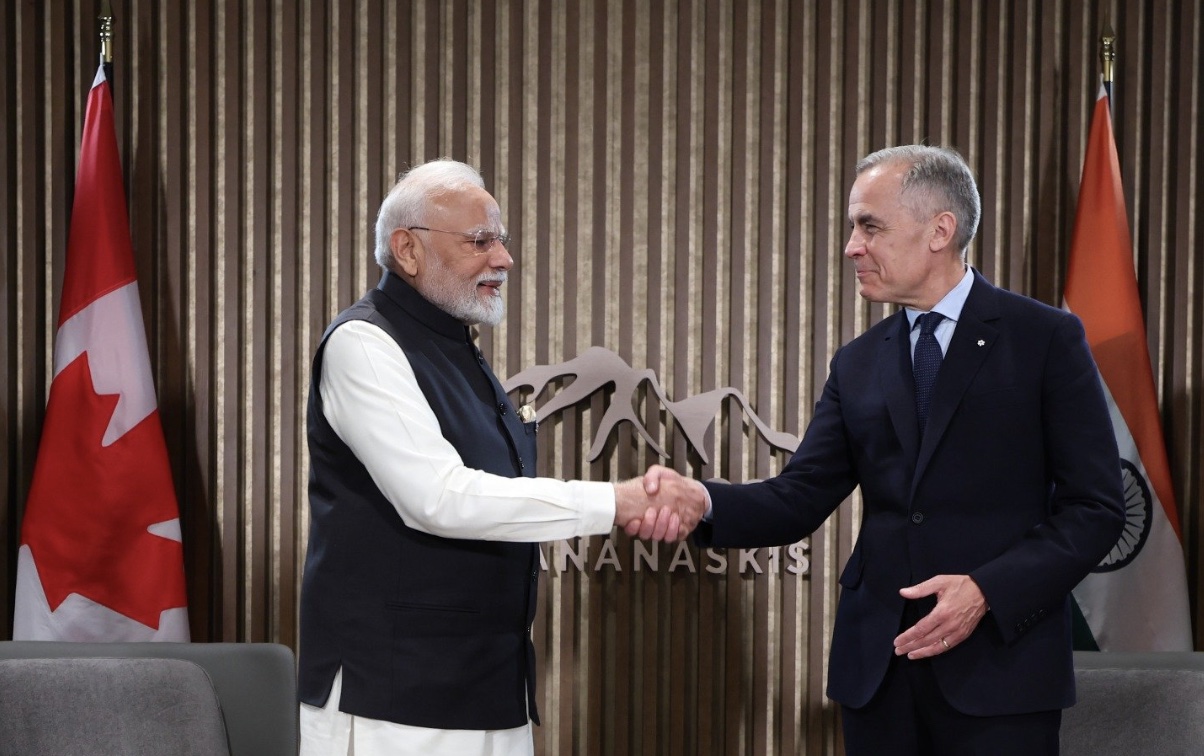
The official visit of Prime Minister of Canada, Mark Carney, to India from February 27- March 2, 2026, is being widely interpreted as a diplomatic reset. Yet trade analysts argue it could be far more consequential laying the foundation for a long-term economic and energy partnership built on complementary needs, with uranium cooperation at its core.
Invited by Narendra Modi, Carney’s first official trip to India comes after nearly three years of strained relations that followed the 2023 diplomatic crisis and the suspension of Free Trade Agreement (FTA) talks. While the itinerary spans Mumbai and New Delhi and touches sectors ranging from artificial intelligence to education, experts point to two outcomes that could define the visit: revival of FTA negotiations and the signing of a long-term uranium supply agreement.
According to an assessment by the Global Trade Research Initiative (GTRI), both countries now have compelling economic reasons to move decisively forward. Canada is seeking to diversify trade beyond its heavy reliance on the United States, while India is looking for stable export markets alongside secure, long-term access to energy and critical minerals essential for its growth and industrial transition.
This convergence is already visible in trade numbers. Bilateral trade has grown steadily, reaching US$7.8 billion in 2025. India exported around US$4.5 billion worth of goods—led by pharmaceuticals, gems and jewelry, textiles, and machinery—while Canada exported approximately US$3.3 billion, dominated by pulses, timber, pulp and paper, and mining products. GTRI notes that because the two economies largely trade complementary rather than competing goods, an FTA could significantly amplify trade and investment flows, particularly in agri-food, clean energy, and critical minerals.
Carney’s visit begins in Mumbai, where he will engage with business leaders, innovators, and major Canadian pension funds already invested in India. These engagements are designed to underscore Canada’s intent to treat India as a long-term strategic market rather than a transactional partner. Yet the most consequential decisions will emerge in New Delhi.
On 2 March, at Hyderabad House, Modi and Carney will hold delegation-level talks reviewing cooperation across trade, investment, energy, critical minerals, agriculture, education, innovation, and people-to-people ties, building on their earlier meetings in Kananaskis and Johannesburg. Beneath this wide-ranging agenda, however, nuclear energy has emerged as the visit’s strategic centerpiece.
GTRI highlights the proposed long-term uranium supply agreement as potentially the most transformative outcome of the visit. For India, the deal would directly support the expansion of its nuclear power program at a time when sectoral reforms—under the SHANTI Act, 2025—are aimed at accelerating reactor deployment, attracting foreign technology partners, and enabling advanced reactors and small modular reactors. Assured uranium supplies from a trusted partner, GTRI argues, are indispensable to these ambitions.
For Canada, the agreement offers more than commercial gain. It secures a dependable export destination beyond the United States and embeds Canada within India’s long-term clean energy transition. In this sense, uranium becomes both an energy input and a strategic instrument, reinforcing mutual trust after the diplomatic rupture of 2023, when relations deteriorated under former Canadian Prime Minister Justin Trudeau. The visit aims to inject new momentum into bilateral ties, which were severely strained following a diplomatic row over the killing of a Khalistani separatist in 2023.
Carney’s election victory in 2025 initiated a gradual normalization process, including the reinstatement of high commissioners and the reopening of political dialogue. The uranium agreement, if concluded, would represent the strongest institutional signal yet that this reset has matured into strategic alignment.
Alongside nuclear cooperation, GTRI sees the likely restart of FTA negotiations as the second pillar of the reset. Combined, the FTA and uranium deal would anchor India–Canada relations in long-term economic logic rather than episodic diplomacy—binding energy security, trade diversification, and industrial growth into a single strategic framework.
When Modi and Carney jointly address the India–Canada CEOs Forum on 2 March, that message will be unmistakable: the relationship is no longer about repairing damage from the past, but about constructing a future defined by secure energy supplies, expanding trade, and shared economic resilience. If realized, the uranium supply agreement will stand as the clearest symbol of that shift—powering India’s reactors while energizing a renewed partnership between two major democracies.
Related posts:
 India–Canada Uranium Deal, Trade Talks May Advance During Prime Minister Carney’s Expected March Visit
 G7 Summit 2025 Ends with Renewed Alliances, Sharp Divides, and a Surprise Exit by President Trump
A New Chapter: Rebuilding the India-Canada Partnership
G7 Summit 2025 Ends with Renewed Alliances, Sharp Divides, and a Surprise Exit by President Trump
A New Chapter: Rebuilding the India-Canada Partnership
 Canadian PM Mark Carney Announces First Official Visit to India
