Research from De Montfort University Leicester (DMU) and Barclays Eagle Labs highlights South Asian founders’ contributions to the UK economy and the systemic barriers that hinder their growth.
Based on 125 interviews with South Asian entrepreneurs, business leaders and support organizations across England and Wales, the study identified challenges including cultural attitudes toward debt and risk, stereotyping in investment and banking, and limited access to elite business networks.
Separately, research by London hotelier Tony Matharu found that recent increases in National Insurance and business rates have disproportionately affected South Asian-owned businesses. According to the research, these businesses account for around 68% of those operating in London’s hardest-hit sectors, including wholesale, retail, hospitality, restaurants, venues, transport, care and business services.
Against this backdrop, South Asian Herald is launching a series of interviews with South Asian founders building innovative businesses in the UK.
Advertisement
The series begins with an exclusive interview with Siddarth Patwardhan, co-founder of AmpliSi, a University of Sheffield spinout. Patwardhan is a professor of sustainable chemical and materials engineering at Sheffield and previously held lecturer positions at the University of Strathclyde and Nottingham Trent University.
What’s your product, in lay man’s terms?
A battery is made up of an anode where electrons are lost during oxidation; a cathode, which gains electrons; and an electrolyte, which is a liquid or gel substance inside the battery that lets negatively charged ions to move between the anode and cathode.
The anodes are traditionally made from graphite. But as the world need more and more batteries and ever-higher performance, the existing silicon production methods are expensive, dangerous, and unscalable. So we’ve come up with a new solution to make the anodes without needing the graphite, but instead using silica, which is abundant in the world.
We’re in the process of registering various patents for both the process that we use, as well as the technology itself.
You’ve had a long academic career – how did the move to co-founding a startup happen? How are both different and how did you respond to those changes?
Having an engineering background, a lot of research in my group has been directed towards solving real-world problems and developing the underpinning science. Hence, translating academic research into a deep-tech spin-out company felt like a natural evolution. However, that does not mean that the transition was easy.
Both operate at different pace with different priorities, have different languages and ways of working. In academia, success is measured by high-impact outputs and impact over a long-term – the work leading to AmpliSi took nearly eight years of research and development (R&D). In a startup, execution velocity, commercial validation and scaling are key priorities. It’s a change in mindset and I am still working on it.
So, the transition took a lot of learning but it was facilitated by the other founders, collaborators, university tech-transfer office and the investors.
Navigating the legal processes of spin-out formation and completing an investment round were challenging for me given my lack of prior experience.
Founding a startup is hard and can be lonely, but you’ve had a co-founder and a CEO that joined. How does the division of labor between you work?
The spin-out process was a collective effort. The executive/founding team has complementary skill sets, which also made it easy to decide areas of focus and responsibility.
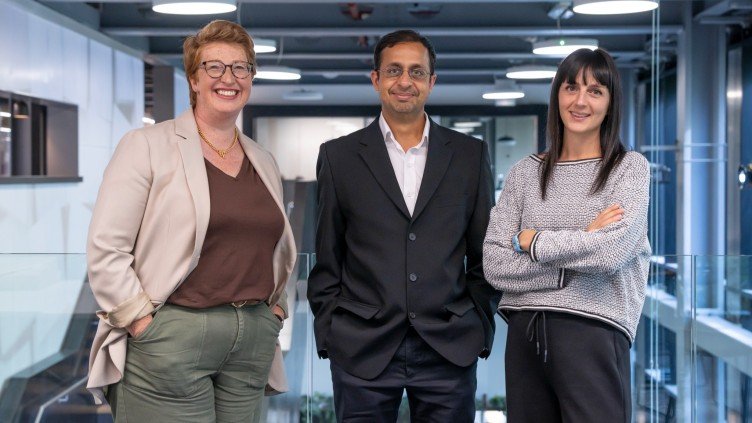
My technical co-founder, Gwen Chimonides, leads the technology development, our CEO, Ruth Sayers, manages commercialization and I am focusing on scientific and IP related aspects. In addition, our regular communication is ensuring that the decision-making is transparent.
What has been the one high point and one low point in the journey so far?
Seeing the invention making its way out of the lab is really satisfying and exciting. This was possible through getting early backing by the University of Sheffield and Faraday Institution’s research funding followed by securing a £2 million ($2.65 million) investment from the UK’s Clean Growth Fund and the Northen Gritstone, which is a venture capital (VC) firm focused on deeptech and life sciences companies from the north of England (since a lot of investor interest tends to be focused in the UK’s main corridors of London, Oxford and Cambridge). They backed us to develop next-generation silicon anode materials for lithium-ion batteries.
Silicon anodes are a top area of strategic importance for developing a UK sovereign battery capability. Where do you see your company scaling and developing?
Our focus is on unlocking commercial-scale manufacturing of high-capacity porous silicon materials to directly replace or blend with traditional graphite anodes. Right now, we’re scaling the technology, developing the process and building the team to deliver world-leading silicon that meets our customer’s needs, and we’re doing this in the UK.
By supplying cell manufacturers with localized, sustainable anode material, we aim to anchor critical upstream battery materials right here in the UK while catering to global demand.
Under the UK’s current 2025 Critical Minerals Strategy (Vision 2035), silicon is on both the critical minerals list, as well as on the growth minerals list.
Critical minerals are identified primarily based on global supply risk and UK economic vulnerability, whereas growth minerals are forward-looking and identify materials expected to be particularly important to the UK’s Industrial Strategy growth sectors. So to be on both lists is a big deal.
For silicon specifically, the UK forecasts demand rising from 57,500 tons in 2024 to around 785,800 tons by 2035, largely driven by advanced manufacturing and clean energy.
How does the UK compare to the US in terms of having a sovereign battery capability? What does the UK have to do differently?
The US innovation ecosystem operates very differently – it is less-risk averse with relatively more access to VC investments. In AmpliSi’s case, we’re very fortunate to have supportive and proactive VC investors, who understand the deep-tech sector. The UK has an emerging sovereign battery capability through the government’s Battery and Industrial Strategies. Rather than replicate the US model, the UK focus is on supporting UK businesses to scale locally, while using trusted global partners where needed.
In a world where access to critical minerals and the entire value chain in the battery industry is a focus for many high-level political considerations, we’re happy to be developing it in the UK.
Deep-tech innovation coming out of universities holds the key to the net-zero transition. A thriving and connected ecosystem to support the translation from lab to market.