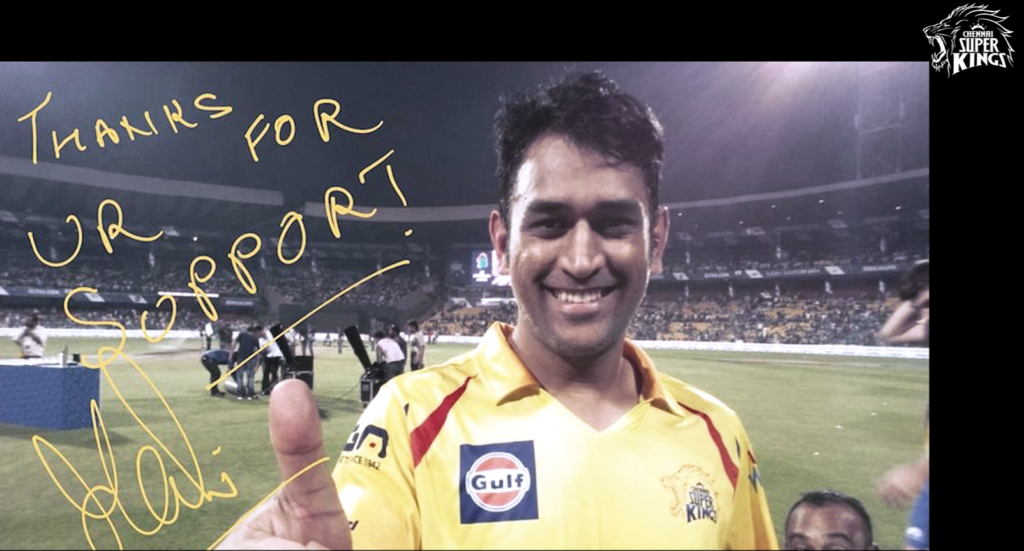
Cricket has produced bigger hitters, more prolific run scorers and captains with impressive trophy cabinets. But few have mastered the art of making millions believe that a game is never lost until the final ball. MS Dhoni built his legend on that belief. Now, after 19 seasons, the man who made the last over his personal domain has finally walked away from the crease.
Chennai Super Kings (CSK) announced Dhoni’s retirement from playing on November 17, 2026, bringing to a close one of the most enduring associations in Indian Premier League (IPL) history. He will continue with the franchise as a mentor from the 2027 season, but the prospect of seeing No. 7 stride out in the yellow jersey to rescue another improbable chase has given way to nostalgia.
There was no elaborate farewell, no emotional press conference and no carefully choreographed announcement. Dhoni chose an exit that reflected the man himself.
During a video conference discussing CSK’s player releases for the 2027 season, CEO Kasi Viswanathan was reading the names when Dhoni quietly interrupted: “Maybe you should add my name in.”
Advertisement
The call disconnected shortly afterward.
CSK co-owner Rupa Gurunath later recalled the moment in an emotional video, joking that even the internet could not handle the news. She said Dhoni had hinted for months that he was uncertain about continuing, adding that he would not play unless he could give the team his 200 percent.
It was a characteristically Dhoni decision: no sentimentality about the past, no attempt to cling to the spotlight and no willingness to compromise on his standards.
For CSK, however, the departure is anything but ordinary.
“There is no CSK without MS Dhoni,” owner N. Srinivasan said, recalling how he had insisted on bringing the former India captain into the franchise in 2008. “It turns out that’s the best decision I took. Not because of all his achievements for the franchise, but for the kind of human he is. Dhoni will always be a part of our identity. This will always be his home.”
The numbers make a compelling case for his greatness. Across 278 IPL appearances, Dhoni scored 5,439 runs at an average of 38.30 and a strike rate of 137.45. He struck 24 half-centuries and 264 sixes, while his 100 not-outs reflected an extraordinary ability to stay at the crease until the work was finished.
Behind the stumps, he registered 205 dismissals — 158 catches and 47 stumpings — the most by any wicketkeeper in the tournament’s history.
Yet, Dhoni’s real legacy lies beyond the conventional scorecard. He transformed the final overs into a psychological contest in which opposing bowlers often appeared to be defending their reputations as much as their totals.
In overs 16 to 20, he accumulated 3,468 runs from 1,982 balls at a strike rate of approximately 175. His tally was comfortably ahead of the next-best batter in that phase. Between overs 17 and 20, his strike rate climbed to around 187-190. In the 20th over alone, he scored 844 runs from 347 deliveries at a remarkable strike rate of 243.22.
These figures capture something distinctive about Dhoni’s batting: he did not merely hit boundaries; he controlled the tempo of a contest.
He could allow a bowler to believe he had the upper hand, take a few singles, absorb pressure and then dismantle the attack in a handful of deliveries. His helicopter shot became an iconic feature of his batting, but his greatest asset was an almost forensic understanding of match situations. He knew when to hold back, when to accelerate and when to take the game away.
For opposing captains, bowling to Dhoni in the closing overs was an examination in nerve and execution. A yorker missed by a few inches could disappear into the stands. A slower ball that sat up could become a six. Even a seemingly comfortable target could become vulnerable once he found his rhythm.
His five IPL championships as CSK captain — in 2010, 2011, 2018, 2021 and 2023 — tell another part of the story. He led the franchise in 221 matches, winning 136, and guided it to 10 finals and 12 playoff appearances. The five titles placed him alongside Rohit Sharma as the most successful captains in IPL history.
CSK also became the first franchise to defend its IPL championship, winning back-to-back titles in 2010 and 2011. Two Champions League T20 trophies, in 2010 and 2014, further strengthened Dhoni’s record.
But trophies alone do not explain the unusual loyalty between Dhoni and Chennai.
In a league built around auctions, player transfers and constant reinvention, he cultivated continuity. Suresh Raina, Ravindra Jadeja, Ravichandran Ashwin and Dwayne Bravo became part of a team culture in which players understood their responsibilities and were trusted to deliver. Dhoni rarely sought attention for himself, preferring to absorb criticism when things went wrong and share the credit when they went right.
His calm demeanor was not an absence of aggression. It was a tactical advantage. He could change bowling combinations, reposition fielders and introduce unexpected match-ups without betraying the slightest anxiety. His leadership rested on instinct, experience and an ability to recognize what individual players needed at critical moments.
Even the franchise’s two-year suspension in 2016 and 2017 failed to break the association. Dhoni represented Rising Pune Supergiant during that period, but his return to CSK in 2018 coincided with a championship-winning comeback. The Yellow Army had waited, and its captain delivered.
The emotional response to his retirement has crossed franchise boundaries.
CSK captain Ruturaj Gaikwad recalled learning the meaning of simplicity after joining the team in 2019. Sharing the dressing room and the 22 yards with Dhoni, he said, was a dream.
“You are, and you will always be, our Thala, our captain, our leader,” Gaikwad said.
Jadeja’s tribute was shorter but deeply personal: “8 ka 7 ke liye respect forever,” accompanied by a photograph of their embrace after the dramatic 2023 final.
Rohit Sharma congratulated Dhoni on an extraordinary IPL career, while former India all-rounder Irfan Pathan described him as a leader, finisher and one of the most influential figures in Indian cricket.
Veteran commentator Harsha Bhogle captured the larger significance of the moment, calling it the end of an era and observing that Dhoni and CSK were meant to be.
That relationship was also central to the IPL’s evolution. Dhoni demonstrated that T20 cricket was not exclusively the domain of young power hitters, that experience could be a competitive advantage and that a player could remain influential by adapting his role. In his later seasons, he increasingly concentrated on wicketkeeping and brief but explosive appearances at the death, extracting maximum value from limited opportunities.
His transition to mentoring in 2027 will allow CSK to retain his tactical experience as the franchise prepares for life beyond its most recognizable player. Gaikwad and the next generation must now shoulder the responsibility of sustaining a culture that Dhoni spent nearly two decades building.
For supporters, however, the transition will not be easy. The IPL will continue to deliver spectacular finishes, new heroes and championship celebrations. But the sight of Dhoni walking out with the bat, adjusting his gloves and surveying the field before another late assault will remain one of the tournament’s defining images.
His playing career ends without a grand farewell, much like the way he conducted much of his life in cricket. No unnecessary drama. No prolonged goodbye. Just a quiet decision when he felt the time had come.
The final scorecard will record 5,439 runs, 264 sixes, 205 dismissals and five IPL championships as captain. The deeper record belongs to the millions who found hope in his presence whenever a match went down to the wire.
The yellow jersey will remain. The whistle will still podu. The game will go on. But the man who made the final over an art form has taken off his gloves for the last time. And for the Yellow Army, no replacement can quite fill those shoes.