A Trump administration proposal to deny federal income tax-exempt status to private schools that use race, color, or national or ethnic origin as a basis for admissions, scholarships and other educational programs could have far-reaching implications for South Asian students and diaspora organizations, placing some community-specific scholarships and philanthropic initiatives under scrutiny.
The proposed regulations by the Treasury Department and the Internal Revenue Service (IRS) are part of President Donald Trump’s broader campaign to dismantle race-conscious diversity, equity and inclusion (DEI) policies in American institutions. While the administration presents the move as an effort to restore merit-based opportunity and enforce a uniform standard against racial discrimination, its implications could extend to educational assistance programs established by Indian-American, Pakistani-American, Bangladeshi-American and other South Asian communities.
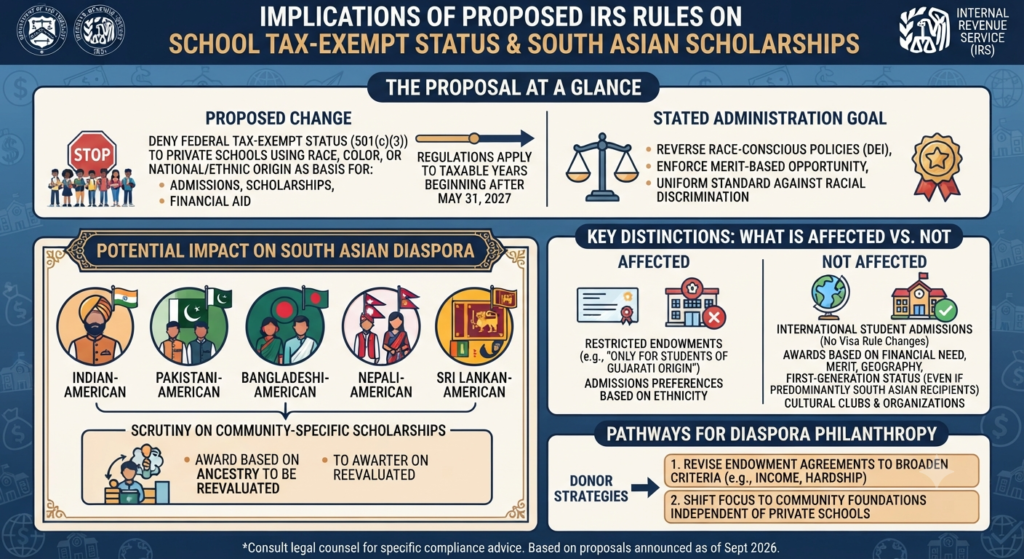
The proposal would not prevent students from India, Pakistan, Bangladesh, Sri Lanka, Nepal or other South Asian countries from enrolling in American schools and universities. Nor would it change student visa rules or require institutions to reduce international admissions. Its potential impact lies instead in the financial assistance and educational opportunities that private institutions make available through programs explicitly designed for particular racial, ethnic or national-origin groups.
For a diaspora that has developed extensive philanthropic networks to support students from its communities, the central question is whether private universities can continue administering scholarships and educational initiatives based on ethnic identity, or whether they will have to shift towards criteria such as household income, geographical disadvantage, individual hardship and first-generation student status.
Advertisement
The proposed rule would deny tax-exempt status under Section 501(c)(3) of the Internal Revenue Code to private educational institutions that adopt, maintain or enforce policies discriminating on the basis of race, color, or national or ethnic origin in admissions, educational policies, scholarships, loans, athletics or other school-administered or school-supported programs.
The prohibition would apply irrespective of whether a policy is justified as an effort to remedy historical discrimination, address underrepresentation or promote diversity. The regulations would cover private elementary and secondary schools, colleges, universities, preparatory institutions and professional or trade schools.
The IRS estimates that the proposal could affect approximately 18,000 private educational institutions and 750,000 students. The regulations would apply to taxable years beginning after May 31, 2027, giving institutions time to review their policies before the new requirements take effect.
Executive orders provide the policy impetus
The proposal is closely linked to Trump’s January 21, 2025, Executive Order 14173, titled Ending Illegal Discrimination and Restoring Merit-Based Opportunity, which directed federal agencies to identify and deter what the administration considers unlawful discrimination, including practices adopted by institutions of higher education.
The order sought to dismantle what the administration characterized as illegal preferences embedded in DEI programs and to restore merit-based decision-making in education, employment and other institutional settings. It also directed federal agencies to develop plans for implementing the administration’s approach and scrutinizing entities receiving federal support.
A second executive order, issued on April 23, 2025, Executive Order 14280, Reinstating Common Sense School Discipline Policies, directed the Education Department and the Justice Department to take action aimed at preventing racial discrimination in school disciplinary systems.
The IRS proposal cites these executive actions alongside federal civil rights legislation and Supreme Court decisions as evidence of the government’s policy against racial discrimination. In announcing the regulations on September 3, 2026, the Treasury Department explicitly described them as delivering on Trump’s executive orders to end discrimination and restore merit-based opportunity.
Treasury Secretary Scott Bessent argued that schools could not escape scrutiny by describing race-based preferences as equitable, inclusive or diversity-enhancing. The administration’s position is that racial preferences remain discriminatory regardless of the objectives invoked to justify them.
The proposal therefore represents more than a technical revision of tax regulations. It seeks to translate the administration’s broader anti-DEI policy into a specific condition for private educational institutions seeking federal tax exemption.
There is, however, an important distinction between an executive order and the proposed IRS regulation. The executive orders establish the administration’s policy direction and instruct federal agencies to act within their authority; the proposed tax regulation would create a specific standard governing the eligibility of private schools for Section 501(c)(3) status. Its final form will depend on the regulatory process and could face legal challenges.
The proposal also emerges from a wider enforcement climate. The administration has scrutinized university admissions, hiring, scholarships and other programs, while the Department of Health and Human Services announced compliance reviews of five medical schools in August 2026 to examine whether their admissions, scholarships, fellowships and related practices violated federal civil rights requirements.
These actions form part of the political and regulatory backdrop, although the IRS has not identified a single recent incident at a named private school as the trigger for its proposal.
A wider interpretation of the affirmative-action ruling
The legal foundation for the tax policy predates the Trump administration. In 1971, the IRS established that private schools maintaining racially discriminatory policies could not qualify for tax-exempt status. The Supreme Court reinforced that principle in its 1983 decision in Bob Jones University v. United States, upholding the denial of tax exemption to an institution whose policies discriminated on racial grounds.
The new proposal seeks to make that standard explicit in federal regulations while removing portions of Revenue Procedure 75-50, which had allowed certain preferences for racial minority groups in admissions, facilities, programs and financial assistance where their purpose and effect were to promote nondiscrimination.
It also builds on the Supreme Court’s 2023 decision in Students for Fair Admissions v. Harvard, which struck down race-conscious admissions programs at Harvard University and the University of North Carolina.
The administration is seeking to extend the implications of that decision beyond admissions into scholarships, loans and other programs at tax-exempt private institutions. That is consequential because the Supreme Court’s 2023 ruling concerned university admissions, while the proposed IRS regulation would establish a broader condition for retaining charitable tax status.
The extent of the IRS’s authority to impose such a standard, and whether the proposed approach reaches beyond the legal limits established by the Supreme Court, could become central issues in any subsequent litigation.
South Asian scholarships face scrutiny
The most direct implications for the diaspora could emerge in scholarship programs supported by private universities and donors seeking to improve educational access for particular South Asian communities.
Indian-American, Pakistani-American, Bangladeshi-American, Nepali-American and Sri Lankan-American organizations have developed educational initiatives reflecting different migration histories and socioeconomic circumstances. Some awards recognize academic achievement within a particular community; others seek to help students from families with limited financial resources or backgrounds underrepresented in higher education.
Where a private school or university makes race, ethnicity or national origin an explicit eligibility condition, the proposed regulations could require the institution to reconsider the programs. A scholarship reserved for students of Indian ancestry, for example, could raise questions even if the donor’s intention is to encourage educational advancement rather than exclude other applicants.
The same issue could arise with awards reserved for students from a particular South Asian ethnic or national-origin community. The proposal’s explicit reference to national and ethnic origin means that institutions may have to examine not only race-based awards but also scholarships whose eligibility is tied to ancestry or country of origin.
This does not mean that every scholarship associated with South Asian communities would be prohibited. An award based on household income, academic achievement, family circumstances, geographical disadvantage or first-generation status would not be disqualified merely because its recipients were predominantly South Asian.
The distinction would depend on the institution administering the award, the precise eligibility conditions and whether race, ethnicity or national origin determines who receives the educational benefit.
The IRS expects that the overall value and number of scholarships and loans may remain broadly unchanged, although the distribution of recipients could shift. It estimates that restricted endowment-funded grants account for no more than 16 percent of total scholarship dollars, but acknowledges that it lacks sufficient data to determine precisely how many institutions operate race-based programs or how the proposed changes would affect individual communities.
International students: no new admissions bar
Students applying from South Asia should not interpret the proposal as a nationality-based restriction on access to American education.
The regulations would not alter student visa eligibility, change the rules governing F-1 visas or prevent universities from recruiting students from India and other South Asian countries. They would not require institutions to reduce international student intake or treat applicants from South Asia less favorably.
Nevertheless, scholarships explicitly reserved for students from particular countries could require closer examination if administered by private educational institutions covered by the rule. The distinction between an award based on nationality and one based on financial need or individual circumstances could become a compliance issue.
This could matter to universities receiving donor funds earmarked for students from India or other South Asian countries. Institutions may need to review whether the restrictions are compatible with the proposed rules and, where necessary, seek revised terms from donors.
The proposal’s direct focus is on qualifying private educational institutions, not every charitable organization. An independent South Asian foundation awarding scholarships outside a school’s administration would not automatically lose its own tax-exempt status under this particular rule. However, arrangements in which a private school administers, controls or incorporates an identity-based award into its programs could raise more complicated questions.
Diaspora philanthropy faces a rethink
The regulations could prompt South Asian donors to reconsider how they structure educational philanthropy. Community foundations, alumni groups, professional associations and individual philanthropists have often used scholarships to strengthen links with their cultural or national-origin communities. Some awards recognize academic achievement; others are intended to support students from families that have struggled to gain access to higher education.
If private universities can no longer administer scholarships with explicit racial or ethnic eligibility requirements while retaining tax-exempt status, donors may have to renegotiate endowment conditions or identify alternative ways to achieve their objectives.
The IRS has pointed to criteria such as income, geography, individual hardship and first-generation status as permissible alternatives. These could preserve assistance for economically disadvantaged students, including those from South Asian backgrounds, but they would not necessarily reach the same recipients as community-specific scholarships.
That distinction could matter particularly for smaller and less affluent diaspora communities. Treating Asian Americans as a single demographic can conceal differences in income, migration histories and educational outcomes among Indian, Pakistani, Bangladeshi, Nepali and Sri Lankan Americans. A broad income-based programs could address financial disadvantage, but it might not capture every form of underrepresentation that community-specific initiatives were designed to address.
The change could also intensify divisions within the Asian-American community over affirmative action. Some Asian-American applicants and families have argued that race-conscious admissions can disadvantage them, while others have warned that treating Asian Americans as a uniformly successful group obscures economic hardship and barriers faced by particular communities.
The proposed regulations could sharpen that debate by narrowing the scope for institutions to use ethnic identity as a basis for targeted educational assistance.
Cultural recognition remains possible
The proposed rules do not require universities to abandon South Asian cultural organizations, student associations, festivals, heritage activities or academic programs devoted to South Asian history and society. Nor do they prohibit schools from taking steps to prevent prejudice and discrimination, provided those efforts do not allocate educational benefits on prohibited racial or ethnic grounds.
The distinction is between recognizing a community and using membership of that community to determine who receives an educational advantage. A university could continue to support cultural activities and encourage students from different backgrounds to participate, while facing restrictions on scholarships, admissions preferences or other benefits reserved for a particular ethnic group.
Religious schools would also retain the ability to maintain religious missions and select students on the basis of genuine religious affiliation, provided religion is not used as a proxy for race, national origin or shared ethnic ancestry.
For South Asian institutions and donors, the challenge will be to preserve the educational purpose of their initiatives while ensuring that eligibility conditions comply with the final regulations.
Public hearings in December
The Treasury Department and the IRS have scheduled two days of telephonic public hearings on the proposal, on December 2 and 3, beginning at 10 a.m. Eastern Time. The additional hearing day was announced to accommodate the number of individuals seeking to present oral comments.
Only those who submitted timely requests to testify by the November 3 deadline will be permitted to speak, with each speaker allotted 10 minutes. Those wishing to attend without testifying must register by November 30 by emailing publichearings@irs.gov and identifying the proposal as REG-119986-25.
The proposed regulations are expected to apply to taxable years beginning after May 31, 2027. Public comments and the hearings could influence the final language, particularly on the treatment of donor-restricted scholarships, national-origin criteria and programs intended to address educational disadvantage.
For South Asian students and the diaspora, the outcome will be measured not simply by whether American universities continue to admit students from the region, but by whether the financial and philanthropic networks that help them access American education can adapt to the new rules.
The proposal does not close the doors of American universities to South Asians. It could, however, change the terms on which some receive assistance. The larger test for the diaspora will be whether a shift away from identity-based preferences can preserve meaningful access for economically disadvantaged and less represented South Asian communities, rather than allowing their particular circumstances to disappear within broad demographic categories.