
When Emb Hashmi first dreamed of becoming a journalist, she looked at Britain’s newsrooms and saw no one who looked like her.
“I could not see it to be it,” she says.
So she became it. Starting from zero as a single mother, she built a 15-year career at the BBC, reporting and presenting for Radio 4, 5 Live, the World Service and BBC News.
Her storytelling won more than seven awards. It did more than win prizes. Her reporting was picked up by Parliament, led to real change and saw her called to give evidence at the House of Commons.
Advertisement
Now she has done it again, in a new industry. This year she was named one of the Top 100 Women in AI 2026. And Storytelling for CEOs, the company she founded, was nominated for four industry awards in its very first year.
The missing women of AI
The recognition matters because the room is still so empty.
Women make up just 22% of AI professionals worldwide, according to an analysis of 1.6 million AI workers by the think tank interface. LinkedIn found women hold only 13% of C-suite roles at AI companies across 27 countries.
For South Asian women, the picture is even harder to see. Most workforce reports do not count them separately in AI at all.
“If we are not in the data, we are not in the decisions,” Emb says. “That is why I want to be seen.”
From invisible to heard
Emb knows what being unseen feels like. She says she felt invisible for 95% of her life, and that feeling followed her into the newsroom.
What changed everything was learning to be heard, fast. In news, you have seconds to make an audience care. Science backs her up: research in the Journal of Chemical Education found attention first slips around 30 seconds into a talk.
That insight became Storytelling for CEOs. Based at the NatWest Accelerator in Birmingham, it offers the world’s first AI-integrated Mini MBA in business storytelling. The CPD-accredited program is built on her 30 Second Story method and her F.L.I.P framework: Feel, Lift, Inspire, Power On.
Learners then step into The 30 Second Room, an AI rehearsal platform where they pitch, interview or present against the clock and get instant feedback.
Why 30 seconds
Thirty seconds is the window before a listener decides whether to stay. It is also a discipline. To fit an idea into 30 seconds, you have to know exactly what it is.
That is where Emb’s clients see the change. Leaders who once buried their message in detail learn to take something deeply complicated, a strategy, a product, a change program, and say it clearly in half a minute. Teams stop talking past each other. Pitches land.
“Clarity is a superpower,” Emb says. “When you can say it in 30 seconds, people finally hear you.”
Results that business can count
This is not a feel-good course. It is built for business.
Multinational insurer Domestic and General put its people through the Mini MBA. At CTO Academy, Emb’s masterclass drew the biggest turnout of global CTOs of any session it had run, and the most CTOs staying to the end. One founder reported a 40% rise in sales after the program. Another client told Emb their sales and confidence grew by 70%.
The masterclasses feature some of the UK’s most recognized voices, including broadcaster Nikki Bedi and Baroness Sayeeda Warsi, alongside Mariam Zaidi, Sophia Choudhry, Alyha Rafiq and Talha Ahad.
“Your story is your strategy,” Emb says. “If you cannot tell it in 30 seconds, you will lose the room.”
One million young people
Her biggest mission is still ahead.
Some 981,000 young people aged 16 to 24 in the UK are not in education, employment or training, according to the Office for National Statistics. Worldwide, the International Labour Organization puts the figure at 257 million. More than two in three of them are young women, with Southern Asia among the hardest-hit regions.
The Student Room is her answer. Students speak or write their 30-second story and get live AI feedback on how to land it in an interview, a pitch or a seminar. It is being piloted with Birmingham City University, where researchers are studying the F.L.I.P method. Coventry University is a research partner, and universities in the US have asked to pilot it.
The goal: one million students in the UK by 2030, free or close to free, funded by corporate partners.
“Price will never be the barrier,” she says. “Every student deserves to be heard.”
A voice on the world stage
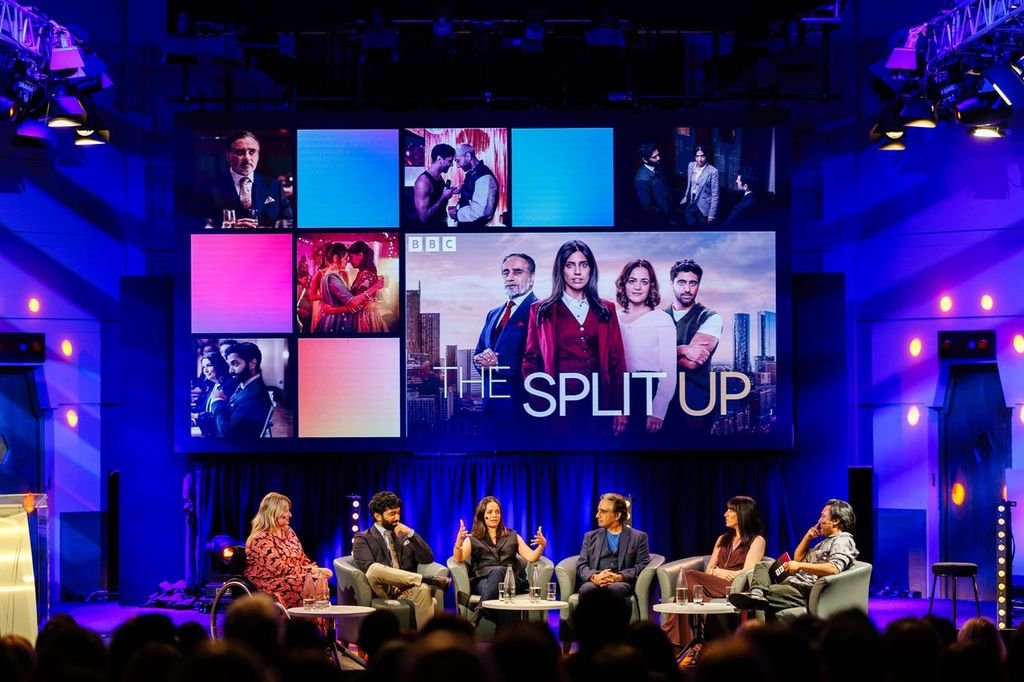
Emb is a TEDx speaker who has spoken and moderated on more than 30 stages worldwide. She moderated a panel at the Cannes Film Festival, led the EdHeroes global panel on education in the AI era alongside Microsoft Worldwide’s Education Director, and hosted the main stage at Ideas Fest.
She is an FT Kindness and Leadership Top 50 honoree, a Visiting Lecturer at Birmingham City University, co-founder of Women in EdTech UK and a contributor to the Women in AI UK white paper.
The face she never saw
She once searched for someone like her and found no one. Today she wants to be that face for a generation of young South Asian women.
“I could not see it,” she says. “So now I want every girl who looks like me to see it, and to be it.”
Changing the world, a second at a time.