Join WhatsApp Channel

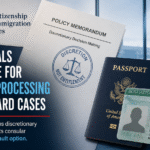
South Asian immigrants seeking permanent residency in the United States could face closer scrutiny of their financial circumstances and use of government benefits under new public charge guidance issued by U.S. Citizenship and Immigration Services (USCIS).
The updated guidance, which takes effect Sept. 18, 2026, explains how USCIS officers will determine whether an immigrant applying to adjust status to lawful permanent resident is likely at any time to become a public charge.
The policy follows a Department of Homeland Security final rule announced July 16 that rescinds the Biden administration’s 2022 public charge regulations. The rule was published in the Federal Register on July 20.
The changes are particularly relevant to the large South Asian diaspora in the United States, including immigrants from India, Pakistan, Bangladesh, Nepal and Sri Lanka, many of whom pursue permanent residency through family- or employment-based immigration.
Under the new framework, most applicants for adjustment of status will be subject to the public charge ground of inadmissibility unless Congress has specifically exempted their immigration category.
The categories generally covered include spouses, children and parents of U.S. citizens; other family-sponsored immigrants; spouses and children of lawful permanent residents; employment-based immigrants; investors; religious workers; diversity visa immigrants and several other categories.
For South Asian families, the rules could affect applicants pursuing green cards through both family and employment channels. Employment-based categories include priority workers, professionals with advanced degrees or exceptional ability, skilled workers, professionals and other workers, as well as investors and certain religious workers.
USCIS officers will assess each applicant individually based on the totality of the circumstances rather than applying a single financial threshold.
Five statutory factors must be considered: the applicant’s age, health, family status, assets, resources and financial status, and education and skills.
Officers may also consider other relevant factors, including receipt of means-tested public benefits and the applicant’s Form I-864 Affidavit of Support, in which a sponsor agrees to provide financial support.
The treatment of public benefits will broaden under the new rules.
For benefits received before Sept. 18, USCIS will generally consider only public cash assistance for income maintenance and government-funded long-term institutionalization when making public charge determinations.
For benefits received on or after Sept. 18, officers may consider a wider range of means-tested benefits, including cash assistance, housing assistance, food assistance, college financial aid and similar government support.
USCIS said receipt of benefits does not automatically make an applicant inadmissible. Officers will examine all relevant evidence and determine whether the applicant is likely at any time to become a public charge.
A number of immigrant groups remain exempt. They include refugees and asylees, certain Afghan and Iraqi nationals who worked for or on behalf of the U.S. government, special immigrant juveniles, victims of human trafficking and qualifying crimes, Violence Against Women Act self-petitioners and certain military-related survivors.
The updated guidance also retains a public charge bond mechanism.
If USCIS determines that an applicant is inadmissible solely because the person is likely to become a public charge, an officer may invite the applicant to post a financial bond. The bond can be paid in cash or provided through a surety company certified by the U.S. Treasury.
The amount will be determined by USCIS after considering the government assistance the applicant could potentially receive over the next five years.
Applicants cannot voluntarily file for a public charge bond. Form I-945 can be submitted only after USCIS issues an invitation through a Notice of Intent to Deny.
The new guidance supersedes USCIS’s 1999 Interim Field Guidance and related previous guidance on public charge inadmissibility.
It will apply to Form I-485 applications subject to the public charge ground of inadmissibility that are postmarked or electronically submitted on or after Sept. 18.
For South Asian immigrants and families navigating the U.S. green card system, the changes underscore the importance of documenting financial resources, household circumstances, education, employment prospects and other factors that could influence an individual public charge determination.