 Join WhatsApp Channel

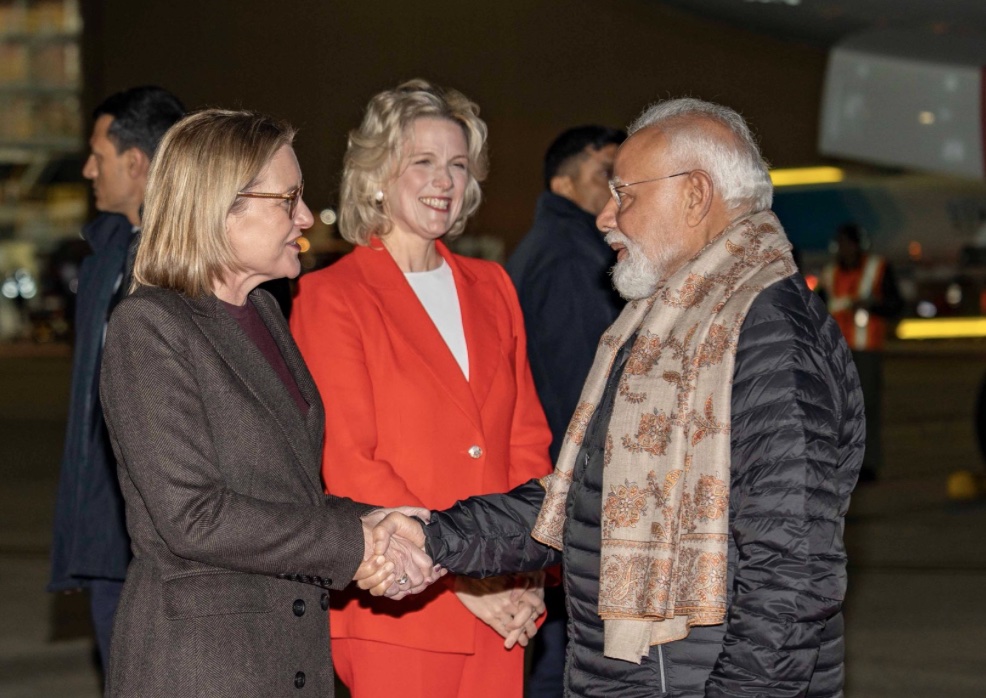
As Prime Minister Narendra Modi flew into Australia on Wednesday, India’s high-stakes Indo-Pacific diplomacy jigsaw started falling into place, shaped by an increasingly familiar strategic reality, that of the unspoken China factor, and the need to garner critical mineral supplies which could drive India’s economic and security future.
Officials said one of the key deals being studied is the import of uranium from Australia, which has more than a quarter of the world’s uranium reserves, for India’s planned nuclear- based electricity plants, which are expected to power upcoming data centers and artificial intelligence labs.
“Chinese state-run mining giants hold massive, controlling equity stakes in the world’s largest producing mines in Namibia and Niger, and are the biggest buyers from Kazakhstan. Which is why we are looking to use an earlier signed deal which allows us to import uranium from Australia,” top mining ministry officials told UNI.
Analysts point out that imports can potentially free the use of uranium mined within India for use in its ambitious plans to build a full nuclear triad, by improving its land-based missile capabilities, integrating Multiple Independently Targetable Re-entry Vehicles (MIRVs), and expanding its fleet of nuclear-powered ballistic missile submarines (SSBNs).
“The visit signals the coming together of middle powers with shared interests in the Indo-Pacific region. The agreements signed indicate emphasis on cooperation in both security and economic spheres,” said Maj Gen Alok Deb, former Deputy Director General of the Manohar Parrikar Institute of Defense Studies & Analysis.
Officials admitted that even though neither India nor its regional partners, Australia and Indonesia, are seeking a new ‘Tropical Cold War,’ the visits underscore a more “nuanced strategy of strengthening security partnerships, diversifying economic relationships and building supply chains without forcing countries into binary choices between Beijing and Washington.”
Though Modi’s trip is not about Quad, a grouping comprising the US, India, Australia, and Japan, its agenda is — critical minerals, supply chain resilience, infrastructure investment, maritime coordination, and defense cooperation.
“Modi’s stops in Indonesia and Australia reflect a carefully calibrated effort to reinforce India’s eastern strategic architecture at a time when the Indo-Pacific is being reshaped by Chinese military expansion, economic coercion, and growing uncertainty over long-term American commitment to the region,” said senior Ministry of External Affairs officials.
The sequencing itself is quite revealing; the trip comes on the heels of Japanese Prime Minister Sanae Takaichi’s visit to New Delhi, where security ties and building a supply chain independent of Chinese interference were a cornerstone of the talks.
Canberra and New Delhi have steadily expanded military cooperation, including work on a joint maritime security roadmap and greater interoperability between their armed forces. Shared concerns over China’s expanding naval presence and increasingly assertive regional posture have encouraged both governments to deepen security coordination while stopping short of formal alliance commitments.
Increasing uncertainty over future American engagement in the Indo-Pacific, combined with the rise of an assertive China, has encouraged middle powers like India, Japan, and Australia to diversify their strategic options.
“Both Australia and India recognize that while the United States remains indispensable to regional stability, Washington’s domestic political shifts have introduced greater unpredictability into long-term security planning,” officials said.
That reality has pushed Canberra and New Delhi towards building more self-sustaining bilateral capabilities rather than relying exclusively on American leadership.
Beyond defense, Modi’s discussions are expected to focus heavily on trade, investment, and energy security. Following India-Australia’s trade pact signed in 2002, trade has boomed and now stands at over USD 54 billion. Officials said the two sides are planning an even more ambitious Comprehensive Economic Pact, which covers both trade and investments and may drive trade to over USD 100 billion by 2030.
“Australia and India had already signed critical minerals agreements, identified projects, and convened investment forums. However, the processing stage, which is dominated by Beijing, has remained undeveloped. We will be planning various joint ventures in that area,” said officials.
Infrastructure is another area for India and Australia to join hands. The two nations are already involved in the Quad initiative to build a port at Fiji as an answer to the “string of pearls” strategy, which China has chosen to build ports in the Indo-Pacific region. More cooperation is expected in the near future.
India will also be working on a proposed Joint Roadmap for Maritime Security Collaboration announced during the India-Australia defense policy talks earlier this year. Both Australia’s National Defense Strategy and India’s Maritime Doctrine emphasize bridging operational gaps across the Indian Ocean region, building on a six-year-old mutual logistics pact which “allows the militaries of the two nations deeper logistics coordination and better regional responses” and a more recent air-to-air refueling agreement for faster interoperability, expanding reach across the region. (UNI)
Related posts:
 India Stresses Maritime Security and Anti-Terrorism as Pillars of National Strategy
 India’s Maritime Vision: From SAGAR to Indo-Pacific to MAHASAGAR
 Japan’s Consul-General in Perth Reaffirms Quad Vision: Friendship, Prosperity, and a Free Indo-Pacific
 Australia and India Seal Three Defense Agreements as Defense Minister Rajnath Singh Concludes Two-Day Visit
