Join WhatsApp Channel

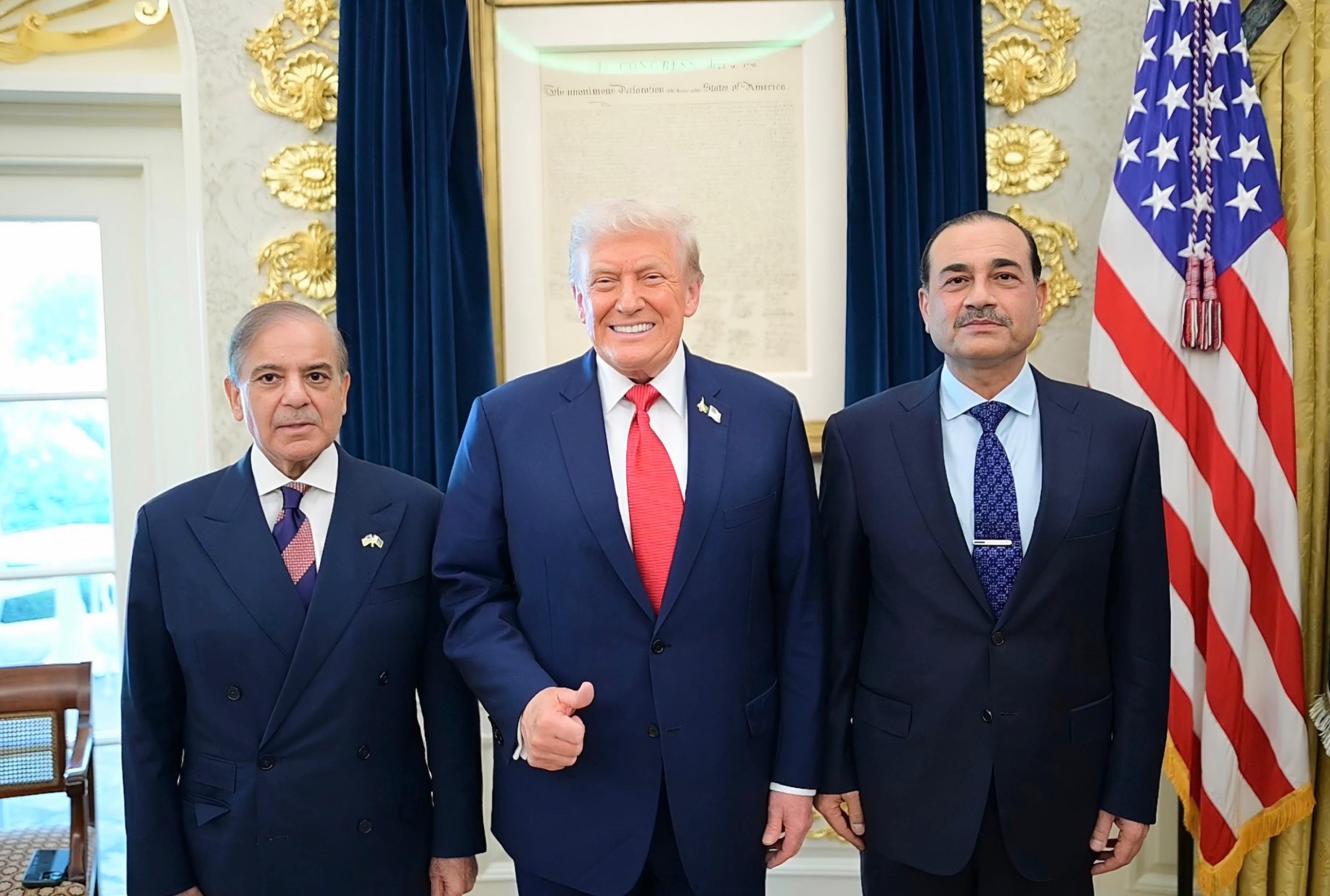
Days after celebrating 75 years of diplomatic relationship with China, Pakistan’s Prime Minister Shahbaz Sharif participated in an event in Islamabad marking America’s 250th anniversary and “a true and special relationship.”
In another gush of superlative words hailing Pak-US relations, he called President Donald Trump a “man of peace” and thanked him for securing the May 2025 Pakistan-India ceasefire. He also thanked him for entrusting Pakistan with a mediatory role between the US and Iran.
Pakistan is one-up on China, which did not get the mediator’s role and is left clapping its ally, whose role promises to be prolonged since the conflict has escalated. But there is no denying the role China is playing from the wings.
Besides hard diplomacy, the “sab kuchh changa hai” approach, shorn of moralizing others, carries Pakistan far in gaining acceptability from quarters that matter.
Arguably, this is Pakistan’s ‘special’ moment, balancing the big powers and myriad players in the Gulf war. But it is seen as China’s team-mate.
Some Pakistani analysts think the current momentum with both the US and China more than compensates for the loss of its east wing in 1971. And Bangladesh has, kind of, ‘returned’ to it after Sheikh Hasina’s ouster.
Perceived as a failing state with an unstable polity and economic distress, Pakistan has not been allowed to fail by the US and China, since both are competing for space in a country that is strategically located at the confluence of South, West and Central Asia.
China finds it convenient to piggyback on this major Islamic nation into the Islamic world where it has the money to spend, but not its godless identity.
In playing the world powers, Pakistan has even consolidated its position with Russia that, while remaining ‘special’ to India, is past the “Bhai-Bhai” relationship.
Should India worry? It may be convenient to condemn Sino-Pak relations or scoff at Russo-Pak ties, but it is unwise to ignore their constantly changing dynamics in a transactional world. Also, Pakistan’s ties with the Gulf Arabs and Turkey. The Gulf war, as well as the festering conflict in Ukraine, where India remains a bystander, only serve to underline this.
Much has already been talked and written about how Pakistan reached out to China within three months of the Sino-Indian conflict of 1962 that ended in India’s debacle. Ayub Khan, with Zulfiqar Bhutto as his foreign minister, was quick to realize that the enemy’s enemy must be befriended.
Pakistan did it by ceding, through a formal agreement signed in March 1963, control of the Shaksgam Valley, roughly 5,180 square kilometers in the Karakoram range, territory India considers part of disputed Kashmir. Rather than fighting India, it handed it over to China, its control, also its defense from India.
This gesture 63 years ago has impacted India’s ties with China and has permanently cemented the Sino-Pak relationship. Indeed, without India as a shared threat, the Pakistan-China relationship would look very different.
China also used it to suit its long-term goals in the region. During the 1960s and 1990s, Beijing systematically settled its land boundaries with 12 of its 14 neighbors. It utilized a template very similar to the Shaksgam Valley agreement—accepting compromise on paper to secure strategic buffer zones and stabilize its frontiers.
Constantly needling India over the decades, it launched the China-Pakistan Economic Corridor (CPEC), gaining access to the Indian Ocean – something which Russia aspired to, but failed. A firm presence in Pakistan’s Gwadar port makes China a player in the current Gulf conflict without direct involvement.
As for India, the Chinese presence in Gwadar ensures that it cannot repeat its naval attack on Karachi the way it did in 1971. It is weaker after quitting the Chabahar port in Iran under American pressure.
It is rare that a relationship between two unequal — a benefactor and a beneficiary, a communist state and a country born and based on religion – has not just endured for over six decades but also acquired great strategic value. The two have never tired of describing their ties in the most superlative terms, like “iron brothers,” translating their “converging vision” through symbols of friendship that has grown “from strength to strength.” Their “all-weather friendship” is “higher than mountains, deeper than oceans.”
The Sino-Pak story includes a diplomatic opening Pakistan helped broker through Henry Kissinger’s secret visit to Beijing in 1971. It defined the role all Western powers played, in ignoring Pakistan’s atrocities in its eastern province.
The military defeat by India only firmed up the relationship. Under Zulfiqar Bhutto, the two formalized what had until then been an informal understanding, signing a bilateral nuclear cooperation agreement that became the framework for Chinese assistance over the following decade.
United States intelligence assessments and most independent analysts point to Chinese help during that critical phase, including weapons-design information and enough enriched uranium for at least two devices, likely during the 1980s. Officially, both governments deny it. To acknowledge it publicly would be to accept China’s role in nuclear proliferation. But wherever Pakistan got stuck, China would bridge the gap in spare parts, knowledge and cooperation.
The exchange ran both ways. Pakistan’s centrifuge program acquired technology through European networks, like Abdul Qadir Khan stealing technology from a Dutch laboratory. The Chinese scientists also learned from Pakistani advances.
When Pakistan conducted its nuclear tests in Chagai, Balochistan, in May 1998, responding to India’s own tests two weeks earlier, China blocked a United Nations Security Council statement regretting the tests. Pakistan’s representative to the UN later said his country was grateful to China for “recognizing the distinction” between India’s ‘provocation’ and Pakistan’s ‘response.’
In conflict post-Pahalgam last year, Pakistan relied extensively on Chinese hardware, including advanced PL-15 missiles and through intelligence and surveillance. Chinese personnel provided critical intelligence sharing and strategic backing. Defense analysts and military officials have noted that the active combat environment functioned as a real-world stress test for Chinese aviation technology against India’s.
Yet, the Sino-Pak relationship has become increasingly transactional, with China counting every Yuan/dollar it spends on CPEC projects, many of which have languished, and have lost personnel in attacks by militants, from Khyber Pakhtunkhwa in the north to Balochistan in the South.
There is complementarity, but not affinity. The Pakistani people, whether those who are left out of the CPEC, or those, like the Baloch youths who resent the Chinese presence. It is more the story of two states finding each other useful, again and again, under changing conditions. China will never let Pakistan collapse because its geopolitical utility against India remains crucial.
It has high geopolitics, but poor economics. A decade after CPEC, Pakistan remains impoverished. But the original rationale has proved robust enough to outlast governments, doctrines and crises, while the costs of failure now outweigh the returns of rupture.
Disclaimer: The opinions and views expressed in this article/column are those of the author(s) and do not necessarily reflect the views or positions of South Asian Herald.