Join WhatsApp Channel

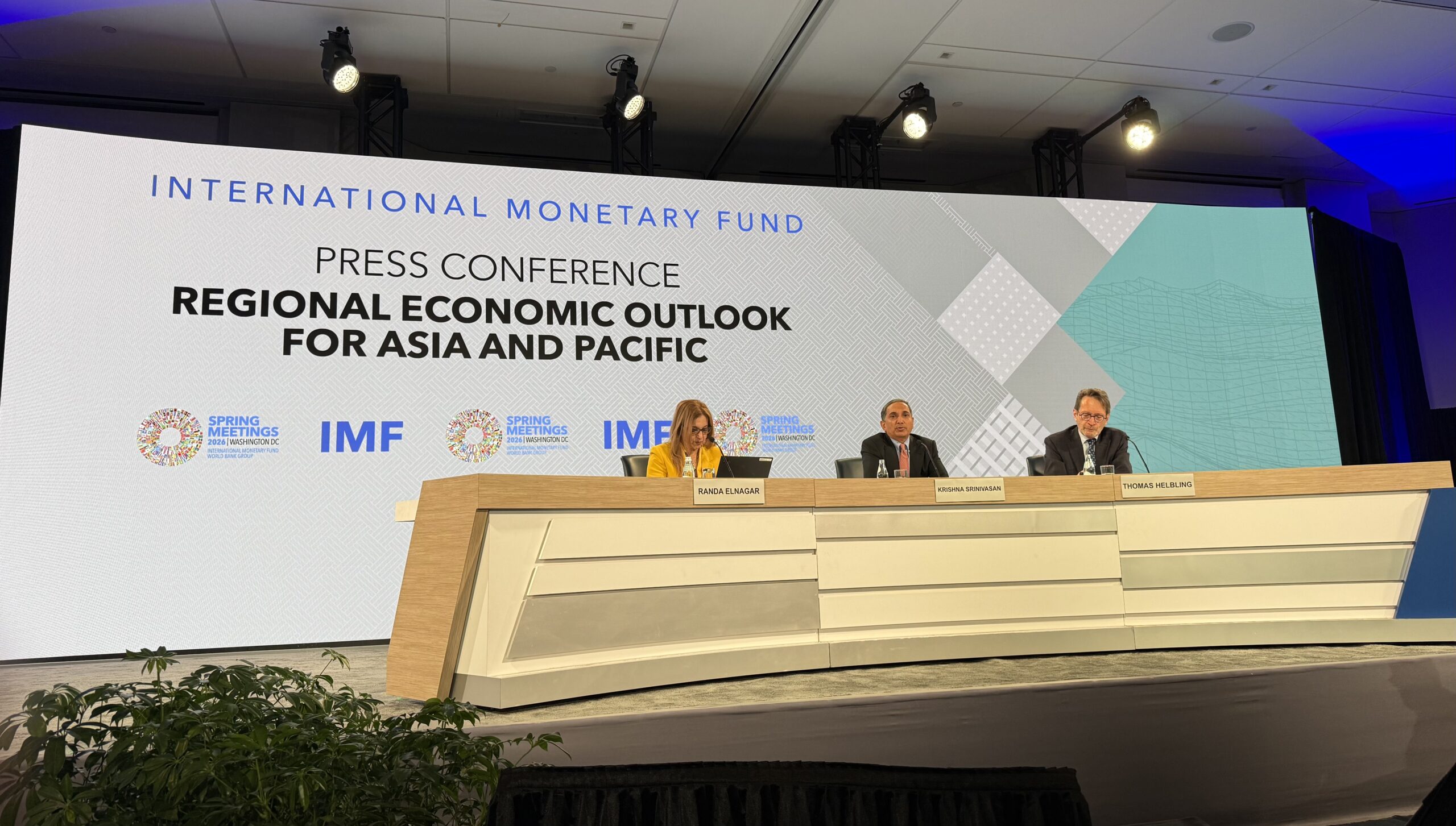
The International Monetary Fund (IMF) has urged South Asian nations to deploy their fiscal buffers judiciously, emphasizing that countries such as India have demonstrated “prudent” fiscal management.
“I think they [South Asian nations] have to use their buffers very wisely. Countries like India have been very prudent on fiscal. They have accumulated buffers. They have to allow price signals to work and use their buffers in an efficient way because if this shock intensifies, they will need the buffers,” said Director of Asia Pacific Krishna Srinivasan, Director of the Asia and Pacific Department, IMF, in response to a question from South Asian Herald on policy measures to mitigate the impact of prolonged volatility in global commodity markets amid the conflict in Iran.
Srinivasan, who was joined by Deputy Director Thomas Helbling at the press briefing, on April 16, at IMF and World Bank Group Spring Meetings 2006, underscored the importance of targeted support measures. He stressed that assistance should be directed toward the most vulnerable populations and viable businesses. “Expand your buffers in such a way that you give it to those who really need it,” he added.
Addressing the impact of the conflict on remittances, Srinivasan noted that flows have remained “pretty strong,” reflecting the continued presence of workers from India and other Asian countries in the Middle East.
“So, they’re still there. So, remittances have held up quite strongly. And one part of me tells me that given infrastructure needs to be built back again in these countries, I think remittances are likely to stay strong. That’s my gut feeling,” he said.
On India’s economic outlook, Srinivasan said the IMF has marginally raised its growth forecast by 0.1 percentage point, citing strong momentum entering 2026. He also pointed to tariff reductions from 50 percent to 10 percent and tax reforms implemented last year as contributing factors.
“So that gives a fillip to the economy activity in addition to the tax reforms, which they’ve done last year,” he said, cautioning that an escalation or prolonged duration of the energy shock could disrupt growth. “But if this intensifies, it’ll get worse for all countries, including for India. So that’s something which you have to watch out for,” he added.
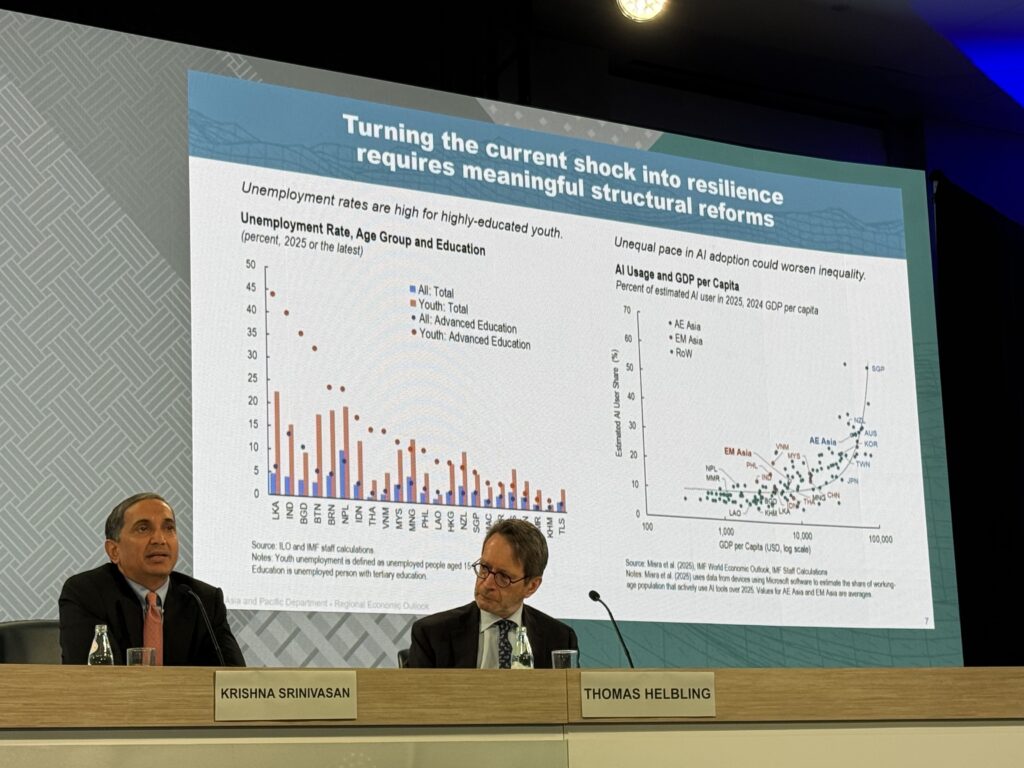
Srinivasan noted that Asia entered 2026 on a relatively strong footing, with resilient growth despite the impact of U.S. tariffs and heightened global uncertainty. However, the region’s dependence on fossil fuels and exposure to conflict-affected areas for key commodities could amplify the negative effects of the ongoing energy shock.
“The shock is raising inflation, weakening external balances, tightening financial conditions, and narrowing policy space,” he said.
Regional growth is projected to moderate from 5 percent in 2025 to 4.4 percent in 2026 and 4.2 percent in 2027. “Advanced Asia is expected to slow as domestic demand stays soft. Emerging Asia remains a main growth engine, but the momentum is set to moderate with broad-based decelerations in China, India, and the ASEAN,” he added.
Srinivasan outlined three key risks facing the region. First, a more severe or prolonged energy shock could have uneven impacts across Asia-Pacific economies. Second, countries heavily dependent on imported energy are particularly vulnerable. Third, risks are heightened in economies with limited fiscal space, weaker energy buffers, or reliance on remittances, tourism, or fertilizer imports, a concern for parts of South Asia, Southeast Asia, and Pacific Island nations.
On Nepal, Srinivasan said the IMF will continue close collaboration to support policymaking through surveillance and capacity development. Regarding Sri Lanka, he noted that despite its heavy reliance on imported energy, the country has made progress in rebuilding fiscal buffers over the past three years. Revenue as a share of GDP has doubled since the crisis, placing Sri Lanka in a better position to deliver targeted fiscal support.
In contrast, he observed that Bangladesh continues to face challenges on the revenue front. “It’s on the lower side,” he said, noting that revenue collection has declined over the past three years. He called for comprehensive reforms, including fiscal and revenue measures, financial sector rehabilitation, and exchange rate adjustments.
Srinivasan emphasized the need for stronger social safety nets across Asia to protect vulnerable populations without relying on “generalized subsidies.” He also highlighted the importance of boosting domestic demand and deepening regional integration to enhance resilience to external shocks.
Additionally, he urged investment in “alternative energy sources, energy efficiency, and power grids” to reduce long-term dependence on fuel imports.
“So, the near-term task is to absorb the shocks while preserving price signals and policy credibility. The medium-term task is to build a more resilient, more balanced, and more inclusive growth model,” he said.
Related posts:
 IMF Forecasts Mixed Outlook for South Asia: India Leads, Bangladesh and Sri Lanka Stabilize
 Fuel Duty Cut Turns Oil Shock into Fiscal Crisis for Centre
 Pakistan Wins Rating Upgrade on Easing Default Risks, Fiscal Gains
 India’s Chief Economic Advisor Calls for Agile Fiscal Policy Amid Global Shocks at IMF-World Bank Meetings