Join WhatsApp Channel

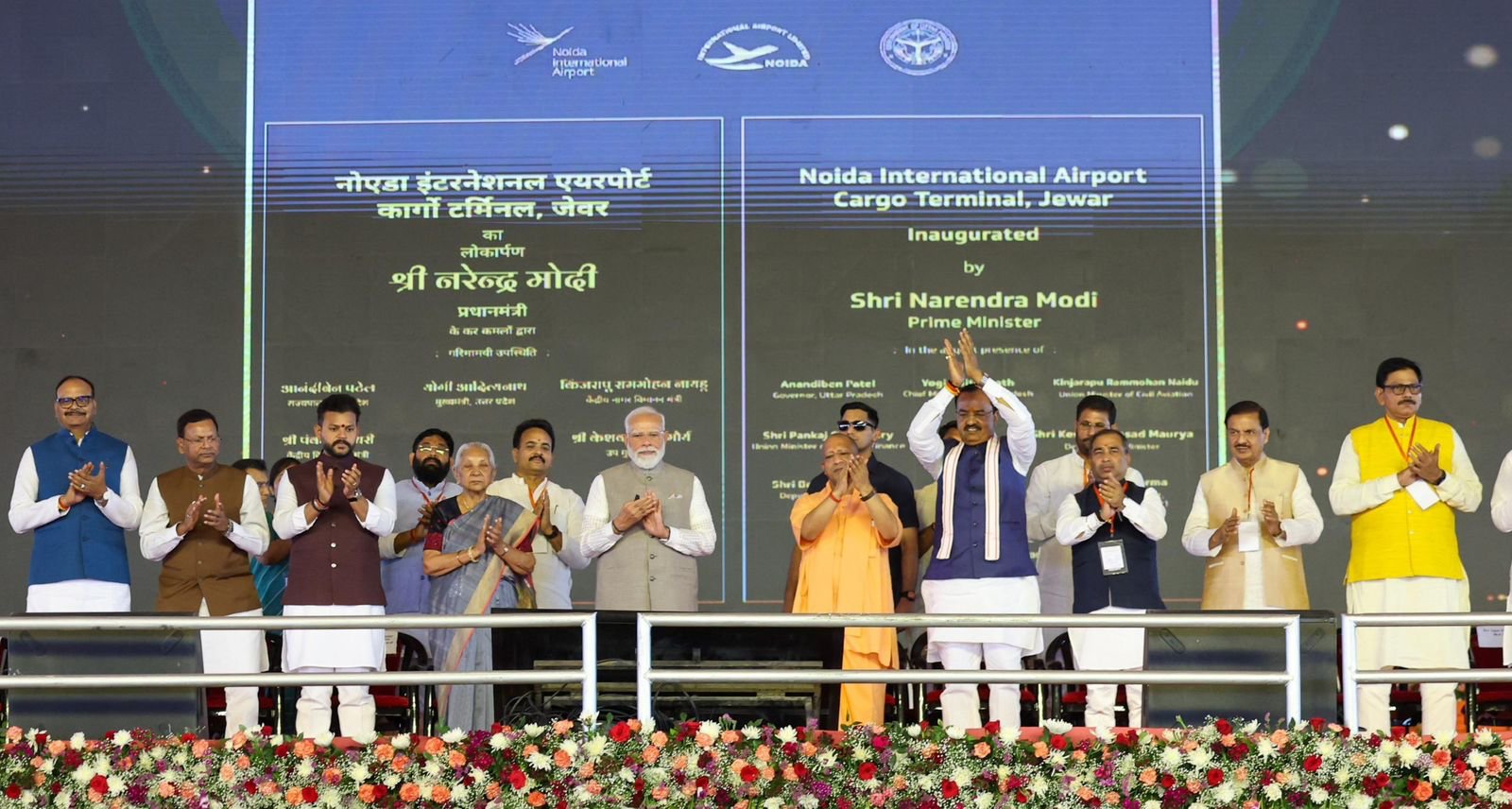
New Delhi, March 28 — Prime Minister Narendra Modi on Saturday inaugurated the first phase of the Noida International Airport, a ₹11,200-crore (about $1.35 billion) greenfield project that is expected to reshape aviation capacity in the National Capital Region (NCR) while anchoring western Uttar Pradesh’s emergence as a logistics and industrial hub.
Located in Jewar, about 75 km from Delhi, the airport is being positioned as a second international gateway for the region, easing pressure on Indira Gandhi International Airport while expanding connectivity to fast-growing urban and industrial clusters across north India.
Calling the inauguration a “new chapter” in the vision of a developed Uttar Pradesh and a “Viksit Bharat”, Modi said airports were no longer mere infrastructure assets but “engines that give wings to progress.” He added that Uttar Pradesh now ranks among the states with the highest number of international airports, reflecting a broader push to decentralize air connectivity beyond metropolitan centers.
Global design, local identity
The airport’s architecture signals a shift in how India is imagining its next generation of infrastructure — blending global efficiency with cultural grounding.
Designed by an international consortium including Nordic Office of Architecture, Grimshaw, Haptic Architects and STUP Consultants, the terminal features a sweeping translucent roof inspired by the flow of the Ganga, allowing diffused natural light to filter into passenger spaces.
A central landscaped courtyard — modelled on traditional Indian havelis — anchors the terminal, integrating greenery and natural ventilation into the passenger experience. Forecourt steps echo the ghats of Varanasi and Haridwar, while jaali-style lattice screens provide shading and a distinctly Indian aesthetic.
The linear terminal layout emphasizes intuitive movement, minimal walking distances and seamless digital processing — hallmarks of Swiss airport design — while sustainability measures such as rainwater harvesting, energy-efficient systems and renewable integration aim to move the facility toward net-zero carbon emissions.
PPP model and infrastructure scale
The airport has been developed under a public-private partnership framework. Noida International Airport Limited (NIAL), a state-led entity, owns the project, while Yamuna International Airport Private Limited — a subsidiary of Zurich Airport International AG — operates it under a 40-year concession.
Construction of Phase I, led by Tata Projects, includes a 3,900-metre runway and a terminal spanning around 100,000 square meters, equipped with 10 aerobridges, automated baggage systems and digital, touch-free passenger interfaces.
Cargo infrastructure is central to the project’s design. Initial handling capacity exceeds 100,000 tons, with facilities tailored for e-commerce, perishables and pharmaceuticals — sectors expected to drive future growth.
The airport has secured its aerodrome license, with commercial operations expected to begin shortly.
Economic multiplier with billion-dollar upside
Officials and analysts say the project’s economic significance could far exceed its initial capital cost.
Government projections suggest the airport could unlock more than ₹2 lakh crore (roughly $24–25 billion) in economic activity by the late 2030s, while generating nearly 1 million (9.8 lakh) direct and indirect jobs across aviation, logistics, hospitality and manufacturing.
Early-phase employment alone is expected to exceed 50,000 direct jobs, with several hundred thousand indirect opportunities.
The total project cost across all phases is estimated at around ₹29,560 crore (approximately $3.5–4 billion), with revenues expected to flow from passenger services, cargo handling, retail concessions and real estate development under an aerotropolis model.
“This is not just an airport — it is an economic platform,” said an industry executive. “It compresses time and distance for trade, which is critical for a $5 trillion economy ambition.”
Logistics hub and real estate trigger
Strategically located near the Yamuna Expressway and the intersection of the Eastern and Western Dedicated Freight Corridors, the airport is expected to transform the region into a multimodal logistics hub.
India’s logistics costs — currently estimated at 13–14% of GDP — are significantly higher than global benchmarks. Infrastructure such as Jewar is seen as key to narrowing that gap.
The project has already catalyzed real estate investments worth tens of thousands of crores (several billion dollars), with developers betting on sustained demand from industries and workforce migration into the region.
Plans for an “aerotropolis” — combining logistics parks, commercial districts, hotels and warehousing — are expected to create new urban growth nodes beyond Noida and Greater Noida.
Phased expansion to global scale
Phase I of the airport is designed to handle about 12 million passengers annually. Future expansion will be demand-driven:
- Phase II: ~30 million passengers
- Phase III: ~50 million passengers
- Final build-out: ~70 million passengers annually
At full capacity, the airport could rival some of Asia’s largest aviation hubs, with cargo volumes potentially scaling to millions of tons annually.
Provision has been made for up to six runways over the long term, positioning the airport as a future-ready aviation ecosystem.
Balancing growth with local concerns
Despite the scale of opportunity, some concerns persist. Residents who gave up land for the project have raised issues around employment access, particularly the reliance on contract-based hiring.
Authorities say skill development initiatives and job platforms are being expanded to improve local participation in the airport ecosystem.
Strategic complement to Delhi airport
Policymakers stress that the Jewar airport is designed to complement, not compete with, Delhi’s existing aviation hub.
With Indira Gandhi International Airport approaching capacity constraints, the new facility is expected to act as a “relief valve” while opening new corridors of growth across Uttar Pradesh and neighboring regions.
Infrastructure push amid global headwinds
The inauguration comes amid global uncertainty, particularly due to tensions in West Asia affecting energy markets. Modi said the government was taking steps to shield households and farmers from external shocks while continuing to invest heavily in infrastructure.
Over the past decade, India has sharply scaled up capital expenditure, with trillions of rupees (hundreds of billions of dollars) invested in highways, railways, ports and airports.
As Modi framed it, the significance of Jewar lies not just in aviation metrics but in what it represents: “Aircraft will fly from here to the world, but this airport will also become a symbol of a developed Uttar Pradesh taking flight.”