Join WhatsApp Channel

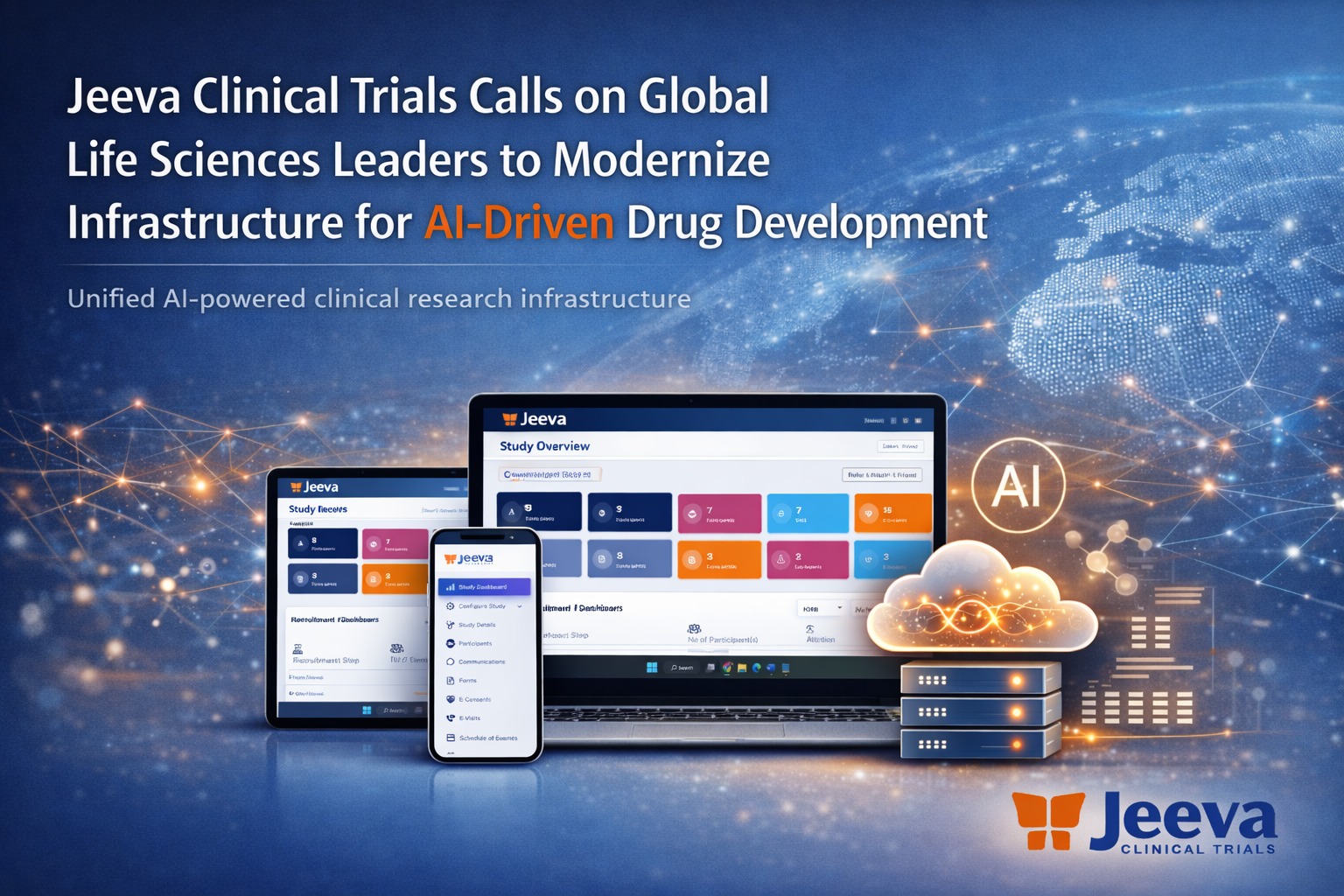
Jeeva Clinical Trials has intensified its call for the global pharmaceutical and clinical research community to modernize foundational IT systems, arguing that artificial intelligence alone cannot transform drug development without infrastructure reform.
In a statement issued February 24, the company said its message, first outlined in a recent thought leadership article by Founder and CEO Harsha K. Rajasimha, has gained momentum following discussions at the AI Impact Summit, the JPMorgan Healthcare Conference, and the BIO International Convention.
According to the statement, a consistent theme emerged across these high-level forums: “AI is advancing rapidly — but infrastructure modernization is lagging behind.”
The company noted that artificial intelligence applications are expanding across the drug development lifecycle, including predictive enrollment modeling, protocol optimization, and real-time financial forecasting. However, conversations at the AI Impact Summit 2026, as well as at JPMorgan and BIO, revealed what it described as a “sobering reality” that many organizations are attempting to deploy AI on fragmented, legacy IT systems.
“AI is not the constraint,” said Founder and CEO of Jeeva Clinical Trials, Harsha K. Rajasimha. “The constraint is infrastructure. If you deploy advanced intelligence on siloed, outdated systems, you amplify inefficiency. If you deploy AI on a unified, cloud-native architecture, you amplify speed, compliance, and patient impact.”
At the AI Impact Summit 2026, industry leaders highlighted rapid advances in generative AI, agentic AI frameworks, and predictive automation in life sciences. At the same time, panel discussions underscored ongoing challenges related to integration friction, data harmonization gaps, and validation complexity.
Similarly, at the JPMorgan Healthcare Conference 2026, investor discussions centered on capital efficiency, trial acceleration, and operational resilience. At BIO Biotech Showcase 2026, biotech executives emphasized the need to shorten development timelines and mitigate trial risk.
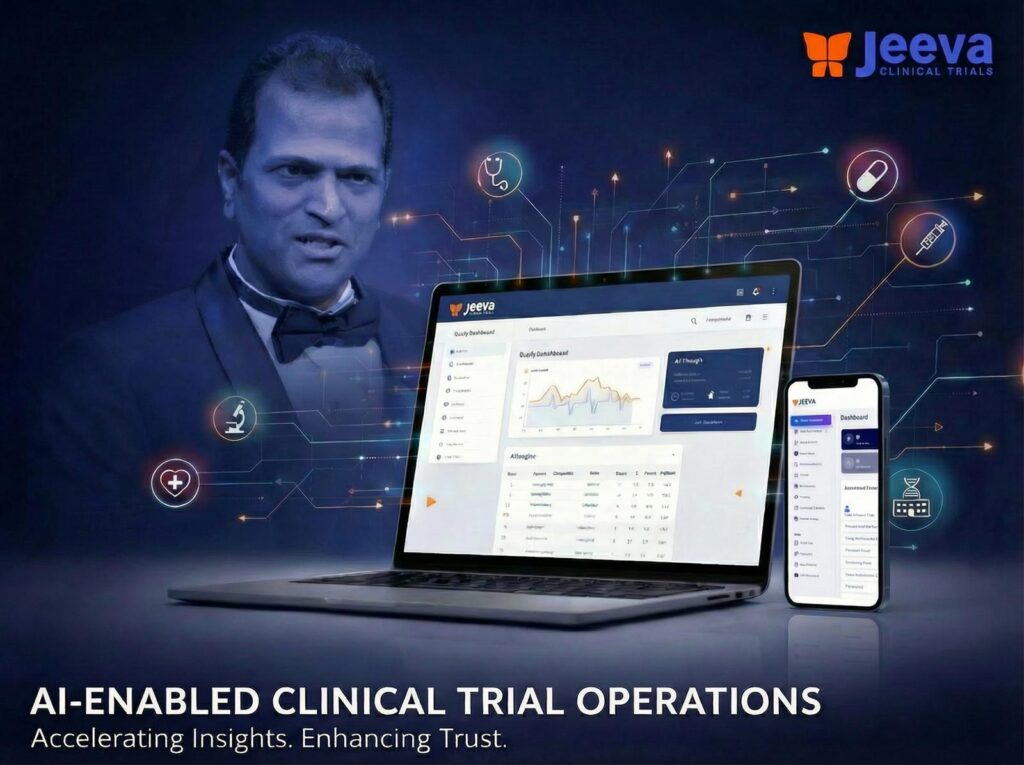
The statement described the broader industry divide as one between fragmentation and unification, noting that “AI adoption is inevitable. Infrastructure transformation is optional — but only for now.”
According to Jeeva Clinical Trials, life sciences companies are facing two strategic options.
The first path involves layering AI tools onto fragmented legacy systems. While this approach may minimize short-term disruption, the company said it often results in continued data silos, manual reconciliation processes, validation complexity, technical debt, and costly system integrations. Organizations may achieve incremental improvements, but not systemic acceleration.
The second path calls for transitioning to unified, AI-native platforms. These systems are described as cloud-based, interoperable, and regulatory-grade, enabling real-time data visibility, embedded AI within validated workflows, automated compliance tracking, multi-site scalability, and dynamic forecasting of development timelines and revenues.
“The difference is structural,” Rajasimha stated. “AI cannot sit outside your operational backbone. It must be embedded within a unified system designed for intelligence from day one.”
The company framed infrastructure reform as a timely issue in 2026, citing investor demands for efficiency, patient expectations for faster access to therapies, and evolving regulatory openness to innovation, provided data integrity and auditability are maintained.
“Every month of delay in drug development represents enormous financial cost and human cost,” said Rajasimha. “When infrastructure is unified and AI-native, you can reduce site start-up times, detect risks earlier, forecast revenue accurately, and accelerate trial execution. That is not theoretical — that is operational transformation.”
Regulatory readiness also emerged as a key discussion point at recent global conferences. AI systems operating in clinical research environments must comply with 21 CFR Part 11 requirements, maintain comprehensive audit trails, and generate explainable outputs.
“Modern AI does not remove compliance responsibility,” Rajasimha noted. “It intensifies the need for validated, secure, cloud-native systems. Compliance must be embedded — not retrofitted.”
Jeeva Clinical Trials said it is encouraging sponsors, contract research organizations, and site networks to treat infrastructure modernization as a board-level priority rather than an IT function.
The company also pointed to leadership-level questions organizations should consider: whether their data is harmonized and AI-ready, whether systems are interoperable and cloud-native, and whether their strategy prioritizes incremental disruption or full-scale transformation.
“Organizations with existing complex legacy infrastructure that modernize today will define the next decade of clinical research,” Rajasimha concluded. “Those who delay will continue layering intelligence on top of inefficiency. The good news is that modernizing your tech infrastructure need not cost millions of dollars anymore. With Jeeva’s consumption-based transparent pricing, you can get started with a nominal one-time setup/configuration fee and scale on a per-participant-per-month basis as your trials screen and enroll participants across the enterprise. For smaller clinical-stage Biopharmaceutical and MedTech sponsors, it’s best to start your clinical development journey on a regulatory-grade, modern, unified, and AI-ready platform from day #1.”
Related posts:
 HITLAB Partners With Jeeva Clinical Trials to Advance AI-Native Platforms for Decentralized Research
 ‘There are Plenty of Problems Begging to be Solved in Rare Diseases’
 Congressman Suhas Subramanyam Pledges to Champion Rare Disease Community at 2025 Indo-US Bridging RARE Summit
 Indo-US Bridging RARE Summit 2025 to Convene Global Experts and Advocates at George Mason University