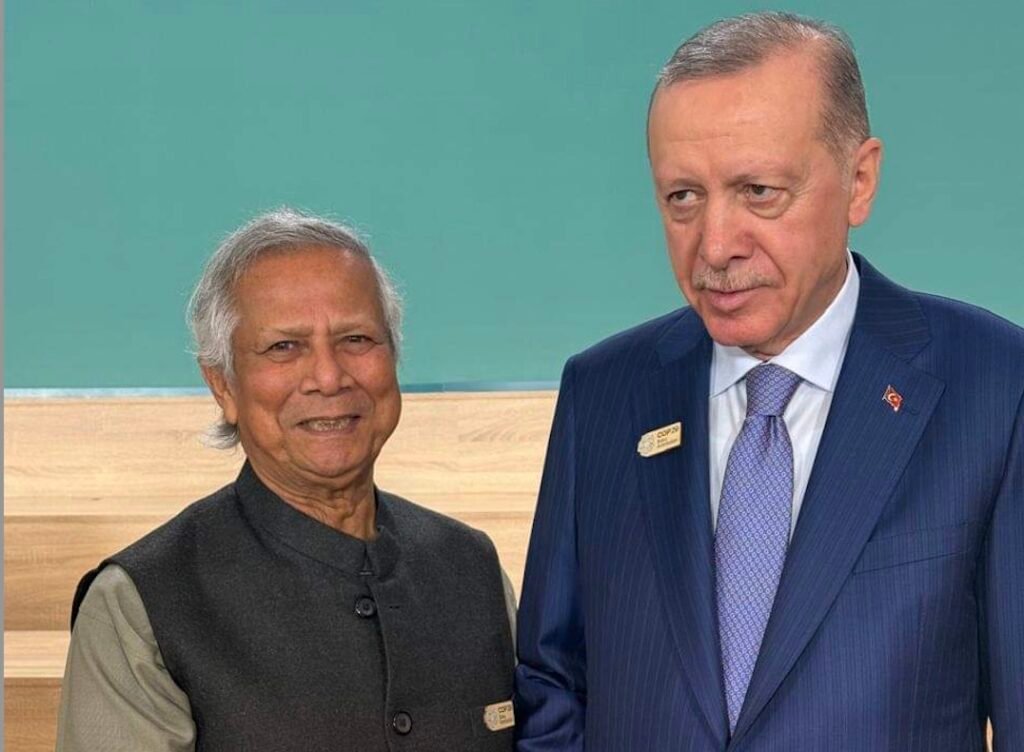
Turkey’s quiet but accelerating outreach to Bangladesh is no longer a bilateral curiosity. It is emerging as a new variable in South Asia’s already crowded strategic equation. As Dhaka explores diversified partnerships after years of India-centric alignment, Ankara’s entry intersects directly with the interests of India, China, and the United States. Each of these powers will need to assess Turkey’s growing role with a different degree of urgency.
From New Delhi’s perspective, Turkish activism in Bangladesh has the potential to reinforce trends India views with concern: the consolidation of a China–Pakistan–Turkey axis and the possible empowerment of Islamist networks in its immediate neighborhood. Reports suggesting that Turkish agencies have cultivated links with Bangladeshi Islamist groups, including elements historically aligned with Pakistan, feed into long-standing Indian anxieties over cross-border radicalization and strategic encirclement.
At the same time, Ankara’s expanding defense-industrial engagement with Dhaka, encompassing arms sales and discussions around joint production and industrial zones, risks diluting India’s traditional position as Bangladesh’s principal security partner. While Turkey does not yet rival China in scale or influence, it is increasingly seen in New Delhi as a complicating factor in India’s regional calculus.
China, by contrast, is likely to view Turkish engagement less as a challenge and more as a complementary development, provided Ankara does not attempt to displace Beijing as Dhaka’s primary extra-regional partner. Bangladesh remains a critical node in China’s Belt and Road strategy, particularly in connectivity, energy, and port infrastructure across the Bay of Bengal.
Advertisement
Beijing prioritizes stability and continuity over ideological alignment. If Turkey’s presence helps loosen India’s influence without drawing Bangladesh into overt US-led security arrangements, China can accommodate a more crowded strategic environment, especially so long as Chinese capital and technology remain indispensable. For Beijing, the greater risk would lie in Turkey injecting ideological competition into what China prefers to frame as a pragmatic, development-focused partnership.
For Washington, Turkey’s growing footprint in Bangladesh presents a more ambivalent picture. Although Ankara is a NATO ally, its independent and sometimes unpredictable foreign policy complicates US calculations. The United States views Bangladesh primarily through the lenses of Indian Ocean maritime access, supply-chain resilience and investment opportunities, and governance and human rights concerns, areas where it already navigates competition with China and, to a lesser extent, India.
A more entrenched Turkish role could provide Dhaka with alternative defense and diplomatic options, potentially reducing its responsiveness to US pressure on governance or security issues, particularly if Ankara positions itself as a sympathetic advocate on Muslim causes such as the Rohingya crisis. At the same time, Turkish activism could prompt closer US-India coordination in the Bay of Bengal if New Delhi perceives its strategic space to be under greater pressure.
From a regional standpoint, the central issue is not whether Turkey “belongs” in Bangladesh, but how Dhaka manages this expanding courtship while maintaining its delicate balance among India, China, and the wider West. Successive Bangladeshi governments have adhered to the principle of “friendship to all, malice toward none,” and the current leadership’s engagement with multiple partners, including Turkey and China, reflects a desire to reduce over-dependence on any single power. In practical terms, Bangladesh is likely to seek economic and defense benefits from Ankara while avoiding overt alignment that could trigger sanctions, debt vulnerabilities, or coercive responses from larger neighbors.
The risk is that intensifying external rivalries, between India and the China–Pakistan–Turkey grouping, between the United States and China, and within the broader Muslim world, could transform Bangladesh from a strategic balancer into a contested arena, with domestic polarization and Islamist mobilization emerging as the most accessible pressure points.
How closely, then, should India, China, and the United States monitor Turkey’s expanding role in Bangladesh? India arguably cannot afford complacency, as developments in Dhaka directly affect its security, connectivity, and political comfort along its longest land border. China can afford a more measured watch, confident in its economic leverage but alert to ideological shifts or unexpected alignments that could disrupt its Indian Ocean strategy. The United States is likely to keep Turkey in its peripheral vision, focusing instead on whether Ankara’s actions push Bangladesh toward or away from a more open, plural, and rules-based order in the Bay of Bengal.
For South Asia as a whole, the broader imperative is to ensure that Turkey’s engagement with Bangladesh becomes an additional instrument of balanced multipolar diplomacy, rather than a trigger for a new phase of zero-sum strategic competition played out on Bangladeshi soil.
Disclaimer: The opinions and views expressed in this article/column are those of the author(s) and do not necessarily reflect the views or positions of South Asian Herald.