Join WhatsApp Channel

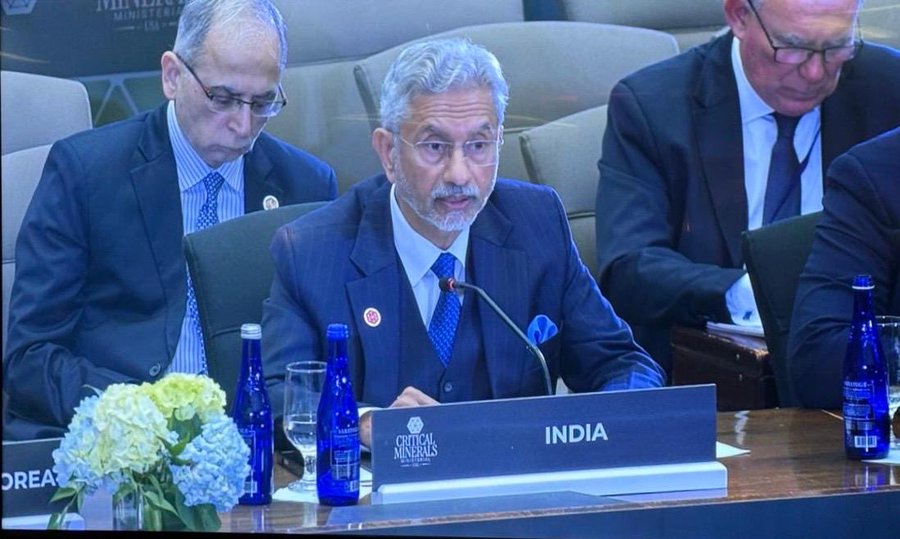
The United States announced on Wednesday the launch of the Forum on Resource, Geostrategic Engagement (FORGE), a new trade bloc aimed at reducing China’s grip on critical minerals by partnering with more than 50 countries, including India, Japan, South Korea, Australia and the EU.
The initiative seeks to diversifying the supply chains for minerals essential to defense and advanced industries through a proposed price-stabilization framework. FORGE is backed by US public financing tools, including up to $ 100 billion in lending authority.
In the first ministerial, External Affairs Minister S. Jaishankar voiced India’s support for the FORGE initiative. During his address he warned that excessive concentration in the critical minerals supply chains has created strategic vulnerabilities. The Indian minister emphasized the need to de-risk these supply chains through structured international cooperation. He also highlighted India’s efforts towards greater resilience through initiatives including National Critical Minerals Mission, Rare Earth Corridors and responsible commerce.
Earlier, kicking off the ministerial, Vice President J.D. Vance said, “Through FORGE, we’re building a durable allied trading bloc, one that rewards long-term planning, stabilizes critical mineral prices, attracts private capital, creates jobs, and reduces strategic dependence.” He said prices in the critical minerals market have become erratic and unpredictable, and proposed enforceable minimum prices aligned with fair market value, to give investors long-term stability.
Without naming China, Vice President Vance told the gathering, “No single country can overcome fragility of critical mineral supply and over-dependence on specific countries on its own. With the launch of FORGE, now it is time for action.” He said that market manipulation is undermining investment with promising mining and processing projects are repeatedly derailed when sudden foreign oversupply collapses prices, causing investors to withdraw and projects to fail.
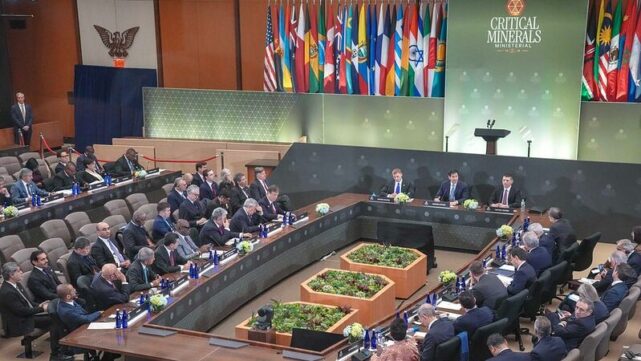
Vance sought to allay concerns that FORGE was designed to serve US interests alone, stressing that the initiative would succeed only if it were broadly adopted by like-minded countries. “While we intend to play a key role and an important role, and to use the size and influence of our markets to drive this, this is an international, multilateral effort,” he said. Vance added that real competition, “diversity and choice” in critical minerals markets, would be possible only through participation by multiple countries.
Addressing media, Secretary of State Marco Rubio outlined the strategic objective of the initiative, “Today it’s (critical minerals supply) heavily concentrated in the hands of one country. And that lends itself to, at worst-case scenario, being used as a tool of leverage in geopolitics, but it also lends itself to any sort of disruptions, like a pandemic or anything that could, political instability or anything that could happen.”
In his opening remarks during the inaugural session, Secretary Rubio told the attending ministers that that having most of the world’s critical mineral production and processing in the hands of a single country creates leverage that could be used against other nations. Without naming China, he said, “Our goal is to have a global market that’s secure, a global supply that’s enduring and is available to everyone, every nation, at an affordable price.”
Rubio further added that there is growing international recognition of the need for supply chains that are both reliable and diverse. He said that the goal of the ministerial is to advance collective efforts among participating countries to strengthen and diversify critical mineral supply chains that are vital for technological innovation, economic strength, and national security.
He noted that while some countries have mineral resources, they have struggled to develop them because foreign competitors can undercut markets, and that global cooperation is essential to overcoming these challenges. He emphasized that expanding partnerships, including with key producers and consumers, is a central part of building a more resilient global minerals market.
Calling for a joint effort to counter China’s dominance, the Secretary of State said preventing supply chain disruptions will require diversifying supply sources, including the refining and processing of geographically concentrated critical minerals. He told the gathering that the progress will depend on collective action. “We must seize this opportunity to advance cooperation among like-minded countries, partners, like us,” he added.
The move comes as trade tensions with Beijing rise. China dominates the rare earth supply chain. According to the International Energy Agency (IEA), Beijing controls roughly 70% of global rare earth mining and about 90% of processing and separation capacity. The IEA’s Global Critical Minerals Outlook 2025 also found China is the leading refiner for 19 of the 20 strategic minerals it tracks, while flagging supply chain concentration concerns.
India’s reliance is even higher. It is heavily dependent on China for critical minerals, with near-total reliance for key materials like lithium, cobalt, and rare earth elements (REEs) essential for batteries, electronics, and defense. In recent months, Beijing has tightened its grip by imposing new export controls on critical minerals, raising concerns in the United States, its allies, and countries like India about growing supply risks.
Related posts:
 India Joins US-Led Talks on Critical Minerals as Secretary Bessent Pushes Supply Chain Security
 Landmark Critical Minerals Framework and AUKUS Commitments Anchor Albanese’s Visit to Washington
 Jaishankar Meets Rubio Ahead of Critical Minerals Ministerial
 Bipartisan House Panel Sees Stronger U.S.–India Ties as Strategic Imperative