 Join WhatsApp Channel

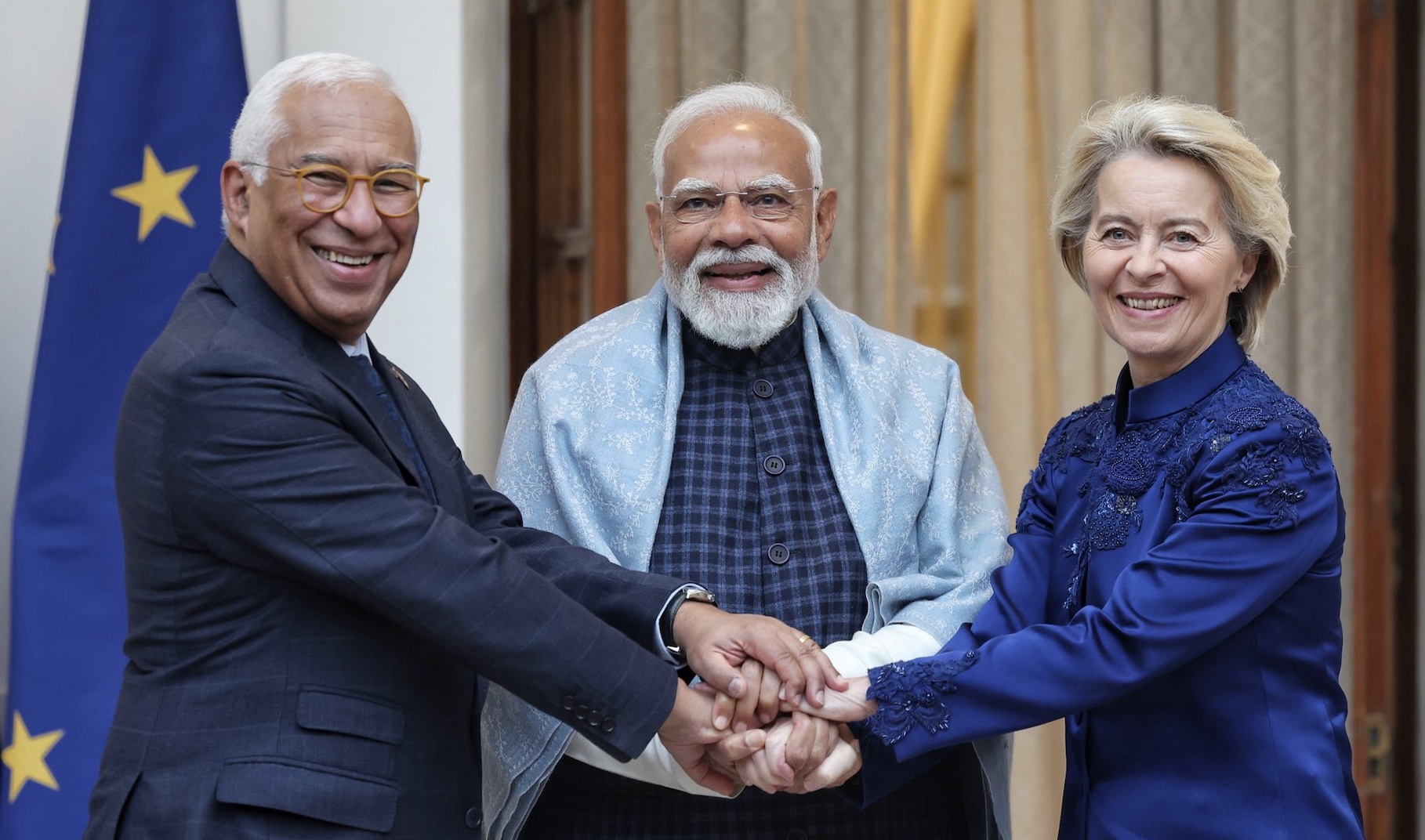
India and the European Union on January 27 announced the conclusion of a long-pending free trade agreement, marking one of New Delhi’s most ambitious trade deals to date and a strategic bet on deeper economic integration with one of the world’s richest markets.
Yet behind the headline promise of tariff-free access and export growth, unresolved concerns—most notably the EU’s carbon tax regime—raise questions about how much of the projected upside will ultimately be realized.
The agreement was announced at the 16th India–EU Summit by Prime Minister Narendra Modi and European Commission President Ursula von der Leyen, concluding negotiations that were re-launched in 2022 after a prolonged hiatus. Officials on both sides described the pact as “historic”, arguing it anchors India–EU ties in a predictable, rules-based framework at a time of global trade fragmentation and geopolitical uncertainty.
On paper, the scale is formidable. India and the EU together account for roughly a quarter of global GDP and about a third of global trade. The EU is already among India’s largest trading partners, with bilateral goods trade at ₹11.5 lakh crore ($136.5 billion) in 2024–25, and services trade at another ₹7.2 lakh crore ($83.1 billion). Under the FTA, the EU will cut or eliminate tariffs on around 98–99% of Indian exports by value, while India will liberalize roughly 97% of EU exports over time.
Tariff gains, unevenly spread
The biggest immediate winners are expected to be India’s labor-intensive sectors, where EU tariffs were still relatively high. Garments, facing duties of around 12%, and footwear, with tariffs of 8–15%, are among the principal beneficiaries. Marine products, gems and jewelry, handicrafts, chemicals and selected engineering goods are also set to gain, with tariffs falling to zero on entry into force for exports worth an estimated $33 billion.
Government projections suggest exports of about ₹6.4 lakh crore ($75 billion) could see a significant boost, supporting jobs across MSMEs, women-led enterprises and artisanal sectors. Services, which dominate both economies, have also been given prominence, with the EU offering commitments across 144 subsectors, including IT, professional services, education and other business services.
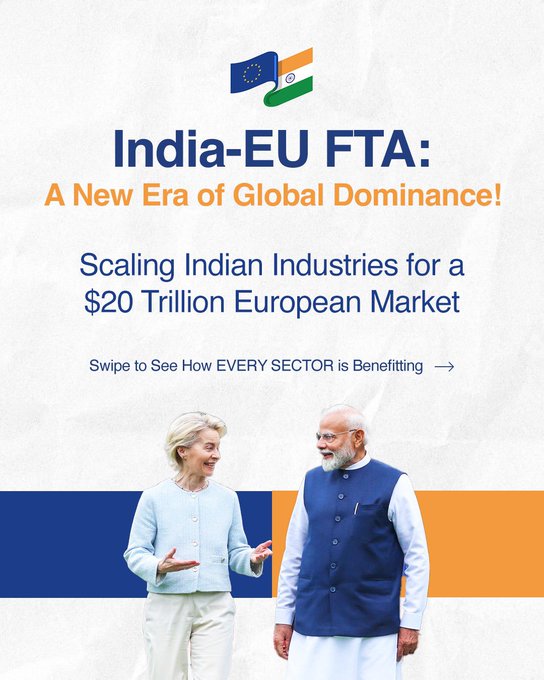
At the same time, India has agreed to substantial market opening for European goods, though with longer phase-in periods of seven to ten years for sensitive areas. Duties on wines will fall from 150% to 20–30%, spirits to 40%, beer from 110% to 50%, and automobile tariffs from 100–125% to as low as 10% under a quota-based system covering up to 250,000 vehicles. A wide range of processed foods, chemicals, machinery, electronics and even aircraft will also see duties reduced or eliminated.
While officials argue this “calibrated” liberalization protects domestic industry and supports Make in India, critics caution that the competitive pressure from high-end European manufacturers could intensify, particularly in automobiles and agri-food segments, before Indian firms are fully ready.
Agriculture protected, but constrained
India has drawn firm red lines around sensitive agricultural sectors. Dairy, cereals, poultry, soymeal and selected fruits and vegetables remain shielded from market access commitments, reflecting domestic political and livelihood concerns. Still, tariff cuts on products such as sheep meat, fruit juices, bakery items, chocolates and pet food signal a gradual opening that could test smaller farmers and processors over time.
For Indian exporters, gains in tea, coffee, spices and processed foods will depend not only on tariffs but also on compliance with the EU’s stringent sanitary, phytosanitary and technical standards—often a more formidable barrier than customs duties.
The CBAM shadow
The most significant unresolved issue is the EU’s Carbon Border Adjustment Mechanism (CBAM), which from January 2026 will impose a levy on imports based on their embedded carbon emissions. The FTA does not exempt Indian exports from CBAM, creating what trade analysts describe as a structural asymmetry: EU goods could increasingly enter India at low or zero tariffs, while Indian exports continue to face carbon-related charges in Europe.
Although CBAM currently covers only six products, including steel and aluminum, it is designed to expand to most industrial goods. As that happens, the effective cost advantage created by tariff cuts could be steadily eroded for Indian exporters, particularly in energy-intensive sectors.
The agreement includes provisions for dialogue, cooperation platforms and possible EU financial assistance—reported to be up to €500 million—for India’s green transition. But these measures stop short of addressing exporters’ immediate cost burden. “Cooperation signals intent, not relief,” said Ajay Srivastava of the Global Trade Research Initiative. “As CBAM expands, it risks neutralizing a large part of the FTA’s tariff benefits.”
Services and mobility: promise, with limits
The pact’s services chapter is among its more ambitious elements, offering non-discriminatory treatment, certainty of market access and facilitation for digitally delivered services. Mobility provisions cover intra-corporate transferees, business visitors, contractual service suppliers and independent professionals across dozens of sectors, alongside frameworks for student mobility and post-study work.
Yet here too, the real impact will depend on implementation by individual EU member states, where immigration rules, professional recognition and labor market conditions vary widely.
A strategic bet, not a finished story
Strategically, the FTA locks India and the EU into a closer economic partnership at a time when the multilateral trading system is under strain and major economies are weaponizing trade policy. It also complements India’s recent trade deals with the UK, EFTA and others, effectively widening access to the broader European market.
But as with many modern trade agreements, the headline tariff cuts tell only part of the story. Non-tariff barriers, regulatory alignment, climate-linked trade measures and domestic adjustment costs will shape outcomes just as much as customs schedules.
For India, the deal is best seen as a strong tariff-cutting framework whose long-term value hinges on whether unresolved regulatory and climate issues—especially CBAM—are meaningfully addressed. Without that, the risk is that a landmark agreement delivers less on the ground than its architects promise.
Related posts:
 Beyond Tariffs: U.S.-India Trade Talks Test New Delhi’s Strategic Trade Vision
 India–NZ Trade Pact Balances Access, Protection
 US, India Agree on Framework for Interim Trade Agreement, Set Path Toward Broader Bilateral Deal
 India’s Export Ambition: $1 Trillion Target Hinges on US Trade Deal, EU Compliance
