Join WhatsApp Channel

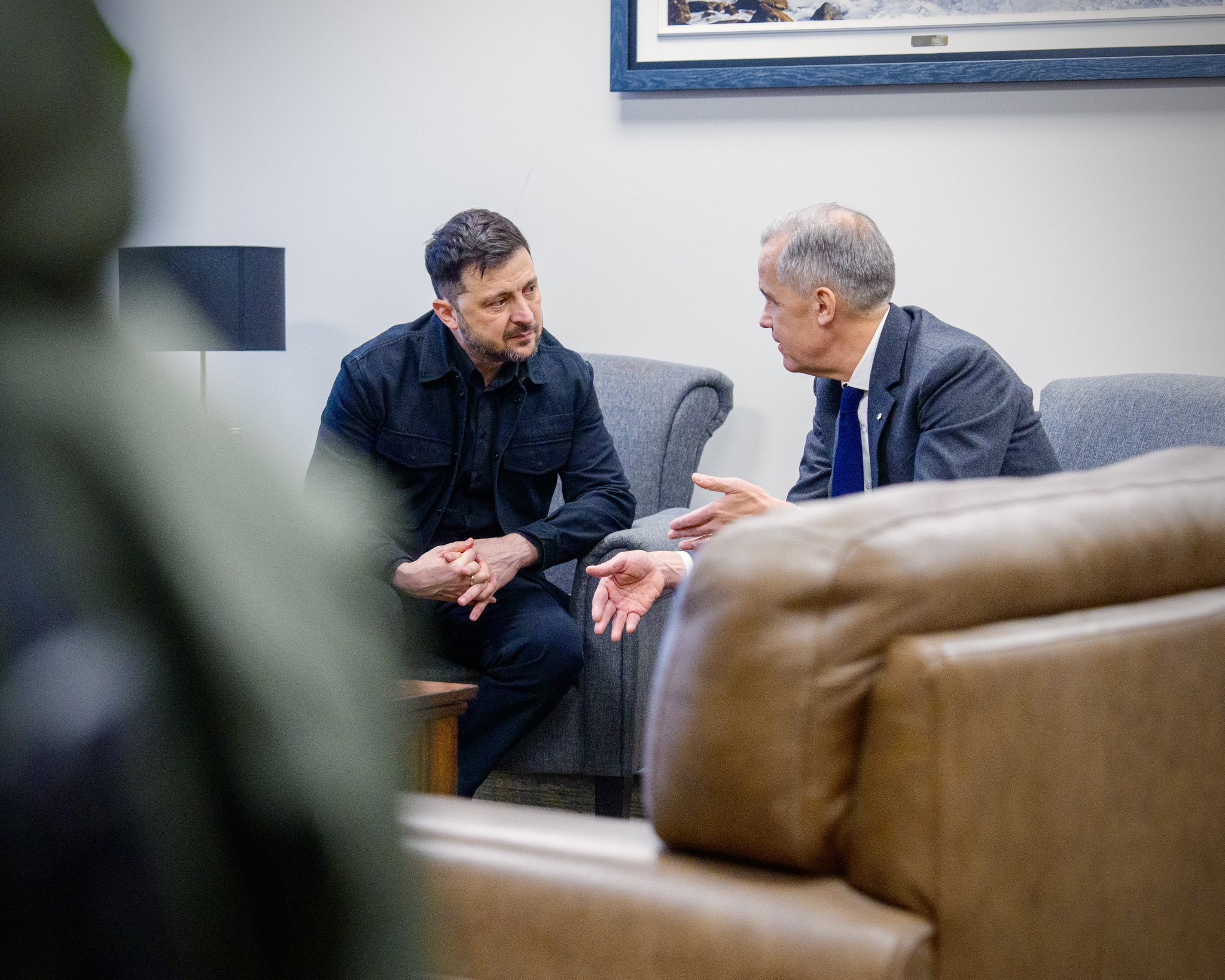
When Canadian Prime Minister Mark Carney unveiled a new economic assistance package for war-torn Ukraine during a brief meeting with President Volodymyr Zelenskyy at a Halifax-area airport, it triggered a wave of reactions both supporting and questioning Canada’s continued financial commitments abroad.
Zelenskyy was en route to Florida for planned peace talks with U.S. President Donald Trump this weekend, which he described as “very important and very constructive.” During the Halifax stopover, Carney and Zelenskyy held a bilateral discussion on the latest developments in the peace process, with Carney reaffirming Canada’s full support for Ukraine.
While the intent behind humanitarian and economic assistance is rarely disputed, the scale of the latest package has drawn scrutiny. Critics point to Canada’s own fiscal constraints, noting that the federal government narrowly secured passage of its 2025 budget in the House of Commons by just a few votes.
Canada has been a strong supporter of Ukraine since Russia’s full-scale invasion in February 2022, committing $6.5 billion in military assistance in addition to humanitarian and financial aid.
According to a Prime Minister’s Office news release, the newly announced $2.5 billion commitment is expected to help unlock nearly $10 billion in lending from the International Monetary Fund and the World Bank to support Ukraine’s reconstruction. The funding will also help guarantee a loan of up to $322 million from the European Bank to bolster Ukraine’s energy security.
“Canada has committed new support to Ukraine, not only to help end this war, but also to help the Ukrainian people recover and rebuild,” Carney said in the statement. “Canada stands with Ukraine, because their cause—freedom, democracy, sovereignty—is our cause.”
The package has generated mixed reactions domestically. While linking the announcement to renewed speculation about wealthy Canadians relocating to lower-tax jurisdictions may be overstated, there is evident unease among some taxpayers about increased spending on overseas conflicts.
Critics argue that the additional $2.5 billion commitment adds to mounting deficits. The federal government’s 2024 fall statement projected a deficit of $42.2 billion for the current fiscal year. The 2025 budget increased that figure to $78.3 billion and forecast deficits exceeding $50 billion annually over the next five years. Opponents warn that sustained deficits could eventually lead to higher taxes, both direct and indirect, as well as increased inflation and unemployment.
While some fiscal pressures stem from deteriorating economic conditions since last year, analysts note that new spending accounts for much of the increase. Higher deficits are also translating into rising debt, with debt servicing charges projected to grow from 10.5 percent of federal revenues last fiscal year to more than 13 percent by 2029-30.
Amid rising spending and deficits, the federal government has again revised its fiscal anchor, a benchmark intended to reassure financial markets, credit rating agencies, and the public about the sustainability of Canada’s finances.
An official communique stated that since Russia’s “unprovoked, unjustified, full-scale invasion,” Canada has provided nearly $22 billion in assistance to Ukraine, including more than $12 billion in direct financial support, placing Canada among the largest contributors to Ukraine’s recovery and reconstruction efforts.
Building on this support, Carney announced additional measures last weekend aimed at advancing a just and lasting peace. These include the $2.5 billion commitment, financing that would enable the IMF to provide an additional $8.4 billion to Ukraine under an extended program, and Canada’s participation in expanded debt service suspension of up to $1.5 billion in 2025-26.
The package also includes a loan guarantee of up to $1.3 billion in 2026 to the World Bank’s International Bank for Reconstruction and Development for reconstruction efforts, and a guarantee of up to $322 million to the European Bank for Reconstruction and Development to support Ukraine’s gas imports and energy security.
Since early 2022, Canada’s $6.5 billion military commitment has enabled continued assistance to Ukraine through 2029.
“The barbarism that we saw overnight—the attack on Kyiv—shows just how important it is that we stand with Ukraine during this difficult time,” Carney said.
Zelenskyy thanked Canada for its support, describing the latest attacks as “Russia’s answer to our peace efforts,” and said they showed that Russian President Vladimir Putin “doesn’t want peace.” He also referred to Putin as a “man of war.”
Moscow has said the strike was in response to Ukraine’s attacks on what it described as “civilian objects” inside Russia.
Related posts:
 Ukraine-India Relations: Navigating Historical Ties and Russian Disinformation in a New Geopolitical Era
 President Biden calls Prime Minister Modi to discuss about Ukraine and the United Nations General Assembly
 Putin Rejects Peace as War Slouches Into Its Fourth Year
 G7 Summit 2025 Ends with Renewed Alliances, Sharp Divides, and a Surprise Exit by President Trump