 Join WhatsApp Channel

State Department Expands Social Media Screening to H-1B/H-4 Applicants
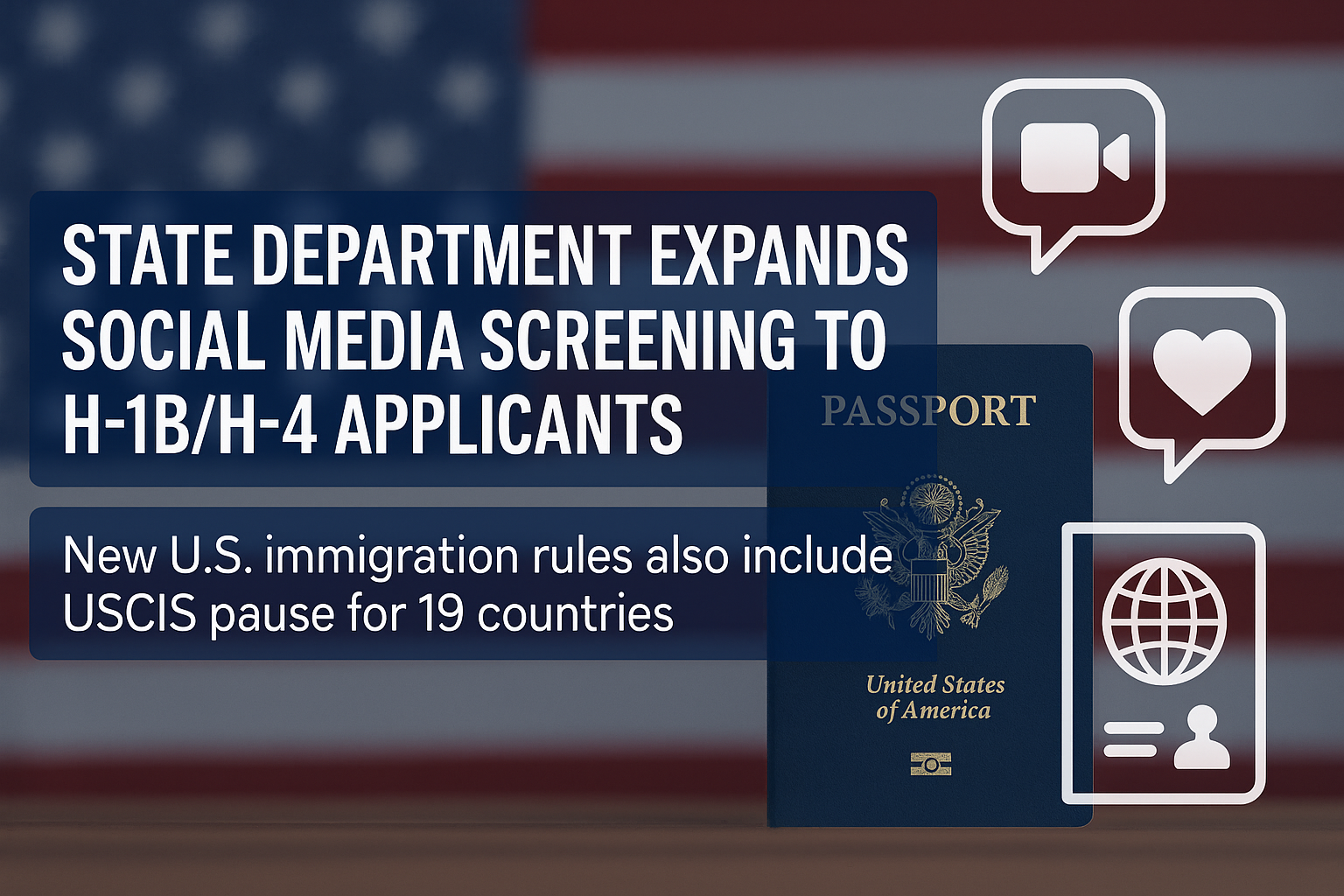
A new December 15, 2025, policy change by the U.S. State Department is expected to complicate international travel plans for thousands of H-1B professionals and their H-4 dependents. Starting December 15, all H-1B/H-4 visa applicants seeking visa stamping at consulates abroad will be subject to enhanced social media vetting procedures.
Applicants Required to Make Social Media Profiles Public
Under the expanded policy, consular officers will review applicants’ online presence for any content considered a threat to national security or public safety. Applicants are being instructed to set all social media profiles to public visibility. Applicants must follow instructions Embassies and Consulates send to them, typically via email, either before or after the visa interview.
Applicants should follow consulate instructions. They should be ready to open their social media for review before their interview, but doing so as soon as the DS-160 is submitted may avoid delay.
Delays Expected at High-Volume Posts
The new vetting requirement could significantly slow down appointment scheduling and visa issuance, particularly at high-volume consulates such as Chennai and Hyderabad, India. Applicants with an extensive social media presence may face deeper scrutiny. When consulates cannot review information before the interview, they could temporarily refuse visas under INA section 221g, commonly known as “administrative processing.” This process may take from a few days to many weeks.
Both Employers and H-1B Workers Should Avoid Unplanned International Travel
Employers should track their H-1B employees’ overseas travel plans and have them screened for issues before travel. Of concern here is the potential risk of an H-1B worker’s unavailability for an extended period if their visa is refused under 221g or denied. Similarly, H-1B workers should plan for increased travel disruption and even visa denial.
USCIS Pauses Applications from 19 High-Risk Countries
In a separate move, USCIS announced on December 2 that it will “pause, re-review, and re-interview” immigration benefit applications from individuals who are citizens of or born in 19 designated high-risk countries. This change affects individuals who entered the United States on or after January 20, 2021.
Wide Range of Benefits and Forms Impacted
This USCIS pause will affect a wide range of applications including green card applications (Form I-485), those who seek green card renewals (Form I-90), and spouses who seek removal of conditions on green cards (Form I-751), among others. Naturalization interviews for affected applicants have also reportedly been paused.
Other applications that are impacted include Form I-129 – this form is commonly used for H-1B visas (professional workers); L-1 visas (intra-company transferees); O-1 visas (applications from high-achieving individuals); P1/P2/P3 (athletes, entertainers, performers); and R-1 (religious workers). Also affected are immigrant visa petitions (Form I-140), change or renewal of temporary visas (Form I-539), and applications for work (I-765) and travel/re-entry (I-131) permits.
USCIS has said that it has ordered this immediate pause to “fully assess all national security and public safety threats” along with screening for other issues such as determining the applicant’s admissibility or eligibility.
A New Era of Heightened Scrutiny
Together, these policies represent one of the most significant immigration slowdowns in recent years. Employers and visa holders should plan ahead before traveling abroad, expect delays, and be prepared for deeper scrutiny while awaiting further government guidance.
(This content is for informational purposes only. It does not constitute legal advice, nor does it substitute legal advice.)
Disclaimer: The opinions and views expressed in this article/column are those of the author(s) and do not necessarily reflect the views or positions of South Asian Herald.
Related posts:
 New $250 Visa Integrity Fee to Increase U.S. Travel Costs for Foreign Nationals and Employers
 FIIDS Urges Trump Administration to Preserve H-1B Visa Appointments Amid Expanded Social Media Vetting
 U.S. Tightens Birth Tourism Scrutiny as Digital Vetting Widens for Indian Visa Applicants
 Immigration Experts Discuss Challenges Under Trump’s Second Term

1 comment
Wow — this new social media vetting twist for H-1B and H-4 applicants really feels like a curveball. Suddenly having to open up your online life just to get your visa stamped and then watching travel plans get delayed or interviews pushed months down the road? It’s the kind of disruption no one saw coming and definitely not how most people pictured their holiday trips or job start dates going.
It’s easy to see why folks are talking — you’ve got tech workers trying to juggle new roles, families trying to visit loved ones, and suddenly a whole extra layer of screening where your LinkedIn, Instagram, and other profiles become part of your visa application. That’s bound to slow things down and make planning feel like a guessing game.
If nothing else, this change is a reminder to double-check all your documents and your online presence before booking flights. Hopefully the consulates find ways to clear the backlog faster, but for now it’s one of those stories that hits close to home for so many people navigating life and work across borders.