Join WhatsApp Channel

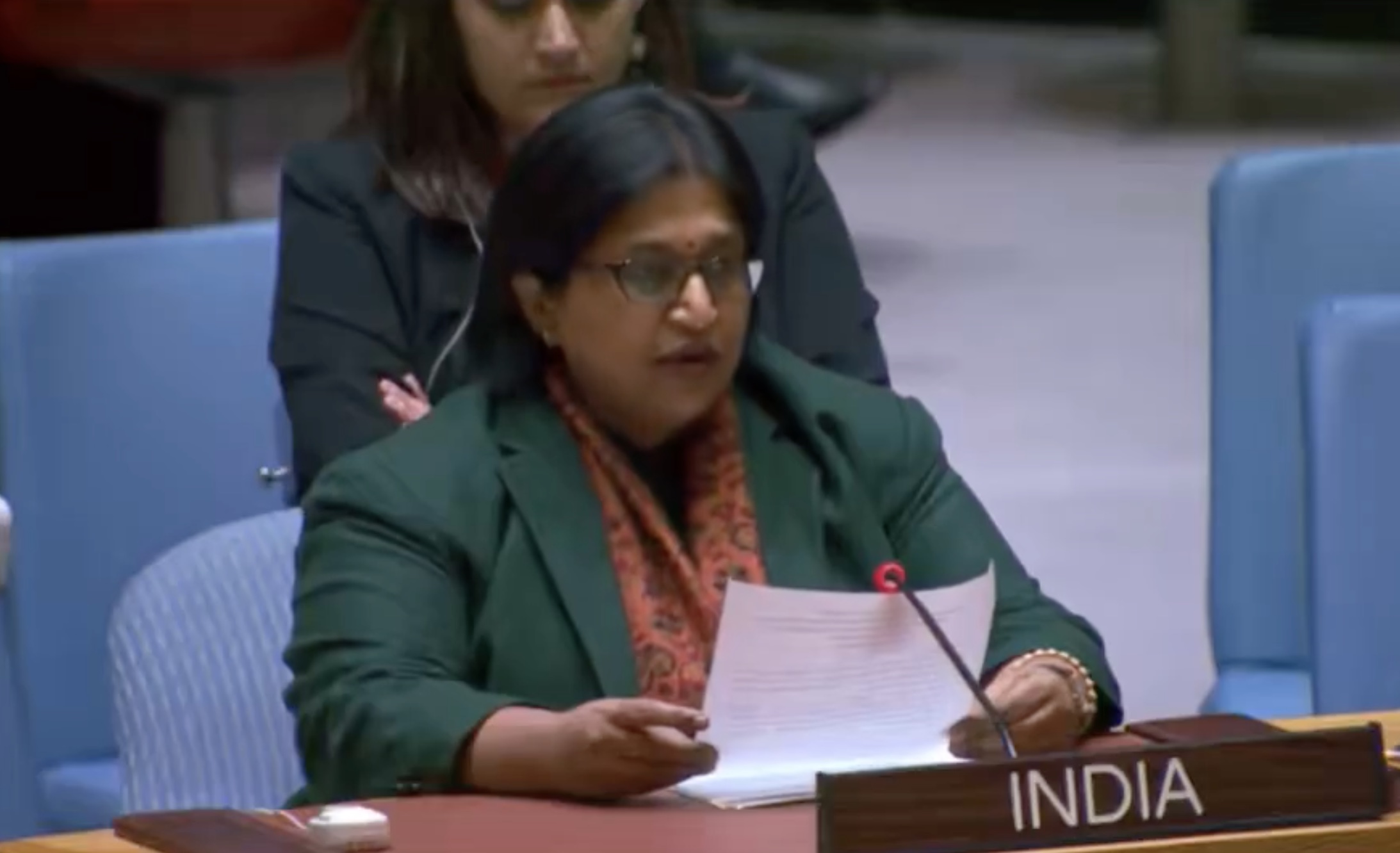
Deputy Permanent Representative of India to the United Nations, Ambassador Yojna Patel, has cautioned that food insecurity remains one of the most devastating “consequences of conflict,” emerging when violence and political instability disrupt “agriculture, displace communities, destroy infrastructure, and impede humanitarian access.”
Speaking at the United Nations Security Council High-Level Open Debate on “Framing the global dialogue: addressing food insecurity as a driver of conflict and ensuring food security for sustainable peace” on November 17, 2025, Ambassador Patel described widespread hunger as “a manifestation of governance breakdown and prolonged insecurity.”
She thanked the Republic of Sierra Leone for convening the debate, noting that the theme goes to the heart of one of today’s most urgent humanitarian challenges: the growing prevalence of hunger in conflict-affected regions.
“We must distinguish between addressing violations of international humanitarian law – which falls within the Council’s purview – and building food-secure, resilient societies, which requires the long-term, coordinated engagement of the UN development system (UNDS),” she said. She also stressed that using starvation as a weapon of war is unequivocally prohibited under Resolution 2417 and the Geneva Conventions.
Ambassador Patel emphasized that armed conflict disrupts food systems by destroying “infrastructure, blocking markets, and displacing communities.” Mitigating these impacts, she said, requires restoring peace, strengthening governance, and rebuilding national capacities. The Security Council’s role should focus on safeguarding humanitarian access and ensuring its own measures, including sanctions, do not hinder food assistance.
She further argued that food insecurity is most often the result of “instability and underdevelopment.” A sustainable path forward, she said, must reinforce “social protection systems, climate-resilient agriculture, and livelihood programs” supported through the UN Sustainable Development Cooperation Framework and national development plans.
Highlighting that national governments hold primary responsibility for ensuring food security and the resilience of food systems, Ambassador Patel said regional organizations can play a complementary role by facilitating cross-border trade, early warning systems, and transport corridors. Above all, she stressed, countries must respect international humanitarian law and guarantee safe humanitarian access.
To improve access in conflict zones, she noted that coordination through the UN Office for the Coordination of Humanitarian Affairs and the World Food Programme’s logistics mechanisms remains the most effective approach. The Security Council should also support de-confliction arrangements to protect humanitarian operations.
Looking ahead, Ambassador Patel said innovation must come from within the development sphere. “Anticipatory-action financing, climate-smart agriculture, digital supply-chain platforms, and South-South knowledge partnerships can all strengthen resilience in fragile contexts,” she said, adding that predictable, concessional financing – consistent with the outcomes of the Fourth International Conference on Financing for Development – is essential to scaling these efforts.
“India firmly believes that peace, development, and food security are interdependent. The Council should support an enabling environment for development actors to function effectively, while the General Assembly, ECOSOC, and Rome-based agencies lead the substantive response,” she said.
Reaffirming India’s commitment to multilateralism and solidarity with the Global South, Ambassador Patel stressed that renewed trust in the UN development system is essential to ensuring that every person, in every nation, has access to safe, nutritious, and sufficient food.
Related posts:
 India Calls for Peace, Stability, and Greater Humanitarian Support for Afghanistan at UN Security Council
 ECOSOC President Lok Bahadur Thapa Calls for Stronger Multilateral Action at Council’s 80th Anniversary
 India Reaffirms Two-State Solution, Highlights Gaza Reconstruction and Situations in Syria, Lebanon, and Yemen at UNSC
 At UN Security Council, India Affirms Jammu & Kashmir, Ladakh as Integral Parts of India, Criticizes Pakistan’s Conduct