

In March 2024, an iPhone factory in Narsapura, Karnataka, changed hands. Tata Electronics completed its acquisition of Wistron’s Indian operations, bringing an Indian company into the business of assembling Apple’s phones. By January 2025, Tata had added a controlling stake in Pegatron Technology India. A group long associated with steel, cars and software was establishing itself in the production networks behind a device sold around the world.
Further north, Dixon Technologies has built a different route into mobile manufacturing. Through its subsidiary Padget Electronics, it makes Motorola phones for Indian buyers and overseas markets. Lava, headquartered in Noida, has developed handset design and manufacturing capabilities alongside its own brand. These are distinct businesses: Tata and Dixon manufacture for international brands, while Lava also competes under an Indian name. Each illustrates a route through which domestic firms can acquire industrial capabilities.
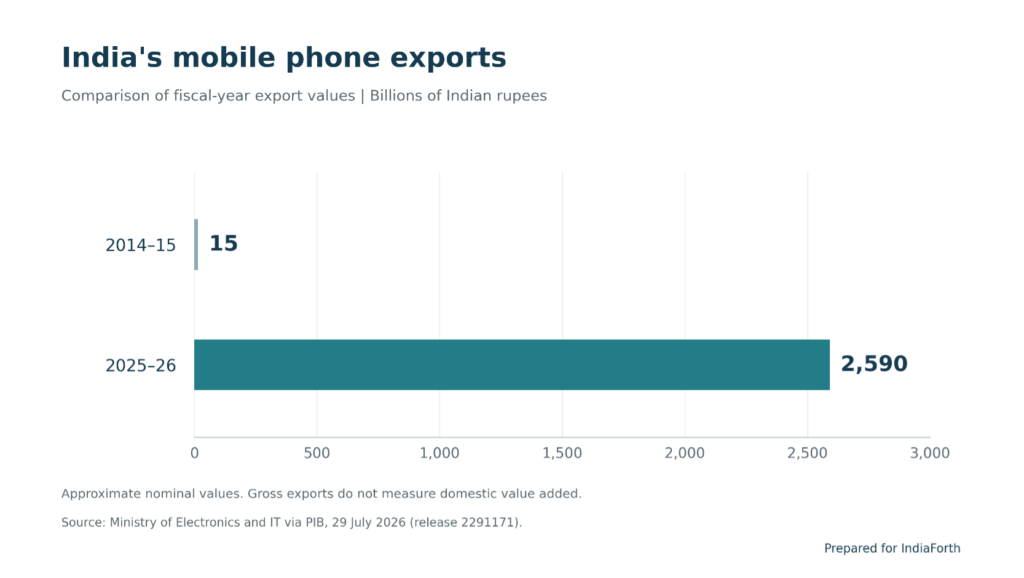
Their progress belongs to a wider transformation. Government figures put India’s mobile phone exports at approximately 2.59 trillion rupees in 2025–26, compared with about 15 billion rupees in 2014–15. The strategic significance depends on what develops around those exports, and how ecosystems evolve. India’s international influence will become more durable as its firms acquire the knowledge and production capabilities that make them valuable to customers abroad.
Manufacturing gives substance to India’s diplomatic relationships and market size. When overseas businesses depend on Indian suppliers, they acquire a commercial interest in the country’s stability and success. That can strengthen New Delhi’s negotiating position. But the export value of a finished phone includes imported components and foreign technology. It does not tell us how much income or expertise remains in India, or how easily the manufacturer could be replaced.
Advertisement
Assembly is a starting point. It trains workers and teaches firms to manage production at scale. The next step is to develop suppliers that can make reliable components, secure certification and serve several customers. Those capabilities can survive changes in any one multinational’s sourcing strategy. They give India a stronger industrial foundation than dependence on a single large order.
Policy is beginning to address this challenge. India’s Electronics Component Manufacturing Scheme covers products including printed circuit boards, camera modules and equipment used in electronics manufacturing. Its importance lies in the attempt to connect the final product to a wider supplier base. Its eventual success should be judged by whether those suppliers become productive and commercially viable, including after incentives expire.
Solar manufacturing offers another view of the same problem. Official figures put India’s annual module manufacturing capacity at approximately 172 gigawatts in March 2026. That is a measure of potential factory output, not electricity generation or the volume of panels actually produced. It demonstrates the scale of investment, while leaving open the question of how deeply India participates in the technologies and inputs behind each panel.
The distinction matters because a module is the finished panel, while the cells inside it convert sunlight into electricity. Wafers and polysilicon sit further upstream. Waaree’s inauguration of a 5.4-gigawatt solar cell facility in Gujarat in March 2025 illustrates investment in an earlier production stage. Moving into such activities can retain more value locally, but each stage must also meet demanding cost and quality requirements.
India does not need to manufacture every input within its borders. Attempting to do so regardless of cost could make its exports less competitive and its energy transition more expensive. The strategic task is to identify where domestic capability is essential, where several dependable foreign suppliers are sufficient, and where joint ventures can accelerate learning. Resilience comes from having workable alternatives when supplies are disrupted.
This makes industrial policy a difficult exercise in coordination. A subsidy can help finance a factory, but production also requires dependable electricity, suitable water supplies and timely customs clearance. Smaller firms need working capital while they wait for customers to pay. Testing laboratories and technical colleges must respond to actual production problems. These institutions determine whether an investment announcement becomes an industry that can grow.
Much of this work falls to state governments and local agencies. National diplomacy may secure an investment, but implementation depends on where the plant operates. Transparent land processes, functioning industrial estates and predictable approvals affect whether suppliers cluster nearby. Coordination between the centre and states is therefore part of India’s economic security agenda, with responsibilities that continue beyond an inauguration.
Public support also needs discipline. Incentives should carry clear performance expectations and periodic review. Governments should publish evidence of productivity improvements, domestic supplier development and sustained employment, rather than relying only on announced investment. Support that repeatedly shelters an uncompetitive producer can raise costs for the rest of the economy. Officials need the capacity to withdraw it, even when the beneficiary is politically influential.
Employment is a further test. Advanced factories matter, but an industrial strategy must also create routes into stable work for people without elite qualifications. Apprenticeships, safe transport and opportunities for advancement can help translate investment into broader participation. High-technology sectors should sit alongside competitive, employment-intensive industries such as garments and food processing. A narrow collection of successful plants cannot carry the country’s development ambitions alone.
International partners can help Indian suppliers meet technical standards and enter durable commercial relationships. Research partnerships should develop capabilities that businesses can use. The diaspora can connect smaller Indian firms with overseas customers and technical expertise, reducing the difficulty of establishing a first commercial relationship.
The geopolitical gains will depend on these foundations. A country that supplies reliable industrial products can offer partners additional choices and negotiate from a stronger position. But that influence is conditional: customers can move if quality falls, costs rise or policy becomes unpredictable. Industrial success must be renewed through learning and competition. India’s diplomacy will gain lasting weight when its firms can repeatedly earn their place in the world’s production networks.
Disclaimer: The opinions and views expressed in this article/column are those of the author(s) and do not necessarily reflect the views or positions of South Asian Herald.