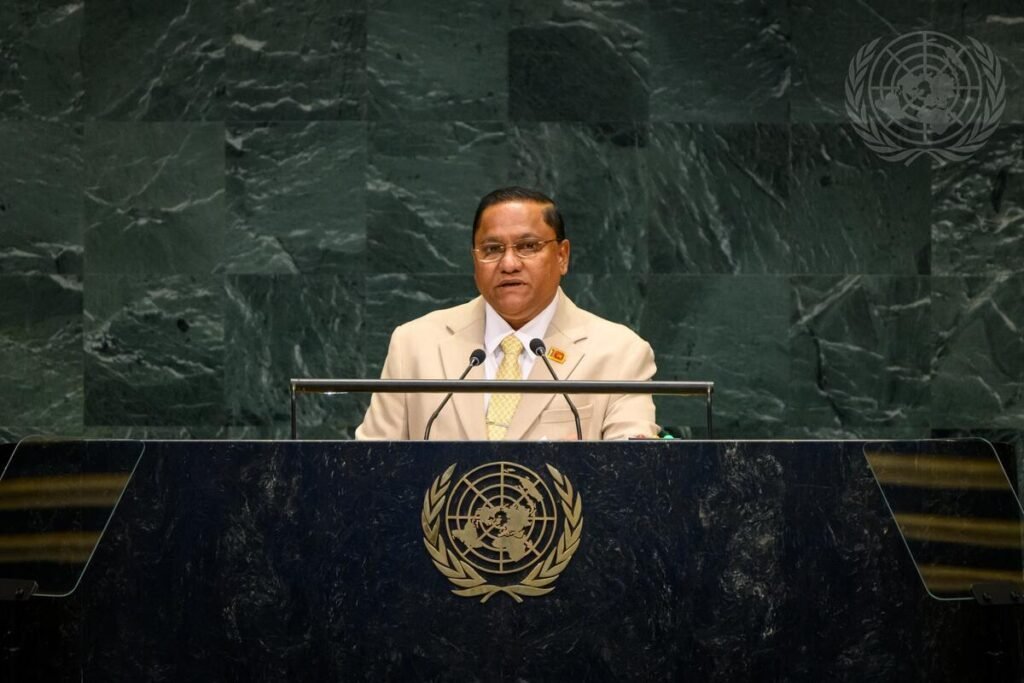
Sri Lankan Foreign Minister Vijitha Herath has called for stronger international cooperation and the United Nations that responds more effectively to global challenges, saying conflicts, climate disasters, debt and technological change were testing public trust in institutions.
Addressing the 81st session of the UN General Assembly in New York on September 28, Herath said “seminal” changes were taking place faster than many institutions could adapt. People around the world were demanding “greater clarity, honesty and action” from their leaders, he said.
Herath linked those concerns to the theme of this year’s General Debate, “Restoring trust, managing transformation: a United Nations that delivers for all.” Unresolved conflicts, humanitarian crises, increasingly frequent climate disasters, widening inequality and technological advances that outpaced governance had all contributed to a sense that global institutions were distant from the people they served, he said.
Sri Lanka had experienced the consequences of lost trust and breaches of the social contract, Herath said. He described the mandate given to President Anura Kumara Dissanayaka’s government two years ago as a turning point and said it had since worked to rebuild trust.
Advertisement
“We are building trust through action, not rhetoric; through delivery, discipline and the courage to confront wrongdoing,” he said.
Herath said Sri Lanka had restored macroeconomic stability after its 2022 economic crisis despite conflicts abroad and the effects of a cyclone at home. He cited the World Bank’s reclassification of the country as an upper-middle-income economy and said ratings agencies had recognized its economic trajectory.
Those developments did not fully capture Sri Lanka’s vulnerability to debt and external shocks, he said. The government remained aware of the hardship facing vulnerable communities as it worked with international partners to consolidate economic stability.
Herath described Cyclone Ditwah as one of the worst natural disasters in Sri Lanka’s recent history. It killed hundreds of people, affected more than two million, disrupted livelihoods and destroyed critical infrastructure, he said.
He also expressed sympathy for people affected by Himalayan floods in Nepal and China. The disasters illustrated the human and economic costs of climate change, Herath said, particularly for countries that had contributed least to global emissions.
“Climate justice must become an urgent reality,” he said. Herath added that Sri Lanka was on track toward achieving 70 percent renewable energy by 2030 and carbon neutrality by 2050.
The Foreign Minister also addressed the lasting effects of Sri Lanka’s three-decade conflict. Although the fighting ended 17 years ago, its wounds remained, he said. The government was strengthening national institutions to address outstanding issues and pursue reconciliation and national unity.
Herath said Sri Lanka was determined to prevent a recurrence of the conflict and continued to reject racism and religious extremism. He called for a more secure and inclusive country strengthened by its diversity.
Conflicts in West Asia and elsewhere were also affecting Sri Lanka, Herath said. Its location in the Indian Ocean and the large number of Sri Lankan migrant workers in West Asia meant developments in the region had direct security, economic and social implications for the country.
He described an incident in March in which a ship belonging to a party to a conflict was in distress near Sri Lanka’s territorial waters. Sailors’ lives were at risk, he said, and Sri Lanka used its limited resources to rescue people and care for the wounded and sick. It later rescued hundreds more.
Herath said Sri Lanka had sought to safeguard its neutrality while acting on its commitments to international law and the protection of human life. “We saw human lives in danger, and we acted,” he said.
The experience reflected the approach Sri Lanka wished to bring to international affairs, Herath said, as he turned to developments in Gaza and the occupied Palestinian territories. He expressed concern about the deterioration of the global security environment and questioned the resources spent on weapons while children faced hunger and lacked medicine and education.
Sri Lanka was deeply concerned about conflicts in West Asia and their effects beyond the region, he said. Herath called on all parties to respect international law, including international humanitarian law, and said dialogue was the only viable way forward.
He reaffirmed Sri Lanka’s support for the Palestinian people’s right to self-determination. The country supported an independent, sovereign Palestinian state alongside Israel, in peace, within the pre-1967 borders, he said.
Herath welcomed a UN Security Council resolution on a ceasefire in Gaza and urged all parties to uphold it. Humanitarian assistance should reach civilians without obstruction, he said, while recovery and reconstruction in Gaza should be urgent priorities.
The Minister highlighted Sri Lanka’s longstanding role in UN peacekeeping, saying it had deployed more than 21,000 personnel on missions since 1957. Sri Lankan peacekeepers continued to serve in challenging environments, protecting civilians, deterring violence and helping communities move from conflict toward stability, he said.
Herath also reaffirmed Sri Lanka’s support for multilateral disarmament. He cited the country’s earlier call for an Indian Ocean Zone of Peace and its leadership at the 1995 Nuclear Non-Proliferation Treaty Review and Extension Conference. Amid rising geopolitical tensions and rhetoric about nuclear escalation, he said the only real guarantee against nuclear weapons was their total and verifiable elimination.
With the 2030 deadline for the Sustainable Development Goals approaching, Herath called for reform of the international financial system and fairer rules governing debt and development finance. Sri Lanka welcomed the Seville Commitment, including its call for urgent action to close a $4 trillion financing gap for sustainable development in developing countries, he said.
“It is now time to translate those commitments into concrete action,” Herath said.
He said poverty and inequality also required attention within Sri Lanka. The previous national budget made substantial allocations to health care and education, he said, while the government remained committed to the country’s longstanding policy of free, universal access to both.
Herath emphasized Sustainable Development Goal 16, which concerns just and inclusive institutions. Institutions that treat people equally were essential to building and restoring public trust, he said.
Good governance, anti-corruption measures and institutional transparency formed a central part of the government’s national agenda, Herath said. Corruption weakened democracy and destroyed trust, he added, while the law should be enforced regardless of a person’s background or social standing.
He said investigations and prosecutions were continuing without political interference and that progress had been made in strengthening the independence of institutions responsible for addressing bribery and corruption.
The Foreign Minister also discussed narcotics and related organized crime. He said the government’s “United as a Nation” Anti-Narcotics National Programme had made progress over the past year, including arrests of key figures in the narcotics supply chain.
As an island nation whose prosperity was closely linked to the Indian Ocean, Sri Lanka remained committed to a fair and peaceful order at sea, Herath said. He reaffirmed its support for the UN Convention on the Law of the Sea and the work of the Commission on the Limits of the Continental Shelf.
Herath said Sri Lanka wanted the oceans preserved for peaceful and sustainable use and international cooperation. As a founding member of the agreement on marine biological diversity in areas beyond national jurisdiction, the country remained committed to protecting the oceans for present and future generations, he said. He also called for further work to make the agreement operational.
On technology, Herath urged the international community to promote meaningful technology transfers, improve access for developing nations and bridge the digital divide. Sri Lanka was working to build an inclusive digital future and had developed national ethical guidelines for artificial intelligence in line with international frameworks, he said.
Artificial intelligence and other emerging technologies needed to be developed and used responsibly and consistently with international law, including international humanitarian law, Herath said. Their use should contribute to international peace and security while advancing humanity’s collective interests.
Herath described the UN as an indispensable partner for Sri Lanka and a forum that gave countries, large and small, a voice. It had supported Sri Lanka during difficult times and remained important to developing countries facing challenges they could not address alone, he said.
The UN had shortcomings and room for improvement, Herath said, but Sri Lanka supported the UN80 initiative as an opportunity to strengthen the organization and advance reform. He called for institutions that listened more closely, represented countries more fairly and delivered more effectively.
Global change had to be inclusive, he said. It should narrow the divides between North and South, between countries that shape new technologies and those that receive them, and between those able to withstand shocks and those most exposed to them.
Sri Lanka did not expect the UN to solve every problem, Herath said. It did, however, believe that some problems could not be solved by any country acting alone.