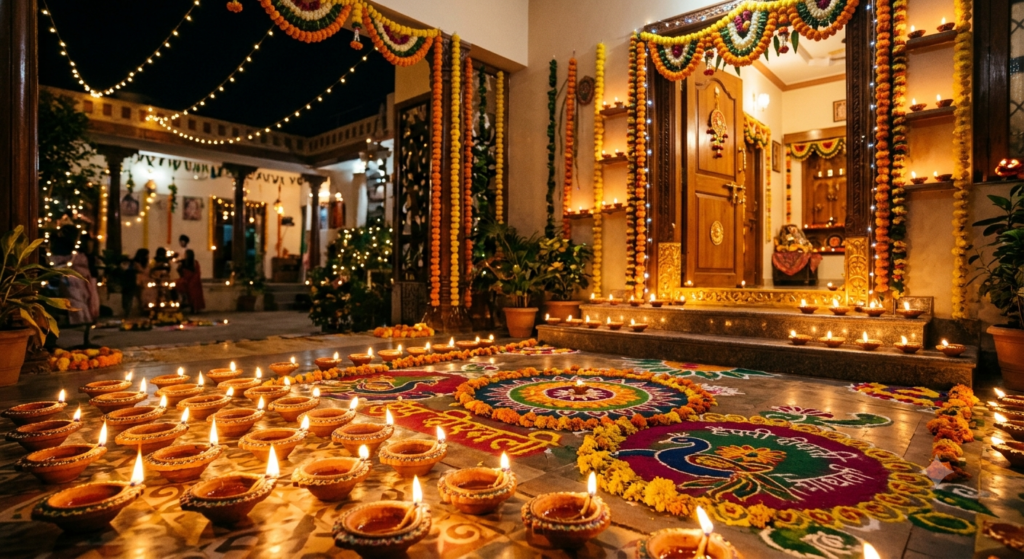
Diwali, widely celebrated as the festival of lights, is far from a uniform national celebration. Across India, the festival takes on different religious, cultural and regional meanings, reflecting the country’s diverse traditions, mythology and social practices.
While much of North India associates Diwali with Lord Rama’s return to Ayodhya after 14 years of exile and his victory over Ravana, celebrations in South India largely center on Naraka Chaturdashi, commemorating Lord Krishna’s defeat of the demon Narakasura.
In Tamil Nadu, Karnataka, Andhra Pradesh and Telangana, festivities traditionally begin before sunrise with ritual oil baths, prayers, new clothes and sweets. In Tamil Nadu, newly married couples observe Thalai Diwali, with celebrations hosted at the bride’s parental home. In Goa, the occasion is marked by the burning of large effigies of Narakasura at dawn.
In West Bengal, Diwali coincides with Kali Puja, when devotees worship Goddess Kali through elaborate ceremonies and decorated pandals. The preceding night, known as Bhoot Chaturdashi, sees families lighting 14 lamps to honor ancestors and ward off evil spirits.
Advertisement
Odisha also has a distinctive tradition of ancestor worship. People burn jute sticks during Kauriya Kathi to symbolically guide departed ancestors home and seek their blessings.
In Gujarat, Diwali marks the end of the traditional year, with the following day celebrated as Bestu Varas, the Gujarati New Year. Merchants perform Chopda Pujan, worshiping new account books and seeking prosperity for the coming business year. Lakshmi Puja, rangolis and illuminated homes remain central to the celebrations.
Maharashtra observes a series of festivities beginning with Vasu Baras, which honors cows and their calves. Dhanteras, Naraka Chaturdashi and Lakshmi Puja follow, accompanied by traditional delicacies collectively known as Faral. Karnataka also celebrates Bali Padyami, commemorating the annual return of King Bali.
In Punjab, Diwali coincides with the Sikh observance of Bandi Chhor Divas, commemorating the release of Guru Hargobind and 52 kings from Mughal imprisonment. Gurudwaras, particularly the Golden Temple in Amritsar, are illuminated, while prayers, community meals and celebrations mark the occasion.
The festival also has distinct significance beyond Hindu traditions. Jains commemorate the attainment of moksha by Lord Mahavira, while Sikhs observe Bandi Chhor Divas. Newar Buddhist communities in Nepal also celebrate with regional rituals.
In Chhattisgarh’s Bastar region, Diwali is observed as Diyari, with tribal communities performing harvest-related ceremonies, including symbolic crop weddings.
Despite these differences, the underlying themes remain remarkably consistent: the triumph of good over evil, renewal, prosperity, gratitude and the celebration of life.
Diwali, therefore, is not merely one festival celebrated in different ways, but a collection of traditions that brings India’s diverse cultural and religious heritage together through a shared celebration of light.