
For years, the global education conversation has rightly focused on getting children into schooling. While enrolment is the beginning, the harder question is whether a child can stay, learn, progress and complete their education when poverty strikes.
That question matters because poverty works overtime. First, a parent becomes ill, then income disappears, food prices rise, and soon a child begins missing classes to care for siblings or earn extra cash. This is followed by school materials becoming unaffordable, transport becoming too expensive. The absences accumulate and before one knows it, motivation to learn dips.
Then, sometimes almost imperceptibly, a child who was once enrolled is no longer there.
The latest global evidence makes clear just how strongly wealth shapes educational opportunity. In low-income countries, for every 100 children from the richest households who complete primary school, only 40 from the poorest households do so. By lower secondary school, that number falls to 20, and by upper secondary, just 13. This issue has to understood beyond access gap.
Advertisement
The gradual pathways out of school
Consider Mohan, a student in western Nepal. His father was the family’s primary breadwinner when he broke his leg and could not work for a period. As the family coped with the injury and financial shock, Mohan took on more responsibilities at home and spent less time at school. He repeated a year and grew discouraged. Eventually, he was missing about ten days of school every month. His disengagement developed gradually as circumstances at home made staying in school increasingly difficult.
His Math teacher noticed this, and through an Education Above All (EAA) Foundation and build On-supported project, Mohan received support to attend catch-up classes. He began attending regularly again and ultimately finished first in his class.
The circumstances that jeopardized Mohan’s education are not unusual. Children rarely leave school all at once. There is often a period when warning signs accumulate: repeated absence, difficulty keeping up with lessons, frustration, slipping grades or waning interest in education.
For many, falling behind makes returning harder. As frustration sets in, increased absences can follow, and a child on the margins may then be pushed out of the classroom altogether.
Even a temporary setback can have lasting consequences for a child’s education when a family is living in poverty. A broken leg can be critically inhibiting, making the cost of transport or school materials a luxury. As Mohan’s case demonstrates, a child may also need to work or take on responsibilities at home to help the family.
Economic pressures can make these choices even harder. UNICEF estimates that the fallout from the current conflict in the Middle East could push up to 23.4 million more children into poverty by the end of 2026. Soaring food and energy prices are reducing what families can afford well outside the region.
For families who are no stranger to making difficult decisions, higher prices leave even less room to negotiate education and other essential needs.
The hidden struggle
The world currently has 273 million children and young people out of school. Reaching them is an enormous task in its own right. Yet there is another, nearly invisible, cohort to keep an eye on: children who are technically enrolled, but at risk of dropping out. They may still appear on the school rolls, but they are missing classes, struggling keep up, lacking school supplies, arriving late because they are working before school.
They are losing confidence. And unless someone intervenes, today’s spotty attendance can become tomorrow’s dropout.
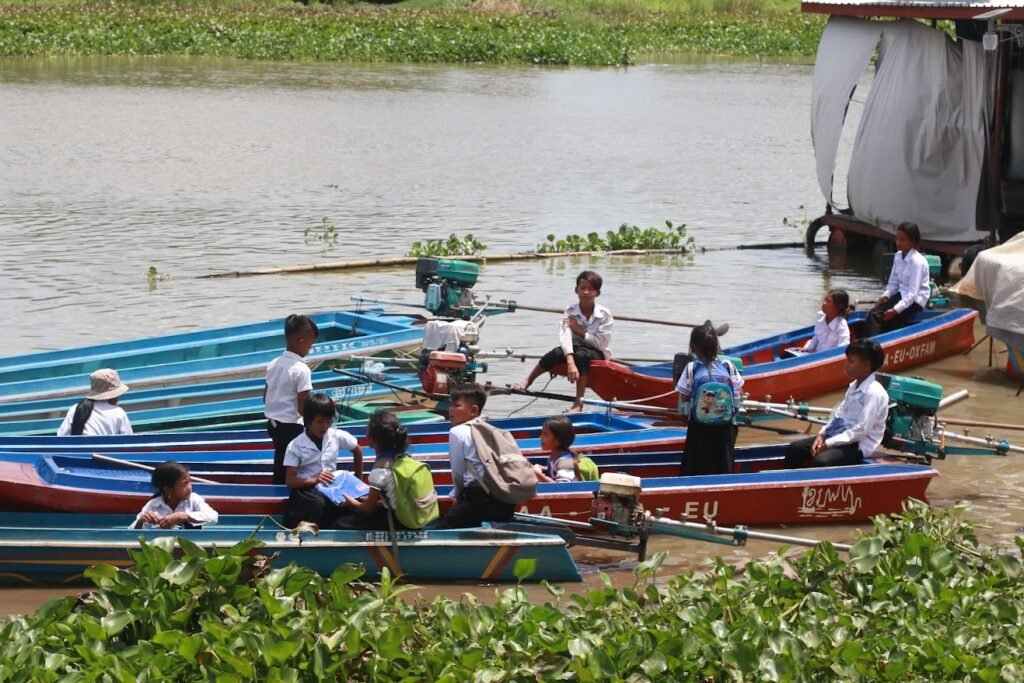
Sreyneat, a 13-year-old girl in Cambodia’s Tonlé Sap for example, faced pressures unsuited to an adolescent. Every morning before class, she spent about two hours selling breakfast snacks to support her household. Sometimes she would arrive late to class, while her grandmother struggled to pay for books and other materials.
Through an EAA Foundation-Action Education project, her situation was identified and she received a scholarship that helped her stay in school.
This shows that early intervention can change the trajectory of a child’s life. Teachers and others working closely with children are often well placed to notice changes in attendance or when a child begins to slide. Early-warning systems can also help identify patterns, but identifying a problem only makes a difference if it leads to intervention. What that intervention looks like will depend on the barriers a child faces.
A hungry child may have difficulty concentrating; a child without safe housing may not be able to study; a child whose parent has lost their livelihood may have to work; a displaced child may have no school nearby; a child caring for a sick parent may be absent for days at a time. Clearly, many barriers extend beyond the classroom.
Education systems alone cannot address the housing insecurity faced by families experiencing displacement. Education authorities also cannot solve hunger, poor health or child protection problems on their own and teachers cannot replace lost income when a parent becomes ill or can no longer work.
Keeping children in education can therefore require services from a range of other sectors, including social, child protection, health, nutrition, and housing. This matters because poverty rarely affects a singular part of a child’s life. UNICEF estimates that 417 million children in low- and middle-income countries experience severe deprivation in two or more essential areas, including education, health, housing, nutrition, sanitation and water. The right to education is truly realized when excluded and/or children at-risk of dropout are identified, supported, and empowered to remain in education, learn, and thrive.
From warning signs to action
Poverty should be recognized not only as a barrier to education, but as a force that can gradually push children out as well. Loss of income, rising prices, poor health, insecure housing or responsibilities at home can interrupt a child’s education at any point. Attendance data can help identify early signs.
Teachers can, too. Community workers have a role. Parents are essential. But merely identifying the troubled child is not enough. On this International Day for the Eradication of Poverty, Education Above All Foundation calls on governments, education systems and their partners to act on both sides of education exclusion – continue finding children who are already out of school and supporting them to enter or return, while identifying and supporting children at risk of leaving. This means addressing poverty and the pressures it creates as a critical component of preventing exclusion.
This also means investing in systems that can detect early signs of disengagement and connect children and families with the right support before a temporary setback becomes permanent exclusion.
It further means treating scholarships, school materials, catch-up classes, social protection, transport and other targeted interventions not as separate initiatives, but as part of a broader effort to keep children learning.
Getting into school is just the beginning. Every child should have the opportunity to stay, learn, and progress, regardless of the circumstances into which they were born or the setbacks their family may face.
Disclaimer: The opinions and views expressed in this article/column are those of the author(s) and do not necessarily reflect the views or positions of South Asian Herald.