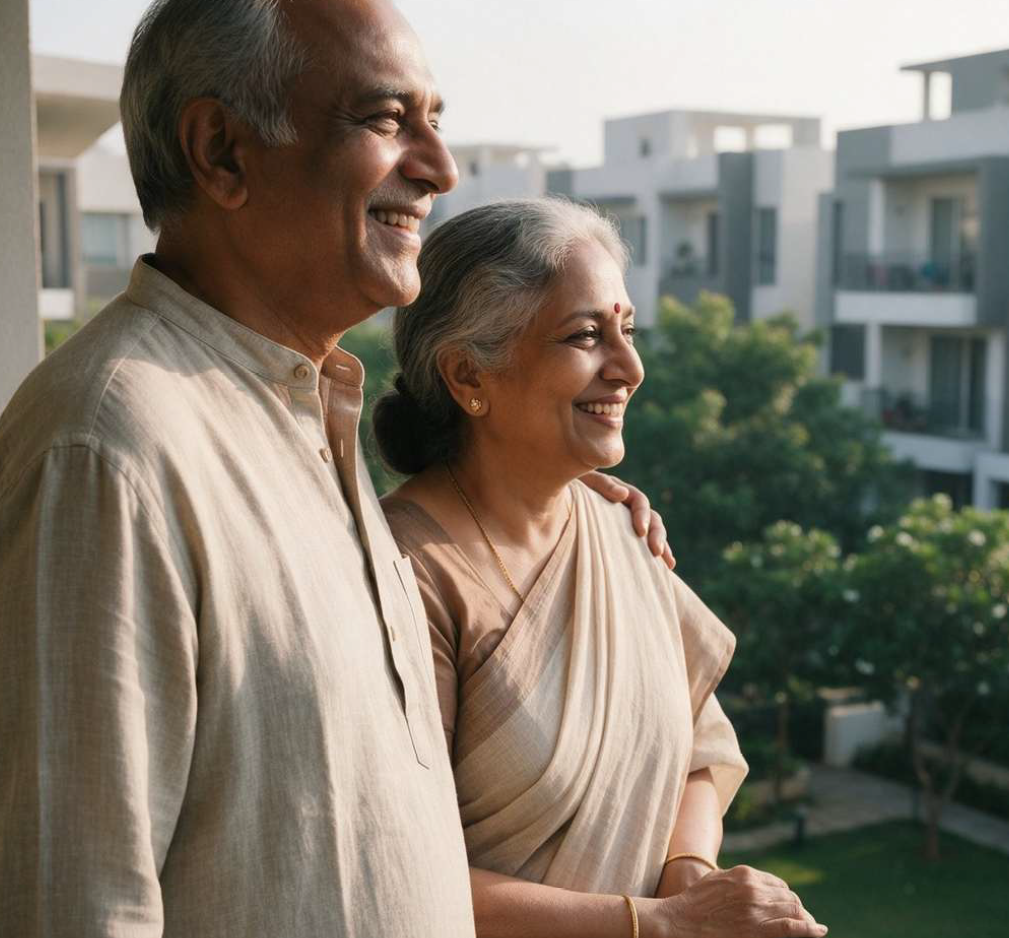
For millions of Indians living abroad, retirement planning increasingly involves a difficult question: how can they build lives overseas without leaving ageing parents in India to navigate healthcare, emergencies and everyday living on their own? India’s emerging senior living industry is beginning to offer a potential answer, with developers looking beyond major metropolitan centers to smaller cities, coastal destinations and spiritual hubs that promise a combination of affordability, medical access and community.
The shift could also influence where members of the Indian diaspora eventually choose to retire. Rather than returning to expensive metropolitan housing markets, overseas Indians may find more options in cities such as Coimbatore, Mysuru, Kochi and Vadodara, or in destinations including Haridwar, Varanasi, Ayodhya and Tirupati, where organized retirement communities could bring together accommodation, healthcare, wellness and social engagement.
India’s senior housing market is estimated at $4.31 billion in 2026 and is projected to reach $11.43 billion by 2031, according to Square Yards’ report, Expanding Horizons: The Next Growth Markets for Senior Living in India. The report identifies 15 cities with potential to shape the sector’s next phase, as an ageing population, migration and changing household structures increase demand for housing designed around older people’s needs.
For diaspora families, the opportunity extends beyond real estate. It concerns whether India can build a reliable system of residential care for parents whose children may live thousands of miles away, while also creating retirement communities that appeal to returning non-resident Indians (NRIs) seeking familiar cultural surroundings and a more manageable cost of living.
Advertisement
The distance between parents and children
The demographic shift is intensifying the challenge. India’s population aged 60 and above is projected to rise from 143 million in 2021 to approximately 230 million by 2036 and 347 million by 2050, according to figures cited in the report. Longer life expectancy and declining fertility are coinciding with the migration of younger Indians for employment, education and family opportunities abroad.
For families settled in the United States, Canada, the United Kingdom, Australia and elsewhere, distance can turn routine decisions about medical appointments, household assistance and emergency care into complicated logistical problems. Parents may prefer to remain in India, close to familiar neighborhoods, friends, language and cultural traditions, while their children may be unable to return at short notice when care needs change.
Organized senior living communities could help bridge that gap by providing professionally managed accommodation, access to healthcare, emergency response systems and opportunities for social interaction. For overseas children, the attraction would be the prospect of more dependable local support; for older residents, it would be the ability to retain independence without relying entirely on family members.
But the model will work only if the promise of care is credible. Families living abroad will need to distinguish between developments that offer age-friendly apartments and those equipped to provide consistent support, particularly as residents become less mobile or require more intensive medical assistance.
“India is observing the emergence of a multi-billion-dollar asset class driven by a generation of seniors, seeking not only assistance but also autonomy, specialized wellness and a high quality of life,” said Tanuj Shori, founder and chief executive of Square Yards.
The long-term benchmark, he said, would be the ability to integrate reliable medical access with residential environments that protect dignity, accessibility and social connectivity.
Beyond metros: where diaspora demand could go
Square Yards’ assessment suggests that established markets such as Bengaluru, Hyderabad, Pune and Chennai will remain important because of their healthcare infrastructure, established senior housing supply and access to urban services. However, rising property prices and congestion are encouraging developers to consider smaller cities where land, housing and everyday living may be more affordable.
Coimbatore offers a combination of climate, healthcare access and relatively affordable housing, while Mysuru provides a quieter urban environment within reach of Bengaluru. Kochi has a substantial NRI-linked market, airport connectivity and an established hospital ecosystem, making it a potential destination for overseas Indians seeking to remain connected to Kerala. Vadodara and Nashik could appeal to families looking for regional centers with urban amenities at lower costs than larger metros.
These locations may prove particularly relevant to NRIs considering a return to India after retirement, when proximity to relatives, healthcare access and the cost of maintaining a household can matter more than access to employment centers.
Spiritual destinations offer a different proposition. Haridwar, Varanasi, Ayodhya and Tirupati could attract older Indians who want retirement to incorporate pilgrimage, religious practice and community life. For some diaspora retirees, such destinations may offer a stronger cultural connection than conventional gated housing developments.
Yet the appeal of a pilgrimage center should not be confused with readiness for permanent retirement. Specialist hospitals, dependable emergency transport, trained caregivers and year-round residential services will matter more to older residents than visitor infrastructure alone. The report identifies these cities as potential growth markets, not as proof that all the requirements for senior living are already in place.
A new test for developers
The expansion of the sector is attracting major property groups and institutional capital. Square Yards cites DLF’s ₹2,000-crore Gurugram project, Columbia Pacific’s planned ₹3,000-crore investment across 13 projects in six cities, and a ₹2,000-crore senior living platform established by Primus Senior Living and HDFC Capital among the developments announced in 2026.
The investment pipeline suggests that organized senior living is becoming a more established real estate category. But for diaspora families, the decisive question will not be how many projects developers launch; it will be whether operators can provide consistent care over the long term.
Medical support, physiotherapy, accessible layouts, emergency response systems, in-apartment panic buttons and community spaces are among the features highlighted in the Square Yards report. Wellness services, including yoga, meditation and preventive healthcare, could further differentiate projects, provided they complement rather than replace professional medical treatment.
“Senior living is increasingly about value, not just location,” said Sunita Mishra, vice president of research and insights at Square Yards, adding that older homebuyers may be willing to move to smaller centers for wellness-oriented communities, better care and a lifestyle that fits their budgets.
For NRIs, value must also encompass transparency and accountability. Before committing funds, families will need clarity on monthly maintenance and care charges, the scope of medical services, emergency arrangements, access to specialist hospitals, staff qualifications and what happens if a resident’s needs exceed the facility’s capabilities. The availability of a property management team is not, by itself, a guarantee of quality care.
Affordability could remain a major obstacle. India’s organized senior living market is still relatively underdeveloped compared with mature markets, while limited pension and insurance coverage, gaps in geriatric healthcare and the recurring cost of professional assistance could restrict the number of households able to use such services.
The return-to-India question
The emerging market could reshape retirement decisions across the diaspora, but its potential goes beyond attracting NRI investment into residential property. It offers an opportunity to develop a more structured response to the realities of ageing in families divided across countries.
For some overseas Indians, professionally managed communities may allow parents to remain in India without depending exclusively on relatives or domestic help. For others approaching retirement, they could make returning to India a more practical choice by combining independent living with healthcare and a built-in social network.
The demographic opportunity is substantial, but the sector’s credibility will depend on whether it can deliver more than attractive buildings and wellness amenities. Families separated by continents need dependable care arrangements, transparent costs and confidence that support will remain available as their parents grow older.
India’s projected $11.43-billion senior housing market by 2031 could therefore become an important part of the diaspora’s retirement equation. Its real test will be whether it can turn the anxiety of caring from afar into a workable arrangement that preserves older people’s independence while giving families greater confidence in their parents’ everyday lives.