India’s revised tax treaty with Mauritius has introduced an explicit test that could make it harder for investors to claim treaty benefits through arrangements designed principally to secure tax advantages, strengthening the tax authorities’ ability to examine the commercial purpose and substance of cross-border investment structures.
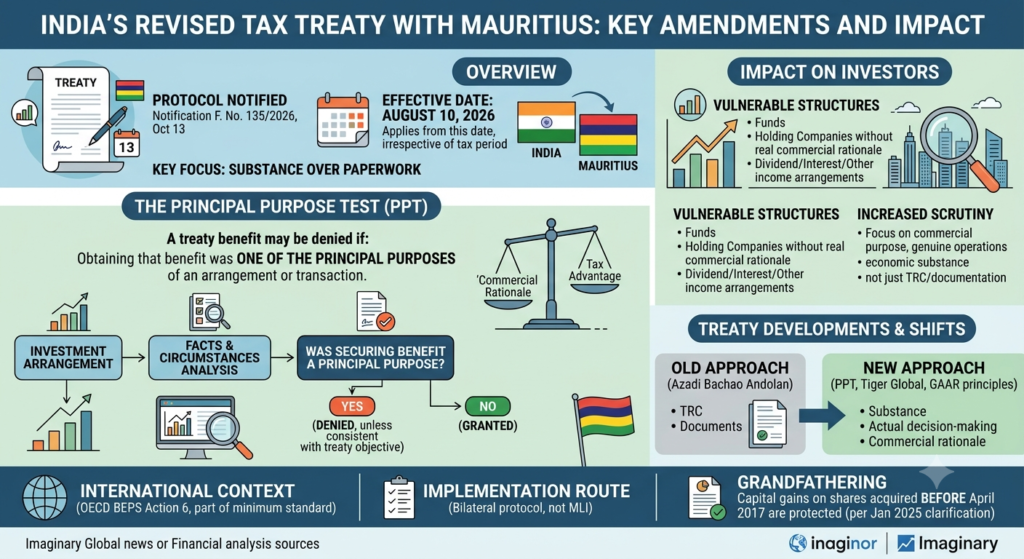
The Central Board of Direct Taxes (CBDT), through Notification F. No. 135/2026 dated October 13, has formally notified the protocol amending the India-Mauritius Double Taxation Avoidance Agreement (DTAA). The protocol entered into force on August 10, 2026, and its provisions apply from that date, irrespective of when the relevant taxes are levied or the taxable years to which they relate.
At the center of the amendment is the Principal Purpose Test (PPT), under which a benefit under the treaty may be denied if, after considering all relevant facts and circumstances, it is reasonable to conclude that obtaining that benefit was one of the principal purposes of an arrangement or transaction. The treaty retains an important qualification: the benefit should not be denied if granting it would be consistent with the object and purpose of the relevant treaty provisions.
The change is particularly relevant to investment funds, holding companies, multinational groups and investors using Mauritius as a base for investments into India. Although the amendment does not automatically disqualify Mauritius-based structures, it places greater emphasis on the reasons for establishing them, their commercial rationale and the circumstances in which treaty relief is claimed.
Advertisement
Maneesh Bawa, partner at Nangia Global, said the protocol should be understood as a shift towards examining the substance of investment arrangements rather than as a disruption to genuine investors.
“The pressure points are dividends, interest and other income arising now, and structures without real commercial rationale in Mauritius,” Bawa said, adding that funds and holding companies should document their governance, decision-making and commercial purpose. He also called for clearer CBDT guidance on how the PPT would be applied.
The immediate significance lies in the fact that formal compliance with treaty requirements may no longer, by itself, settle the question of entitlement to tax benefits. Investors will increasingly need to demonstrate that their arrangements have a defensible commercial rationale, even where the entities involved satisfy applicable residence and documentation requirements.
Vishwas Panjiar, managing partner at SVAS Business Advisors LLP, said the amendment reflected the evolution of India’s approach to treaty entitlement, from an emphasis on tax residence and documentation towards a more comprehensive examination of the substance and purpose of transactions.
The Supreme Court’s decision in Azadi Bachao Andolan had given considerable weight to the Tax Residency Certificate (TRC) framework in the context of the India-Mauritius treaty. However, Panjiar said, subsequent developments involving domestic General Anti-Avoidance Rules (GAAR), judicial anti-avoidance principles and treaty amendments had progressively expanded the scope for examining whether arrangements were intended to secure treaty benefits improperly.
He also pointed to the Supreme Court’s January 2026 decision in Tiger Global as a significant development reinforcing the principle that a TRC and supporting documentation do not, by themselves, shield an arrangement from scrutiny where the facts raise questions of tax avoidance.
“The existence of a treaty entitlement cannot be assessed solely by looking at the paperwork,” Panjiar said, arguing that commercial rationale, actual decision-making and the circumstances surrounding an investment structure would need to be considered alongside formal residence and compliance requirements.
The distinction matters because a tax-efficient investment structure is not necessarily an abusive one. The new test requires consideration of all relevant facts and circumstances and preserves the possibility of granting benefits where doing so is consistent with the purpose of the treaty provisions concerned.
An internationally agreed standard, implemented bilaterally
The amendment also replaces the treaty’s preamble to make explicit that the agreement is intended to eliminate double taxation without creating opportunities for non-taxation or reduced taxation through tax evasion or avoidance. It specifically identifies treaty-shopping arrangements designed to obtain relief indirectly for residents of third jurisdictions.
Panjiar said the PPT was not a new anti-avoidance concept devised specifically for India and Mauritius, but part of the minimum standard developed under the OECD/G20 Base Erosion and Profit Shifting (BEPS) project, particularly Action 6, agreed in 2015 to address treaty abuse.
The route through which the amendment was implemented is also significant. India had listed Mauritius under the Multilateral Instrument (MLI), but Mauritius had not listed India, Panjiar said. Consequently, the treaty could not be modified through the MLI mechanism, requiring the two countries to negotiate a bilateral protocol.
The amendment therefore represents the implementation of an internationally agreed standard through a separate bilateral process rather than the announcement of an entirely new anti-avoidance policy.
For multinational groups and foreign investors, however, the practical implications extend beyond the wording of the treaty. Structures established primarily to access favorable tax treatment may face greater scrutiny, while businesses with substantive operations and demonstrable commercial objectives will need to ensure that their documentation accurately reflects how those arrangements function in practice.
Rajat Mohan, managing partner at AMRG Global, said the amendment had implications for US investors and Indian companies using Mauritius-based investment structures.
“The explicit focus on treaty shopping reinforces the importance of genuine commercial rationale, economic substance and robust documentation,” Mohan said, adding that merely meeting formal treaty conditions might no longer be sufficient.
He told US investors, Indian businesses and multinational groups should reassess their Mauritius-based structures and evaluate potential treaty exposure, particularly in relation to cross-border investments and exit transactions.
Grandfathering and the treatment of existing investments
The transition also raises questions about the treatment of existing investments and income arising after the protocol’s entry into force.
Bawa said capital gains on shares acquired before April 2017 remained grandfathered, citing a CBDT clarification issued in January 2025. He distinguished these investments from dividends, interest and other income arising under current arrangements, where the commercial rationale and substance of the structure could become more important in determining treaty eligibility.
That distinction is important for investors assessing whether the revised framework changes the tax treatment of legacy holdings or principally affects the availability of benefits on income arising from ongoing investment arrangements. Investors should examine the applicable treaty provisions, the nature of the income and the relevant acquisition and transaction dates rather than assume that every existing Mauritius-based investment will be treated identically.
The notification itself states that the protocol’s provisions take effect from August 10, 2026, without regard to the date on which taxes are levied or the taxable years to which they relate. The precise application of the PPT to individual arrangements will depend on the facts and relevant legal provisions.
Amit Kumar Maheshwari, managing partner at AKM Global, also highlighted the CBDT notification and the provision allowing treaty benefits to be denied where securing them was one of the principal purposes of an arrangement, subject to the treaty’s object-and-purpose qualification.
The challenge for tax administrators will be to distinguish arrangements that exploit treaty provisions from legitimate investment structures that use Mauritius for substantive commercial, financial or operational reasons. For investors, the challenge will be to demonstrate that distinction through credible evidence rather than rely exclusively on certificates and formal corporate structures.
Clear administrative guidance on how the PPT will be interpreted could help reduce uncertainty, particularly for funds and multinational businesses making long-term investment decisions. Without predictable implementation, the new test could complicate tax planning even for arrangements that have genuine commercial objectives.
The broader direction, nevertheless, is clear: access to treaty benefits will increasingly depend not just on where an investor is resident, but also on why an investment structure exists and whether the claimed benefit is consistent with the treaty’s purpose.