Join WhatsApp Channel

“A boy sits alone by a riverbank, grief still wrapped tightly around him, mourning the death of his mother. A bird lands close by and it does not fly away. Somewhere in the stillness that follows, something in him begins, quietly, to change. Perhaps this is where the deeper story of Neem Karoli Baba truly begins, in a moment that may well have unfolded in the early life of the child Lakshmi Narayan Sharma, long before the world came to know him as a spiritual figure of great depth.”
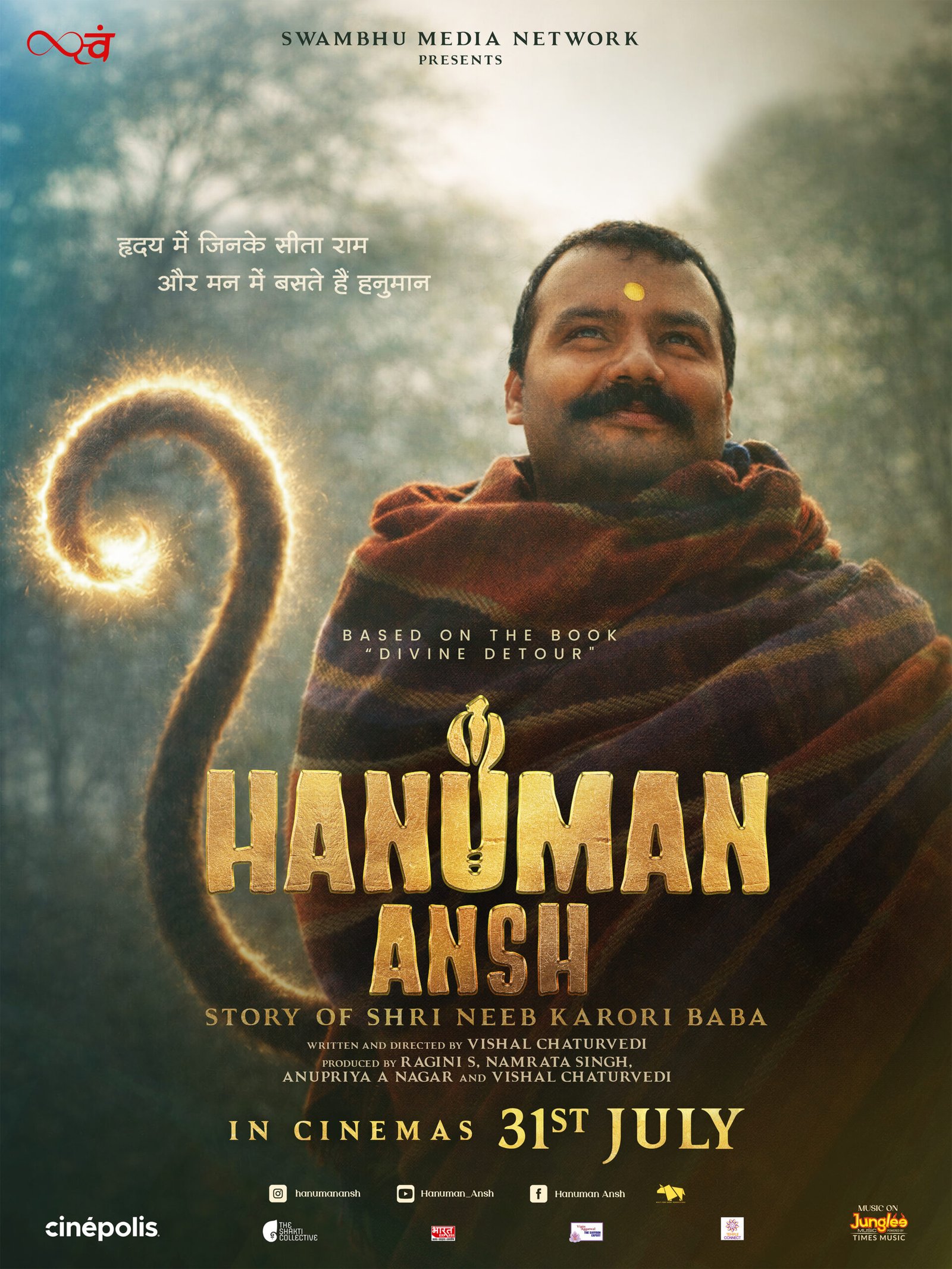
Most people walked into “Hanuman Ansh” expecting a devotional film about Neem Karoli Baba, and that is exactly what it is. Its reverence is sincere, woven into nearly every frame. But within that devotional frame sits something more, ideas that spiritual seekers usually spend years, and several teachers, trying to piece together: the place of nature in inner growth, the subtle dangers of misunderstanding psychic powers, and the undeniable and uncomfortable link between suffering and awakening.
Religion and spirituality are often treated as separate tracks. Religion provides the structure, the rituals and the shared language of devotion passed down through generations. Spirituality is the inner work that structure quietly points toward, understanding one’s own mind and expanding one’s sense of self beyond it. The two were never meant to be competitors. It is precisely the devotional depth of “Hanuman Ansh” that allows its spiritual content to land with the weight it does.
Nature as a Living Teacher
Indian spiritual tradition has never treated nature as scenery. Rivers were named as goddesses; Ganga is addressed as “Ganga Ma,” a mother in every sense the word implies. Thunder was personified as Indra, the sun revered daily as Surya, a way of training the mind to see the sacred as present and immediate, rather than distant.
The scenes where Neem Karoli Baba speaks with birds, animals, and trees are not flourishes for visual effect. They point to something real in contemplative practice, that oneness with creation is not a poetic idea admired from a distance, but a state available to anyone willing to quiet the noise within. The film does not explain this outright. It simply shows a man who has stopped seeing himself as separate from the world around him, and leaves the audience to sit with what that might mean.
Siddhis: The Gifts That Become Traps
Few spiritual ideas are as widely misunderstood as siddhis, the psychic abilities that can emerge from sustained practice. Popular culture treats these as the point of spirituality, the superpowers waiting at the end of the journey. Serious traditions treat them as the opposite: a byproduct, not a destination.
“Hanuman Ansh” shows some of these abilities directly, from Neem Karoli Baba’s capacity to sense what others feel, to his reported ability to move beyond locked doors. But the film does not stop at spectacle. It offers a warning any serious practitioner needs to hear early: meditation itself can give rise to experiences capable of leading a seeker away from meditation. The moment one begins chasing powers rather than clarity, the practice has already failed, even if the powers are real.
Feeding the Hungry as the Actual Practice
If there is one idea in “Hanuman Ansh” that deserves to travel far beyond the film itself, it is this: spirituality that does not ease someone else’s suffering remains incomplete. The scenes where Neem Karoli Baba feeds those who have nothing, are not charity moments inserted for effect. They are the film’s argument for what spiritual maturity looks like, once put into practice.
The film shows, beautifully, a true and significant measure of inner growth: how attentive a person becomes to the hunger, loneliness, and need of those around them. A seeker who has spent years in meditation, yet remains indifferent to the person suffering in front of them, has misunderstood the exercise. “Hanuman Ansh” returns to this idea again and again, until the message becomes unmissable without ever tipping into a sermon.
Suffering as the Uninvited Teacher
The film does not soften Neem Karoli Baba’s early life. The grief and disruption of his childhood are shown with enough weight that the audience understands they were not incidental to his spiritual development. They were, in many ways, the ground from which everything else eventually grew.
This connects to an idea that recurs across contemplative traditions, often called the dark night of the soul: a period of profound loss that tends to precede genuine spiritual transformation. It is not a comfortable idea, since it suggests growth of this depth cannot be manufactured through comfort alone. Karma, in this view, is not punishment handed down from above but the raw material circumstance provides, and what a person does with it determines whether it becomes suffering without meaning, or the foundation of something transformative.
Spiritual Courage and Quiet Mysteries
The film documents practices at the demanding end of the spiritual spectrum: meditation in flowing water, meditation while fully submerged, solitary retreats in caves far from comfort. Most viewers will never attempt any of this, but simply knowing it exists recalibrates expectation, suggesting the casual approach many bring to meditation is only a starting point.
The mahant’s scenes also touch on subjects usually confined to specialist texts, the chakra system, kundalini awakening, the opening of the crown chakra. The film does not attempt a full explanation, but it introduces the vocabulary and the seriousness with which these processes are traditionally treated, valuable for a viewer meeting the terms in a credible context rather than a marketing one.
Two Gems Worth Remembering
When the young Neem Karoli Baba asks how Ram will look once realization is achieved, the mahant answers without hesitation: he will look as you want him to look. The line dismantles the idea that the divine has a fixed, external form waiting to be discovered. Realization, it suggests, is deeply personal, shaped by the seeker rather than imposed from outside.
Later, a disciple sees Neem Karoli Baba surrounded by snakes that pose no threat to him at all. His explanation, offered simply: the eyes see whatever is in the heart. It is a compact statement of a demanding idea, that perception is never neutral, that what a person carries within colors what they see outside, and that purifying the heart is what finally allows reality to be seen as it is.
Why This Matters Beyond the Film
None of this makes “Hanuman Ansh” a substitute for serious study and practice. But it does something few films manage: alongside its miracles and devotion, it treats spirituality as a subject with real depth, an entry point into ideas historically confined to ashrams and lineages, taken forward by the same devotion that has always carried them.
Normalization, in this sense, is not about replacing faith with inquiry. It is about letting the two travels together, carried by a story with enough craft that people stay in their seats, extending what devotion has always done, at a scale a temple or a single teacher rarely reaches.
Disclaimer: The opinions and views expressed in this article/column are those of the author(s) and do not necessarily reflect the views or positions of South Asian Herald.
Related posts:
 India and Core Group Nations Celebrate Second World Meditation Day at United Nations
 World Meditation Day: United Nations Highlights Meditation’s Role in Mental Well-Being and Global Peace
 NJ’s Burlington Township Proclaims “Hanuman Utsav Week,” Honoring SGS Karya Siddhi Hanuman Mandir Consecration
 Don’t Be Shy! Sees Alia Bhatt on the Other Side of the Camera as She Launches Four New Faces