They never came home. Twenty-five years later, that remains the simplest and most devastating truth of September 11, 2001.
They left for work on an ordinary Tuesday morning — kissing children goodbye, catching trains, carrying briefcases, pouring coffee, making plans for dinner — and disappeared into a day that would divide their families’ lives forever into two unbearable parts: everything before, and everything after.
America remembers the burning towers, the collapsing skyline, the smoke and terror. Their families remember something smaller and infinitely more personal: a last telephone call, an unanswered message, a familiar voice, a shirt left hanging in a closet, a chair that remained empty.
A quarter-century has passed. The Twin Towers are gone, a new Lower Manhattan has risen, and the children who were too young to understand what happened that morning have grown into adults. Some have families of their own.
Advertisement
But the dead have remained the same age.
Among the 2,977 victims of the attacks were an estimated 50 to 60 or more people of South Asian origin — men and women with roots in India, Pakistan, Bangladesh, Sri Lanka and the wider diaspora. The precise number remains uncertain because official records tracked nationality rather than ethnicity, while many victims were American citizens or permanent residents whose ancestral origins disappeared into broader categories.
Yet behind those uncertain numbers were lives unmistakably shaped by the immigrant experience: people who had crossed oceans, earned degrees, worked long hours and built families around a promise that tomorrow would be better than yesterday.
They were software engineers and financial analysts, restaurant workers and technology specialists; Hindus and Muslims, husbands and wives, fathers and mothers, sons and daughters.
They had not come to the Twin Towers to make history.
They had come to work.
And 25 years later, September 11 is no longer simply an event remembered by those who lived through it. It is becoming an inheritance passed to those who did not.
The Morning Nobody Knew Would Be the Last
That may be the deepest cruelty of September 11: nobody knew the last morning had arrived.
There was no farewell worthy of history, no warning that ordinary conversations would become sacred simply because they were the last.
There were only ordinary moments.
Alok Agarwal, 36, had come to the United States from New Delhi in 1997 and was working as a computer technician at Cantor Fitzgerald in the North Tower. Like countless immigrants, he was trying to make the difficult arithmetic of distance and ambition work: endure separation from home, provide for his family and build a future.
His wife, Shafali, and their young son, Ankush, were at the center of that future.
About three weeks before the attacks, Alok and Shafali spent a quiet day together. She was preparing to travel to India to care for their son, who had health problems. Alok told her he felt lonely when she was away and hoped that one day she would no longer have to make those journeys.
It was an ordinary conversation between a husband and wife — the sort normally lost in the thousands of words that make up a marriage because both people assume there will always be another day.
For Alok and Shafali, there was not.
His death left the family confronting not only grief but the uncertainty familiar to many immigrant households. Ankush would grow up through birthdays, school, graduation and adulthood with his father’s absence woven into every milestone.
That is the private calendar of September 11 — not the anniversary observed by a nation, but the moments families continue to measure alone.
A Garden He Never Returned To
Shabbir Ahmed came to the United States from Bangladesh in 1981.
For about 11 years, he worked as a waiter at Windows on the World, the restaurant high atop the North Tower. The job offered something many immigrant parents seek: stability and the possibility that their children might travel farther than they did.
His oldest daughter attended Brooklyn College.
Ahmed, however, was more than the job he held above Manhattan. He liked fishing and tended a backyard garden, growing chilies, squash, eggplant and tomatoes and sharing the harvest with his family.
Then, on September 11, he went to work.
The sentence is almost unbearable in its ordinariness.
Like millions of Americans that morning, he may have said goodbye, made plans for later or assumed someone would be waiting when he returned.
He never returned to his garden. He never saw another harvest or watched his children grow older.
No member of the Windows on the World staff or its guests trapped there that morning survived.
Twenty-five years later, the World Trade Center has become a symbol of catastrophe and resilience.
But Shabbir Ahmed was not a symbol. He was a man who planted vegetables in his backyard and wanted his children to have a better life.
For the people who loved him, that was the world.
A Son Born Into His Father’s Absence
Mohammad Salahuddin Chowdhury’s story carries another kind of cruelty — the cruelty of time arriving at precisely the wrong moment.
A Bangladeshi American and banquet server at Windows on the World, Chowdhury held a master’s degree in applied physics from Dhaka University and had continued building a life after coming to the United States.
He was educated and ambitious. He was supporting a family.
His wife was pregnant, and they already had a young daughter.
Then came September 11.
Two days later, a son was born.
The child entered the world after his father had left it.
The tragedy is almost too large for language: a newborn beginning life with a father he would know only through photographs and stories, a mother experiencing birth while carrying unimaginable grief, and a young daughter gaining a brother while losing her father.
For that family, September 11 did not end when the smoke cleared. It entered childhood and followed every question the boy might one day ask about the father whose face he knew but whose voice he had never heard.
Today, that newborn is an adult.
And therein lies the passage of 25 years: the living have grown older, while the dead remain forever suspended in the lives they were living that morning.
She Was Called Minny
Swarna Chalasani was 33. Her family called her “Minny.” Her name meant “gold.”
A vice president in investment research at Fiduciary Trust International, she lived a life that extended well beyond finance.
She travelled, rafted Colorado’s whitewater and backpacked through Thailand. She learned Japanese and Spanish and filled her home with books, paintings, plants and scented candles. She also volunteered with Sakhi, helping victims of domestic abuse, and taught English.
Her family remembered her laughter.
That is one of grief’s cruelest transformations: the smallest details become the most precious. A laugh, a favorite phrase, a familiar scent or the way someone arranged a room can become more enduring than the grandest monument.
Swarna was last seen on the 94th floor of the South Tower.
What remained afterward was the strange archaeology of grief — belongings that outlive their owners and rooms that suddenly become repositories of absence.
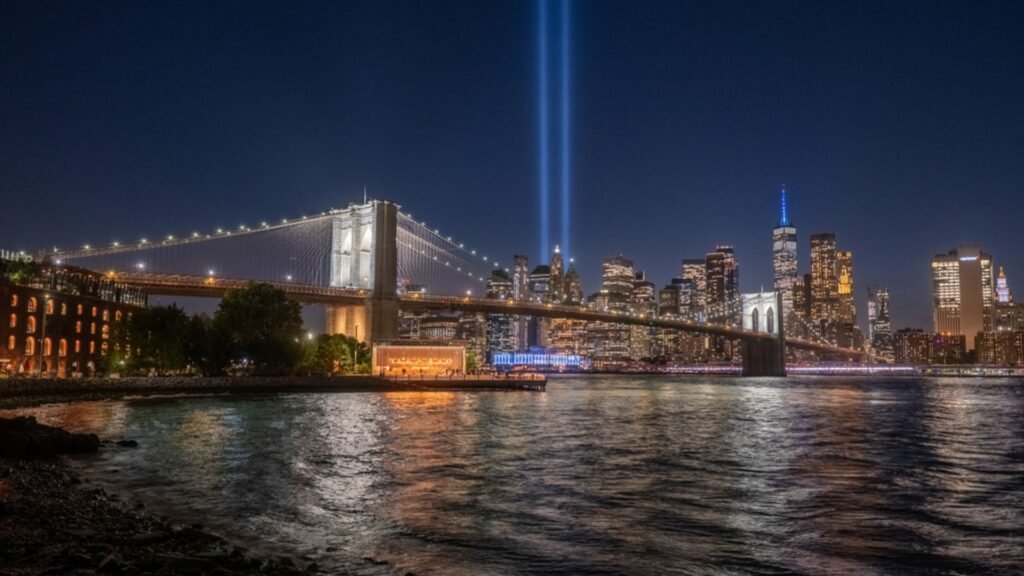
Lower Manhattan has a new skyline.
There is no replacement for a human voice.
The Young Man Who Ran Toward the Fire
Mohammad Salman Hamdani was 23, a Pakistani American, an NYPD police cadet, a certified emergency medical technician and a laboratory assistant at Rockefeller University. He had studied biochemistry and hoped to attend medical school.
Then the planes struck.
As thousands fled Lower Manhattan, Hamdani appears to have gone toward the towers to help.
Months later, his remains were found near the North Tower along with his medical bag.
But even death did not immediately bring his family peace.
In the atmosphere of fear after September 11, Hamdani’s disappearance became entangled with suspicion. He was a young Muslim man of Pakistani origin, and in a country searching desperately for answers, fear often moved faster than facts.
His family had lost a son. Before they knew how he had died, they also had to endure questions about who he was.
The truth came later. Hamdani was recognized as a hero, received a funeral with NYPD honors, and had a Queens intersection renamed “Salman Hamdani Way.”
His story remains one of the most powerful contradictions of post-9/11 America.
While a Pakistani American Muslim lay beneath the rubble after apparently trying to save lives, millions of people who looked like him would spend the years that followed confronting suspicion because of their names, faith or appearance.
Hamdani’s final act answered the question of belonging more powerfully than any speech.
He ran toward the fire.
The Second Wound
For South Asian America, the attacks were followed by another trauma.
Muslims, Sikhs and other South Asians became targets of suspicion, hatred and violence. People were attacked because of turbans, beards, names and skin color. Communities that had spent decades building lives in the United States found themselves forced to defend their belonging.
The contradiction was brutal: South Asian families were mourning loved ones killed in America’s deadliest terrorist attack while members of those same communities were being treated as outsiders.
The backlash helped create a more politically conscious South Asian America. Advocacy organizations expanded efforts against hate crimes, racial profiling and discrimination, insisting that South Asian and Muslim American experiences were not peripheral to September 11.
They were part of its central history.
That legacy continues to shape arguments over immigration, civil liberties, identity and belonging.
When Memory Becomes Inheritance
Twenty-five years is more than an anniversary. It is a generational threshold.
The adults who watched the towers fall are now grandparents. Children who lost parents that morning have reached middle age. Millions of Americans have been born into a country whose airports, security systems, foreign policy and political anxieties were shaped by an event they know only through images and stories.
For them, September 11 is history.
For families of the dead, it remains biography.
And that is the challenge of the next quarter-century.
As eyewitnesses disappear and personal memories fade, September 11 risks becoming what all distant tragedies eventually become: a date, a memorial, a casualty figure and a chapter in a history book.
The human beings can disappear first.
That is why these stories matter.
Alok Agarwal crossed an ocean to build a future for his family. Shabbir Ahmed tended a garden and hoped his children would climb higher than he had. Mohammad Salahuddin Chowdhury never met the son born after his death. Swarna Chalasani travelled the world and devoted part of her life to helping others. Salman Hamdani appears to have seen catastrophe unfolding and chosen to run toward it.
These were not abstract casualties.
They were unfinished lives.
The Responsibility of the Next 25 Years
The task now is not simply to remember how they died, but to preserve how they lived.
Because memory changes as generations pass. Children inherit photographs. Grandchildren inherit names. Eventually, a life can be compressed into a sentence: He worked in New York. She was there that day.
The details disappear first — the laughter, the garden, the plans, the unfinished conversations. Then history is left with a number.
2,977.
But no family ever lost a number. They lost the person who was supposed to come home.
Twenty-five years later, the towers are gone. The skyline has changed. The children have grown up.
But Alok Agarwal is still 36. Swarna Chalasani is still 33. Salman Hamdani is still 23. The dead do not grow older. The rest of the world does.
And perhaps that is the hardest measure of time since September 11: every year carries the living farther away from that morning, while those who died remain forever inside it.
They left for work. Someone expected them home. They never came back.