Join WhatsApp Channel


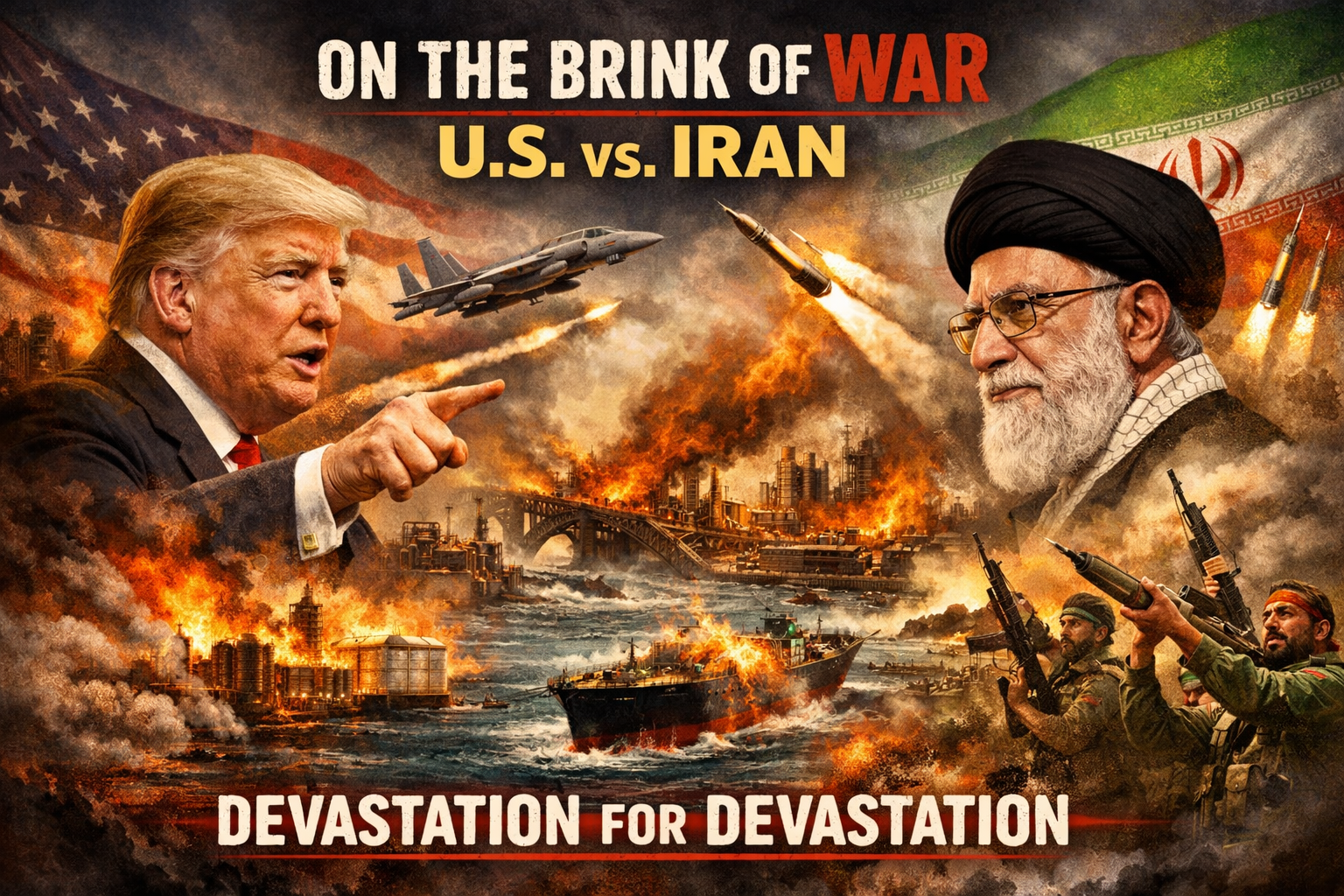
Six weeks into the war between the United States and Iran, the conflict has arrived at its most dangerous inflection point. What began as a rapid military campaign has hardened into a confrontation defined by raw ultimatums, apocalyptic rhetoric, and the very real possibility of a war that neither side — nor the world watching — can contain.
At the center of the storm is a warning delivered with the bluntness that has come to define this presidency. President Donald Trump, in a series of incendiary statements over the weekend, told Tehran in unambiguous terms: reopen the Strait of Hormuz, or face strikes that will make life in Iran unrecognizable. Power plants. Energy grids. Bridges. All explicitly named. All on the table. “You will be living in hell,” Trump warned, as oil markets shuddered and foreign ministries scrambled for their phones.
In an earlier statement, he had said he would send Iran back to the Stone Age, which half of Americans did not like as polling showed.
Iran’s answer came quickly and with equal ferocity.
Tehran’s Response: Devastation for Devastation
Senior Iranian officials did not blink. Within hours of Trump’s statements, Tehran issued what it described as a formal warning — not a diplomatic communiqué, but a declaration. Strikes on civilian infrastructure, Iran said, would trigger “devastating retaliation.” The response, officials made clear, would not be limited to American forces inside Iran. It would extend to U.S. military bases across the region, allied states that host American assets, and critical energy routes that keep the global economy functioning.
Iran’s leadership has framed this conflict from the outset through the language of al-muqawama — resistance — casting it not merely as a military standoff but as an existential struggle against American and Israeli power. The closure of the Strait of Hormuz, through which roughly a fifth of the world’s oil flows, is Tehran’s most powerful lever. It is being wielded deliberately — part threat, part symbol, part economic weapon — to demonstrate that Iran can fracture the global order if it is pushed into a corner.
The message from Tehran is consistent and unambiguous: the United States can bomb Iranian military facilities, it can target weapons research sites, it can send special forces deep into Iranian territory to rescue downed airmen — but the moment it strikes civilian infrastructure, it crosses a line from which there is no return. Iran has promised to make that crossing catastrophic.
Escalation Already Underway
The threats are not being made in a vacuum. The conflict has already widened dramatically, and Iranian-linked forces have shown both the will and the capacity to strike far beyond their borders.
Iranian drones and missiles have hit energy infrastructure across the Gulf — in Kuwait, Bahrain, and the United Arab Emirates — igniting fires and injuring civilians. An Israeli-linked vessel was struck at Dubai’s Jebel Ali port. Missile attacks on Israeli cities, including Haifa, have killed civilians and left rescue workers digging through rubble for survivors. Iranian-backed militias have targeted American diplomatic and military assets across Iraq, signaling clearly that Tehran intends to fight this war across multiple theaters simultaneously.
Inside Iran, American strikes have already caused significant damage — not only to military facilities but to dual-use infrastructure, including universities linked to weapons research and nearby gas distribution networks. Civilian casualties are mounting. Humanitarian organizations report thousands dead across the region, with women and children accounting for a significant share of the toll.
The rescue of a downed American airman — a high-risk operation involving Delta Force, Navy SEAL Team Six, dozens of aircraft, and an elaborate deception campaign conducted deep inside Iranian territory — was hailed in Washington as a military triumph. Tehran called it an act of war, claiming to have downed additional American aircraft during the operation. The Pentagon has neither confirmed nor denied the claim. The episode illustrated, with brutal clarity, how deeply entangled the two militaries have already become — and how easily a single operation can generate the next flashpoint.
It is reminiscent of Hollywood films such as: Behind Enemy Lines (2001), Top Gun Maverick (2024), Tears of the Sun (2003), Land of bad (2024), Lone Survivor (2013) and Flight of the intruder (1991). Top Gun Maverick anchored by Tom Cruise deals specifically with Iran without naming it in a similar situation foreseen about 2026.
“Power Plant Day” and the Legal Alarm Bells
What has alarmed observers — including some of Trump’s own political allies — is not merely the scale of the threatened strikes, but the language surrounding them. Trump’s promise to turn a specific day into “Power Plant Day” and “Bridge Day” is not conventional military signaling. It is something closer to an announcement of collective punishment — a deliberate targeting of the systems that keep civilian populations alive.
Legal experts and United Nations officials have already raised the alarm. Targeting power grids and water systems, they warn, is not simply aggressive — under international humanitarian law, it may constitute a war crime. The UN has signaled concern that actions by multiple parties in this conflict, including the United States, may amount to serious violations of humanitarian norms.
Within Washington itself, dissent is growing louder. Lawmakers from both parties have warned that the rhetoric is reckless, that it endangers American military personnel already operating in a high-threat environment, and that it inflames rather than deters. Advocacy organizations have called on Congress to reassert its constitutional authority over war powers before the executive branch carries the country past a point of no return.
The warnings have not slowed the rhetoric.
Iran’s Ultimatum: Compensation or No Strait
Tehran has made its position on the Strait of Hormuz explicit. The waterway will not reopen, Iranian officials have said, until the United States agrees to pay compensation for the damage already inflicted by the war. It is a demand Washington has rejected without hesitation — and one that, in the current political climate in both capitals, has virtually no path to acceptance.
The impasse is total. Iran is using the strait as both a bargaining chip and a demonstration of strategic power. The United States is threatening to bomb its way to a solution. Neither side has offered a credible off-ramp, and the intermediaries working in the background — Oman, Egypt, backchannel European diplomats — are operating far behind the tempo of events on the ground.
A World Watching and Bracing
The international community has responded with a mixture of condemnation and creeping dread.
China has condemned threats to civilian infrastructure while quietly deepening its economic and diplomatic ties with Tehran, sensing in the crisis an opportunity to expand influence in a region where American credibility is eroding. Russia has aligned rhetorically with Iran, with Moscow warning that strikes on civilian infrastructure could constitute war crimes and hinting at expanded military-technical cooperation with Tehran. Gulf states — the UAE and Saudi Arabia among them — publicly call for restraint while privately bracing for a prolonged conflict that has already exposed the vulnerability of their own energy infrastructure to Iranian strikes.
Oil prices have surged past $110 per barrel. Supply chains are buckling. Countries like India, deeply dependent on Gulf energy imports, are quietly securing alternative supply lines while urging diplomatic restraint through every available channel.
No Endgame in Sight
Six weeks in, the war has produced no resolution — only an accelerating cycle of threat and counter-threat, strike and retaliation, ultimatum and defiance.
Trump has promised hell. Iran has promised to deliver it back, with interest. The Strait of Hormuz remains closed. The global economy is absorbing shocks it was not designed to withstand. And the diplomatic machinery that might, under different circumstances, find a path out is overwhelmed by the speed and ferocity of what is unfolding.
The question hovering over the conflict as it enters its seventh week is not whether another escalation is coming. It is whether, when it does, anyone will be in a position to stop it — or whether the world is watching, in real time, the opening of a war it cannot close.
Disclaimer: The opinions and views expressed in this article/column are those of the author(s) and do not necessarily reflect the views or positions of South Asian Herald.
Related posts:
 U.S. Launches Military Action in Iran as Indian American Lawmakers Question Legality of Strike
 A Region at War, A World on Edge: The Expanding Iran Conflict
 UN Chief António Guterres Urges De-Escalation After U.S., Israel Strikes on Iran, Warns of ‘Grave Threat’ to Global Peace
 South Asia Braces for Economic Shock as Israel-Iran Conflict Deepens