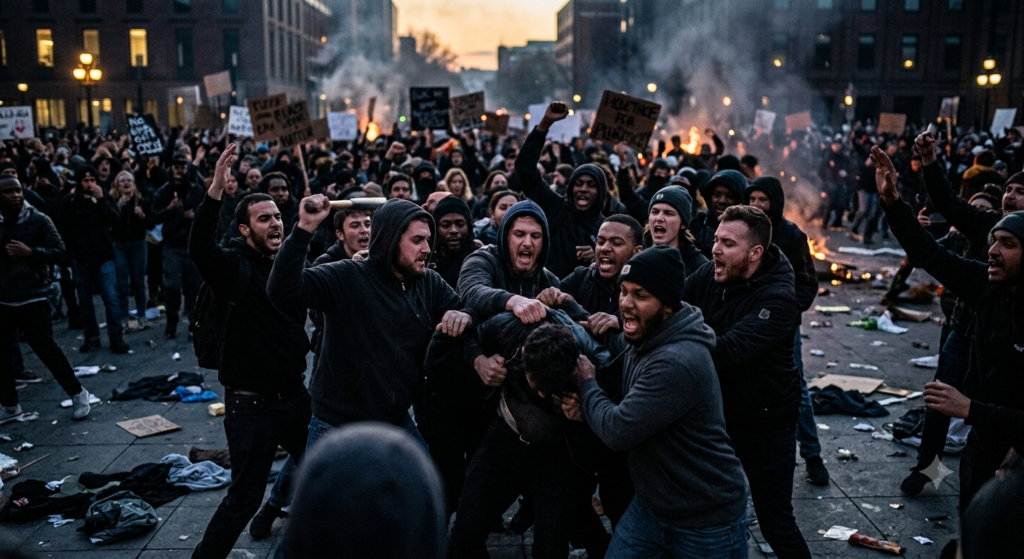
A dispute over water. A rumour whispered in a market. A perceived insult. These are small sparks. Yet they can ignite a fire that consumes a community. In the heat of a mob, ordinary people—neighbours, shopkeepers, students, workers—can do things they would never do alone. They are not born monsters. They are people whose moral brakes have been temporarily disabled by the psychology of the crowd. Understanding this is not about excusing violence. It is about preventing it. If we can see how reason is lost, we can learn how to bring it back.
The first mechanism is anonymity. When people merge into a large, excited group, they lose their sense of individual identity. The crowd becomes a cloak. Personal accountability feels distant. The inner voice that says “this is wrong” is drowned out by the collective roar. In societies where group harmony is deeply valued, this pull can be even stronger. People are taught to subordinate personal judgment to the community. In a mob, that instinct is hijacked. The crowd becomes the community. To dissent feels like betrayal. Anonymity is not just a mask; it is permission. The person who would never strike a neighbour alone finds a hand raised in a crowd and does not recognise it as his own.
The second mechanism is emotional contagion. Emotions spread through a crowd faster than any argument. Anger, fear, and indignation are highly infectious. A rumour becomes a fact. A suspicion becomes a certainty. A grievance becomes a call to action. Digital communication accelerates this process. Outrage can be built and circulated long before any verified truth emerges. A single moment of collective anger, amplified by many voices, creates a fever that no individual could sustain alone.
The crowd does not persuade; it infects. When feelings reach a boiling point, rational thought can begin to sound like an alien dialect. The mob has its own logic: urgency, loyalty, righteousness. Each participant believes they are defending something precious—their honour, their faith, their safety, their way of life. That belief is what makes the violence feel justified.
Advertisement
The third mechanism is the diffusion of responsibility. Inside a crowd, responsibility becomes diluted, and each person can tell themselves the blame is shared by all. If a hundred hands strike, no one hand believes it delivered the fatal blow. If a hundred voices shout, no one voice believes it started the violence. This is moral outsourcing. The crowd member tells himself that he is merely one of many, that his contribution is negligible, that someone else would have done it anyway. This is how the unthinkable becomes permissible. People who would never act alone participate and later convince themselves they were only bystanders. They sleep soundly, convinced they did nothing wrong.
There is also the seduction of certainty. Mobs offer simple answers to complex problems. Scarce resources, historical wounds, economic anxiety, political frustration—all are reduced to a single story: us against them. The crowd provides clarity. It tells you who is to blame. It offers action. For people who feel powerless in their daily lives, this is intoxicating. Participation can feel like agency. It can feel like belonging. It can even feel righteous. A crowd can appear to offer purpose and significance to those who feel overlooked. That is why reasonable citizens can be drawn in. They are not seeking chaos. They are seeking significance, justice, and a sense of control. The tragedy is that these very human needs are twisted into cruelty.
But the crowd is not invincible. The same social nature that makes us vulnerable to mob psychology also makes us capable of resisting it. The most powerful antidote is the active bystander. When one person steps out of the crowd—not with violence, but with presence—something shifts. The spell is interrupted. The illusion of unanimity breaks. One person who speaks another’s name, stands alongside them, or declines to join a chant can shatter the illusion of unanimity and remind others that they remain individuals. The crowd is not a single organism. It is a collection of people, each of whom might hesitate. If one person hesitates, others may hesitate too. If one person speaks, others may find their voices.
This is why bystander intervention matters. It is not about heroism. It is about training. People can learn to recognise the invisible barriers that stop them from acting. They can learn safe and effective ways to intervene—calling for help, creating a distraction, documenting, standing with the target, appealing to a shared identity. When bystander action becomes normal and expected, the calculus of the crowd changes. The mob is no longer an unstoppable force. It becomes a fragile gathering that can be dissolved by a few brave individuals.
The crowd is not the enemy of reason. It is reason’s most fragile environment. We are social creatures. We need belonging. We care what others think. We want to be on the right side of the group. These traits make us human. They also make us vulnerable. But vulnerability is not destiny.
Every act of courage within a crowd is a reminder that mobocracy is not an inevitable feature of human nature. Crowd psychology is a passing condition, and like any passing condition, it can be halted. In that interruption lies hope. A society that chooses the crowd of care over the crowd of cruelty is not a fantasy. It is a choice. And it begins with one person who refuses to disappear into the roar.
Disclaimer: The opinions and views expressed in this article/column are those of the author(s) and do not necessarily reflect the views or positions of South Asian Herald.