Ukraine’s war with Russia is not merely a territorial dispute between two neighboring countries. It is the culmination of more than a thousand years of contested history, imperial ambitions, national identity and the struggle of a people to determine their own destiny. Since Russia launched its full-scale invasion on February 24, 2022, Ukraine has endured a devastating conflict that has transformed Europe, disrupted the global economy and raised fundamental questions about sovereignty, international law and the limits of military power.
For Ukrainian families, the war has meant shattered homes, separated relatives, lost livelihoods, interrupted education and the constant fear of missile and drone attacks. Millions have been displaced, while soldiers on both sides face death, injury, psychological trauma and prolonged separation from their families. Power shortages, damaged infrastructure, rising living costs and economic uncertainty have become part of everyday existence.
Russia, despite its superior military resources, has failed to achieve its initial objective of capturing Kyiv and forcing Ukraine into submission. Ukraine’s resistance, supported by Western military assistance, intelligence, financial aid and diplomatic backing, has turned what Moscow expected to be a short campaign into a prolonged war of attrition. Yet Ukraine continues to face enormous military and economic pressures, while Russia remains determined to retain occupied territories and prevent its neighbor from moving decisively into the Western political and security orbit.
To understand this confrontation, one must go back more than a millennium.
Advertisement
From Kyivan Rus to Russian imperial expansion. The historical roots of Ukraine lie in Kyivan Rus, a medieval political and cultural center that flourished from the ninth century onwards, with Kyiv as its capital. It developed into an important eastern European power, maintaining commercial and religious connections with Scandinavia, Constantinople and other European territories.
In 988, Prince Volodymyr adopted Byzantine Christianity, establishing a religious and cultural inheritance that would influence Ukrainians, Russians and Belarusians. All three nations share elements of this medieval heritage, although their political identities evolved differently.
Kyivan Rus eventually fragmented through dynastic rivalries and regional divisions. The Mongol invasion of the thirteenth century devastated Kyiv and destroyed much of the old political order. Over subsequent centuries, Ukrainian territories came under the influence of Lithuania, Poland and other European powers.
The emergence of the Cossacks in the Dnieper region became particularly important in the development of Ukrainian political identity. Their traditions of military independence and collective self-government inspired resistance against foreign domination.
In 1648, Bohdan Khmelnytsky led a major uprising against Polish-Lithuanian rule. Seeking military assistance, he entered an agreement with the Russian tsar in 1654 at Pereiaslav. Moscow subsequently used this relationship to expand its authority over Ukrainian territories.
During the eighteenth century, the Russian Empire progressively dismantled Cossack autonomy. The Zaporozhian Sich, the principal Cossack political and military center, was destroyed in 1775. Further territorial expansion brought large parts of present-day Ukraine under imperial control.
Yet Russian domination never entirely extinguished Ukrainian identity. The Ukrainian language, literature and cultural traditions survived, nurtured by intellectuals and nationalists, among them the celebrated poet Taras Shevchenko.
Soviet rule, the Holodomor and the price of subjugation. The Russian Revolution of 1917 and the collapse of the Tsarist Empire opened a brief opportunity for Ukrainian independence. The Ukrainian People’s Republic was proclaimed, but competing military forces, including Bolsheviks, White Russians and foreign armies, fought for control.
By 1922, Ukraine had become one of the founding republics of the Union of Soviet Socialist Republics. Although formally a constituent republic with its own institutions, it was effectively governed by the Communist Party leadership in Moscow.
Under Joseph Stalin, collectivization and forced agricultural requisitions brought catastrophic consequences. The famine of 1932–33, known as the Holodomor, killed millions of Ukrainians. The Soviet government’s coercive agricultural policies, restrictions on movement and repression of Ukrainian national expression contributed to one of the greatest human tragedies in the country’s history. Ukraine and numerous other countries recognize the Holodomor as genocide.
The Second World War brought further devastation. Nazi Germany occupied Ukraine, murdering Jewish communities, exploiting its resources and deporting civilians for forced labor. The Red Army eventually recaptured the territory, and post-war Soviet expansion incorporated additional western regions into the Ukrainian republic.
In 1954, Soviet leader Nikita Khrushchev transferred Crimea from the Russian Soviet republic to the Ukrainian Soviet republic. Since both belonged to the same country, the transfer was then an internal administrative decision.
Another defining event was the 1986 Chernobyl nuclear disaster, which exposed the secrecy and failures of Soviet governance. As Mikhail Gorbachev’s reforms weakened central authority, Ukrainian national consciousness gained renewed strength.
On August 24, 1991, Ukraine declared independence following the failed hard-line coup in Moscow. In a referendum on December 1, more than 90 percent of participating voters supported independence. The Soviet Union formally dissolved that month.
Ukraine had finally emerged as a sovereign nation.
Independence, Crimea and the return of Russian aggression. Independence, however, did not end Ukraine’s dependence on its powerful neighbor. Economic links, energy supplies, industrial networks and political relationships continued to bind the two countries.
Ukraine also inherited a complicated political landscape, with competing visions of its future. Some leaders favored close relations with Moscow; others advocated greater integration with Europe.
The 2004 Orange Revolution challenged electoral manipulation and brought a pro-European political leadership to power. The struggle resurfaced in 2013 when President Viktor Yanukovych abandoned preparations to sign an Association Agreement with the European Union, triggering mass demonstrations known as Euromaidan.
After violent clashes and Yanukovych’s departure from Kyiv in February 2014, Russia intervened militarily in Crimea. Armed personnel seized strategic locations, and a referendum conducted under Russian military control was used to justify incorporating the peninsula into the Russian Federation.
The annexation of Crimea remains unrecognized by the overwhelming majority of the international community. The United Nations General Assembly affirmed Ukraine’s territorial integrity and declared the referendum invalid as a basis for changing Crimea’s status.
Russia also supported armed separatist movements in Donetsk and Luhansk, triggering a conflict that continued for eight years despite international peace agreements.
On February 24, 2022, Vladimir Putin escalated the confrontation into a full-scale invasion, launching attacks from Russia, Belarus and occupied Crimea. Moscow sought to force a political and military settlement favorable to its interests, initially attempting to capture Kyiv. Ukrainian resistance frustrated that objective.
Russia subsequently concentrated its operations in eastern and southern Ukraine, while claiming to annex four additional regions in September 2022. These annexations, like Crimea’s, have not received broad international recognition.
Putin, Zelensky and a war without an easy ending. For Putin, Ukraine’s movement towards the European Union and NATO represents a strategic setback and a challenge to Russia’s traditional sphere of influence. His historical argument that Russians and Ukrainians constitute one people has been repeatedly rejected by Ukrainians who regard their national sovereignty as non-negotiable.
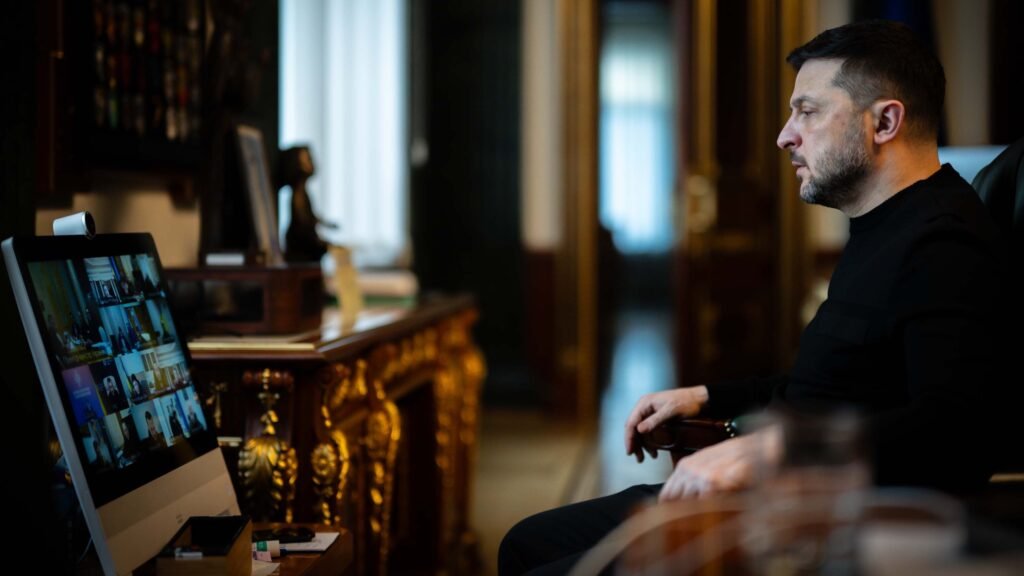
President Volodymyr Zelensky, elected in 2019, has become the symbol of Ukrainian resistance. His refusal to abandon Kyiv during the invasion helped rally domestic support and international assistance. But sustaining the war has brought difficult questions about mobilization, military exhaustion, governance and the country’s economic future.
Russia’s larger population and defense industry have enabled it to sustain military operations, but its economy has faced sanctions, labor shortages, inflation and the increasing burden of military expenditure. Ukraine’s economy has suffered even more direct physical destruction, with damaged factories, power stations, agricultural land, ports and transport infrastructure.
The consequences extend worldwide. Disruption to Black Sea grain shipments has affected food markets, while energy uncertainty has contributed to higher costs for households and businesses. European governments have spent heavily on defense and assistance, while developing countries have faced pressures on food and fuel imports.
Western support for Ukraine reflects a broader concern that allowing borders to be changed through military conquest would undermine international law and encourage further aggression. Yet the coalition faces political fatigue, competing domestic priorities and disagreements over the terms of a possible settlement.
The search for peace remains complicated by irreconcilable demands over occupied territory, security guarantees and Ukraine’s future relationship with Western institutions. A ceasefire without credible guarantees could simply postpone another war.
Ukraine’s tragedy is that a country with deep historical connections to Russia has been forced to fight that same neighbor to preserve its independence. The war has demonstrated that military superiority does not automatically translate into political victory, particularly when a population refuses to surrender its national identity.
Ultimately, the conflict is about more than Crimea, Donbas or the Black Sea. It is about whether a sovereign country has the right to choose its own future without the threat of invasion.
For the millions of families who have lost homes, loved ones and years of ordinary life, the measure of victory will not be the color of a territorial map. It will be the return of peace, security, livelihoods and the freedom to plan tomorrow without fearing another night of war.
Disclaimer: The opinions and views expressed in this article/column are those of the author(s) and do not necessarily reflect the views or positions of South Asian Herald.