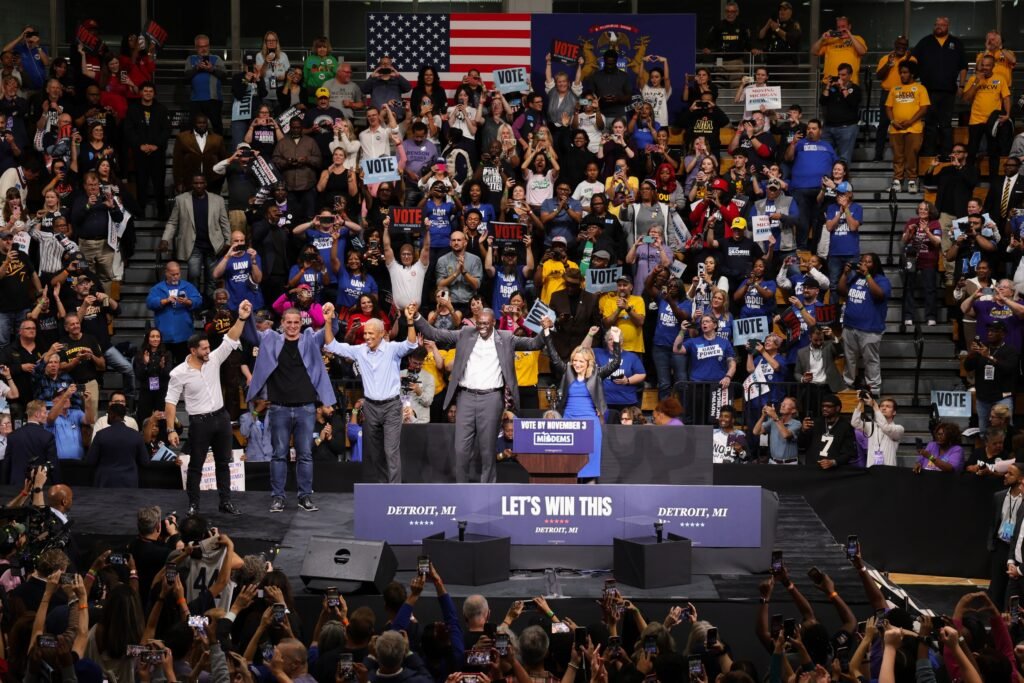
With the November 3, 2026, midterm elections approaching, Barack Obama has brought the contest into sharper political focus by linking three anxieties confronting American voters: the cost of living, the consequences of the war with Iran and concerns about the exercise of presidential power. His appearances in Ohio and Michigan, as reported by media on October 25, were not simply campaign events for Democratic candidates. They were an attempt to frame the election as a judgment on the direction of the country under President Donald Trump.
Obama’s argument was that the consequences of the administration’s decisions extend beyond Washington’s political battles. They reach the petrol pump, the grocery store, the factory floor and the constitutional institutions on which Americans depend. By connecting these issues, he sought to give voters a common framework for assessing a presidency whose supporters continue to defend its approach to trade, immigration and national security.
The central question is whether this framing can persuade voters who remain committed to Trump, mobilize Democrats who have been disappointed by their party and attract independents concerned less with political identity than with their household budgets.
Iran: the foreign-policy decision that reaches the petrol pump. Obama’s most consequential charge concerned the war with Iran. At a rally in Cleveland, where he campaigned for former Democratic senator Sherrod Brown, he described the conflict as an unnecessary war and contrasted Trump’s approach with the nuclear agreement negotiated during his own presidency.
Advertisement
The 2015 Joint Comprehensive Plan of Action, negotiated by Iran and six international powers, including the United States, imposed restrictions and verification arrangements on Iran’s nuclear programme in exchange for sanctions relief. The agreement did not permanently eliminate every concern about Iran’s nuclear ambitions, but its supporters argued that diplomacy had created enforceable constraints without requiring military confrontation.
Trump withdrew the United States from the agreement in 2018 during his first presidency. Obama’s argument in Ohio was that the subsequent confrontation illustrated the costs of abandoning diplomacy in favor of military escalation.
He pointed to attacks on American military bases, US casualties, wounded service members and the depletion of missile stocks. He also highlighted disruptions to shipping through the Strait of Hormuz, a strategic waterway between Iran and Oman through which approximately one-fifth of global oil and petroleum liquids consumption normally passes, alongside significant liquefied natural gas shipments.
The economic connection is immediate. When shipping through the strait is disrupted, oil markets must price in the risk of shortages, longer transport routes and higher insurance costs. Fuel prices can rise internationally, affecting American motorists, truckers, farmers and manufacturers.
Obama’s message was therefore political as well as strategic: decisions taken in the White House can have consequences for the cost of everyday life.
Yet the electoral impact depends on more than the price of oil. Voters will also consider the administration’s stated security objectives, the perceived threat posed by Iran and whether military action has achieved results that justify its costs. Trump’s supporters may regard confrontation as necessary to protect American interests, while critics may question whether the objectives are proportionate to the economic and human consequences.
The midterms will test which assessment resonates with voters in the industrial Midwest.
Tariffs and the household economy. Obama’s second line of attack concerned tariffs, an important part of Trump’s economic nationalism. The president has presented tariffs as instruments for protecting American industry, strengthening domestic production and pressuring trading partners to offer more favorable terms.
Obama challenged the assumption that the costs fall primarily on foreign exporters. Import duties are collected from importers, and some or all of the additional expense may ultimately be passed on to consumers or absorbed by businesses, depending on market conditions.
Even products assembled in the United States may contain imported components. An American car manufacturer purchasing foreign-made parts can face higher production costs when tariffs apply. Those costs may be reflected in vehicle prices, reduced profit margins, investment decisions or employment.
Obama also mocked the trade confrontation with Canada, a longstanding economic partner deeply integrated into North American manufacturing. The prospect of a threatened 50 per cent tariff on Canadian vehicles and auto parts from January 2027, as reported in the article, illustrates the uncertainty facing businesses planning production and investment across the border.
For Michigan, where the automotive industry and its supply chains remain central to the regional economy, this is more than an abstract argument about trade theory. Changes in cross-border costs can affect suppliers, factories, dealerships and consumers.
Ohio, with its manufacturing base and economically diverse electorate, presents a similar political challenge. Trump’s trade policies may appeal to workers who believe earlier trade arrangements disadvantaged American industry. But the same voters may question the strategy if tariffs raise their expenses without producing visible improvements in wages, employment or domestic investment.
The distinction between the promise of protection and its actual economic effects could become an important issue in the campaign.
Obama also invoked the federal debt, cited in the report at approximately $40 trillion. The total represents accumulated federal debt, not the annual budget deficit. It reflects borrowing across successive administrations, although the policies of each administration influence the subsequent trajectory.
His criticism was that tariffs had not delivered the promised reduction in deficits and that the administration’s tax and spending choices required closer scrutiny. Whether voters accept that argument will depend partly on how they assess the competing claims about tax relief, economic growth, public expenditure and fiscal sustainability.
Tax cuts, inequality and the politics of privilege. Obama’s economic critique extended to Trump’s 2025 tax and spending legislation, which he argued disproportionately benefited wealthy Americans while reducing support for programmes such as Medicaid and food assistance.
The political issue is distribution: who receives the benefits of economic policy, and who bears its costs?
Tax reductions can leave households and businesses with more disposable income, potentially supporting consumption and investment. Their effects, however, vary by income group and depend on the details of the legislation. Reductions in public assistance can impose a different burden on lower-income families, particularly when medical expenses, housing costs and food prices are already difficult to manage.
Obama sought to portray this combination as a mismatch between the administration’s economic promises and the everyday experience of ordinary Americans.
His jokes about Trump’s White House renovations, including the planned ballroom, changes to the Rose Garden and gold decoration, served a related purpose. By contrasting conspicuous spending on presidential surroundings with the financial pressures facing households, he tried to make the issue of political priorities accessible beyond policy documents and budget tables.
The charge of corruption and favoritism is more serious than an argument over aesthetics, however. Allegations of misconduct require evidence, and campaign rhetoric should not be mistaken for a legal finding. Nevertheless, perceptions of preferential treatment can influence whether voters believe public institutions serve the broader population or a narrow circle of wealthy interests.
In a midterm election, such perceptions may matter even to voters who do not agree with the opposition on every policy question.
Disclaimer: The opinions and views expressed in this article/column are those of the author(s) and do not necessarily reflect the views or positions of South Asian Herald.