Join WhatsApp Channel

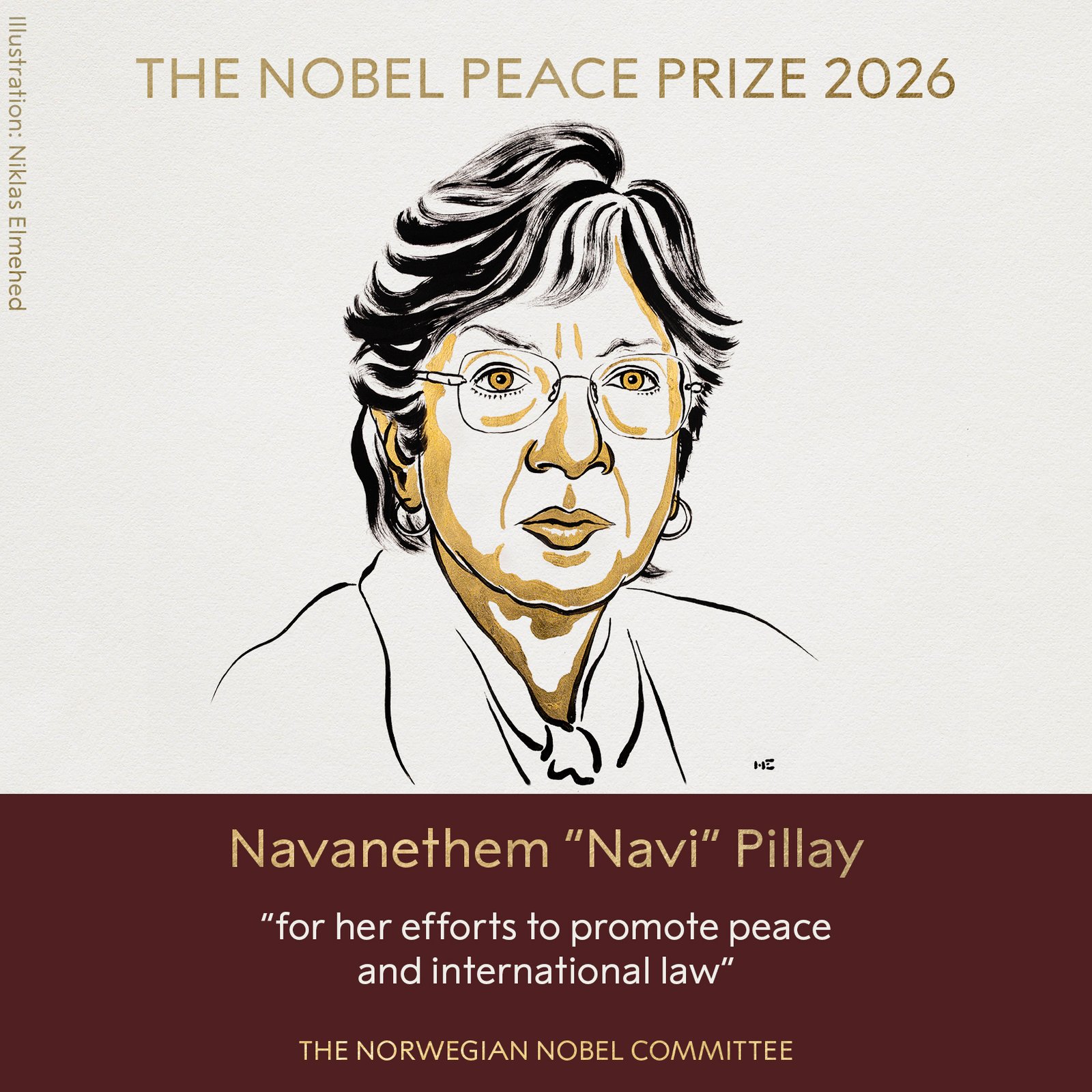
The Norwegian Nobel Committee announced on October 9 that Navanethem “Navi” Pillay, a South African-born jurist of Indian Tamil descent, has been awarded the 2026 Nobel Peace Prize for her efforts to promote peace and international law. The award ceremony will take place on December 10, 2026, in Oslo, Norway.
In its announcement, the committee described the former International Criminal Court judge as a “champion” of the international legal order, noting that she has been at the “forefront” of its development.
“The Norwegian Nobel Committee attaches importance to Navi Pillay’s role as a driving force in the development of an international system of law and order, while further emphasizing her judicial rigor, personal integrity and considerable courage,” the committee said in the announcement.
The committee noted that the award comes as the number of wars and conflicts is “rising” and judges and international legal institutions face “political attack.” It said the prize serves as a “reminder” that resolving conflicts without force or violence depends on the international rule of law. An international legal system that holds war criminals accountable and delivers justice to victims of abuse is a “precondition for a peaceful world.”
During a telephone call with Robyn E. Hardy, senior adviser at the Norwegian Nobel Institute in Oslo, Pillay described where she was when she learned of the announcement.
“I was actually in courtroom 600, where the Nazi trials were held. Wow, it’s so significant. I’m truly impressed with the announcement and why the award has been given,” she said.
Asked how she received the news, Pillay recalled attending a discussion on justice and reparations when Christoph Safferling, director of the Nuremberg Principles Academy, approached her.
“Well, I was sitting in courtroom 600 and listening to the panel of speakers on justice and reparation when the Director of the Nuremberg Principles Academy, Christoph Safferling, asked if I would step out, and I saw his face looking so serious, I thought he had some kind of bad news for me. And then he told me they’ve just seen this. They all saw it in the media first, and so I stared at it in disbelief,” she said.
Pillay said she initially could not “believe” the news, but gradually accepted it after seeing media reports confirming the announcement.
“So, total surprise, and deeply, deeply honored and touched. More by the criteria you selected me for. I know it’s a personal award. But for me mainly, it’s for all the institutions I served on and all the people I worked with as well,” she added.
Noting that she had “no hint” that she would receive the award, she said, “Maybe that’s the best part of getting a surprise announcement. You had absolutely no idea, and so it’s overwhelming, deeply emotional for me.”
Asked how she planned to celebrate, Pillay described herself as a “workaholic” who continues working at 85. Pillay said she was attending an international conference with delegates, including many victims, and wanted to spend the remainder of the day honoring them and the survivors.
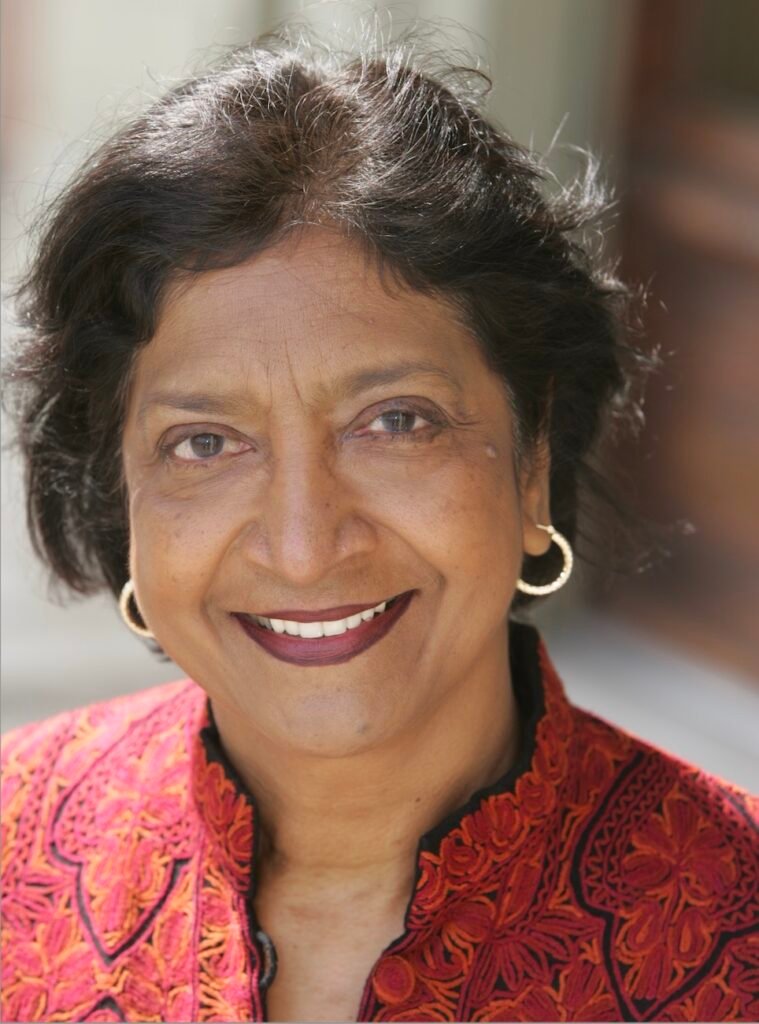
“So that’s how I will spend the rest of the day with the delegates here, who all stood up and gave me a standing ovation, and it was such a moving moment for me,” she said.
“And also such a significant endorsement of the Nobel Committee’s decision to give this award to me as a representative of international law, the international rule of law, justice, and the reports I have done on current disturbing conflicts in the world.”
Pillay reflected on how unusual such recognition is for judges, whose work often involves quietly interpreting the law, conducting investigations, reviewing evidence and addressing serious issues.
“You don’t have this opportunity of being recognized by your peers, and so that’s what happened to me in this courtroom 600. My peers stood up to applaud,” she added. “I don’t think I will ever forget that. It’s just so moving. And of course, your committee made this possible, and all the reasons given were also deeply touching.”
She said it was difficult to imagine that work carried out quietly in distant places would receive recognition of this scale, particularly from the Norwegian Nobel Committee.
Asked about becoming the 21st woman to receive the Nobel Peace Prize, Pillay said she remained surprised because such awards have “rarely” gone to judges, lawyers and others working in the legal field. She noted that the committee has previously recognized civil society and human rights activists.
“All that’s good. It’s just so bad that there’s supposed to be equality between women and men, and that I’m only the 21st recipient,” she said, thanking committee members for considering her without any “gender prejudices.”
“I think your announcement is significant for that as well, to give it to a woman,” she added.
Congratulating Pillay, UN Secretary-General António Guterres highlighted her career in South Africa and her service in international judicial and human rights institutions.
“From her work in South Africa defending Nelson Mandela and others, to her role as an international judge on cases relating to international crimes, including the genocide in Rwanda, to her tenure as High Commissioner for Human Rights, to chairing the UN Independent International Commission of Inquiry on the Occupied Palestinian Territory, she has shown that the force of law must prevail over the law of force and that defending human rights is the surest safeguard against injustice,” he said.
Guterres described the prize as a “tribute” to everyone working to uphold and defend international law, the rule of law and human rights, and to secure peace, justice and human dignity.
UN Human Rights Chief Volker Türk also welcomed the announcement, linking the recognition to the challenges facing human rights defenders worldwide.
“At a time when human rights are under attack on so many fronts, including from those who wield enormous power, this award is particularly poignant. It is an award to all those who, around the world, dedicate their lives to the defense of human rights, often at great risk to their security,” he said in a statement.
Türk described the award to Pillay as a “recognition” and “reaffirmation” that human rights, the rule of law, justice and accountability are fundamental to peace, security and prosperity.
“She embodies international law, having served in many functions, both in South Africa and internationally as judge of the International Criminal Tribunal for Rwanda, the International Criminal Court, and the now International Court of Justice,” he added.
According to the Norwegian Nobel Committee, Pillay was appointed to the High Court of South Africa in 1995. Four years later, she became a judge and president of the International Criminal Tribunal for Rwanda.
At the tribunal, she gained recognition for her role in establishing that sexual violence, rape and the dissemination of propaganda could provide grounds for indictments involving crimes against humanity and genocide. She subsequently served as a judge at the International Criminal Court.
Pillay served as the United Nations High Commissioner for Human Rights from 2008 to 2014. She also chaired the UN Independent International Commission of Inquiry on the Occupied Palestinian Territory from 2021 to 2025. In 2019, she became an ad hoc judge at the International Court of Justice in the case accusing Myanmar of genocide.
Raised in a family of Indian Tamil descent in Durban, South Africa, Pillay studied law and began defending activists who opposed apartheid. She established her own law firm in Durban in 1967. During the 1980s, she studied at Harvard University, earning a Doctor of Juridical Science degree in 1988.