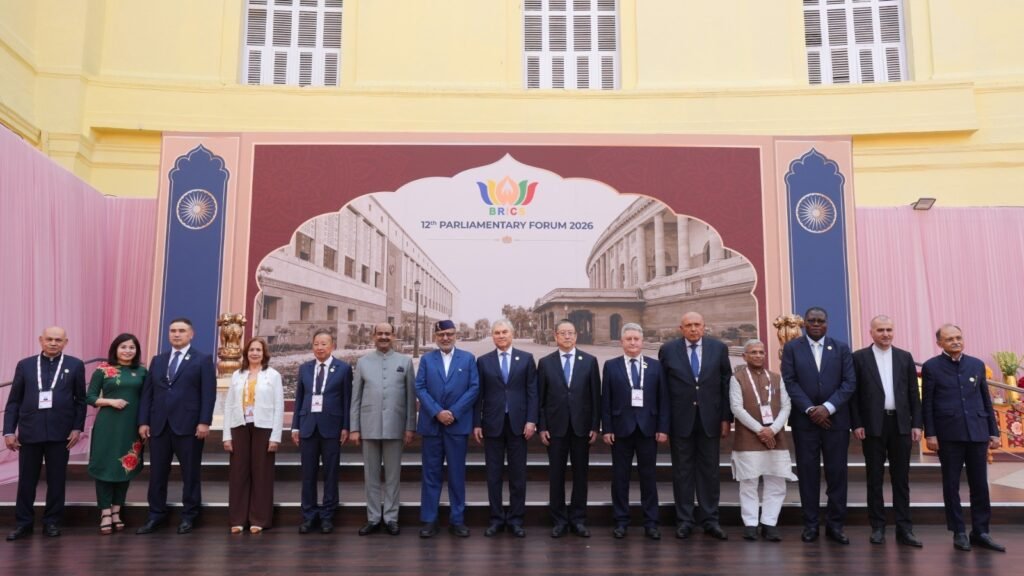
Close on the heels of hosting the eighteenth summit of the leaders of BRICS successfully in September, India did another significant two-day events of Parliamentarians of the BRICS by the Indian Parliament on October 26-27 in the historic Central Hall of Parliament that once heard Jawaharlal Nehru’s ringing tone of India’s tryst with destiny soon after Independence in 1947.
Accounting for roughly 40 percent of global GDP at purchasing power parity against 28 per cent for the G7 countries of the rich world with 49.5 percent of the world’s population (3.9 billion in BRICS) and 26 percent of global trade and half of world economic growth, the disparate members numbering eleven and ten partner countries, their partnership in progress is by design meant to reflect the voice of the Global South. Earlier the global dialogue was between the developed North and the developing South with the binary losing the lacer focus in the 1990s with the collapse of the USSR and the advent of the Washington Consensus for the ascendancy of market forces in shaping economic growth across the globe in a one-size fits all paradigm.
Subsequent developments reflected in the dot com bubble at the millennial dawn and the global financial meltdown in 2007 and the Covid 19 pandemic saw the compact for cooperation fraying with the emerging and developing economies feeling that they had to increasingly fend for themselves in a simmering protectionist world that had turned inward to thwart development drive across the traditional divide! It was against this grim scenario of genuine cooperative spirit losing its sheen among countries keen on pushing themselves to a better world that BRICS was found by the then three so-called fragile five—Brazil, Russia, India, China and South Africa in 2009 with South Africa joining in 2011.
Since its inception, the BRICS agenda has expanded from its initial focus on economic issues of mutual concern and is structured around three core pillars: political and security cooperation, economic and financial cooperation and people-to-people exchanges. Alongside BRICS Parliamentary Forum representing the Parliamentary dimensions of the BRICS process was established with the first BRICS Parliamentary Forum having been held in Moscow in 2015, setting in motion a dedicated platform for inter-parliamentary dialogue and cooperation. It is after a decade that the Parliament of India got the first chance to host the 12th BRICS Parliamentary Forum in New Delhi, although India chaired BRICS meeting of leaders in 2012, 2016, 2012 and 2026.
Advertisement
In a veiled remark reflecting the listless youth of the country holding protests across the country, the Lok Sabha Speaker Om Birla who chaired the two-day sessions in his inaugural address referred to the available avenues for them to make adequate use of access to quality education and technological knowledge, mixed with a keen yen to innovate, excel and contribute to society. His pitch for empowering young people is not only investment in their future but also a commitment to the collective destiny of nations sounded pragmatic for the ruling dispensation everywhere to take the cue.
The adoption of a Joint Declaration by the participating member countries’ Parliamentarians on the concluding day validated New Delhi’s steadfast stance on national security with no demur through uncompromised counter-terrorism language, building on NDD Paragraph 40 condemning cross-border terrorism, terror financing and safe havens while seeking zero tolerance and an end to double standards! The declaration also embodies India-led oft-repeated developmental and climate agenda, encapsulating the expansion of Digital Public Infrastructure (DPI) repositories, ethical governance in deploying AI (artificial intelligence), adherence to
Common but Differentiated Responsibilities and unanimous support for India’s BRICS chairship.
Cryptically but elliptically Om Birla in his concluding remarks told the delegates that “global peace truly means security, respect, justice and the assurance of a better future for everyone—especially the younger generation” adding that coming generations would judge current leaders by the safety and prosperity of the world they leave behind! It is a powerful plea for seeking cooperation instead of competition and peace instead of conflict and war—a meaningful message from the land of the middle path that eschewed extremity in stance that in no way lends to the summum bonum of humanity, going forward.
Disclaimer: The opinions and views expressed in this article/column are those of the author(s) and do not necessarily reflect the views or positions of South Asian Herald.