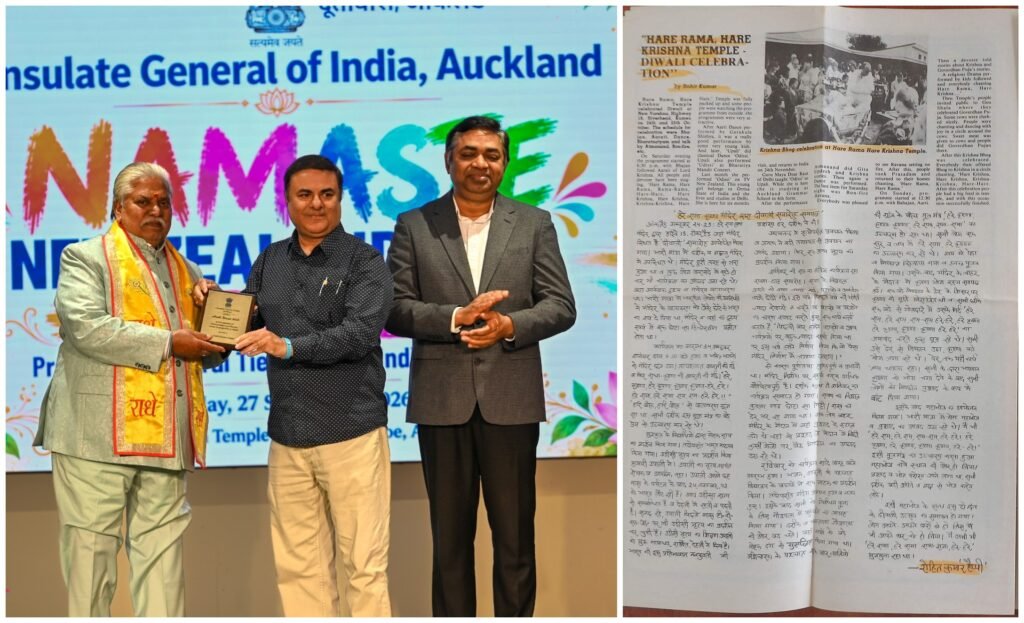
When an Auckland newspaper’s printer had no Hindi fonts in 1992, Rohit Kumar ‘Happy’ found another way: he wrote the Hindi by hand.
More than three decades later, in an exchange with South Asian Herald on October 2, 2026, Kumar shared that Bharat Darshan, the Hindi literary magazine he founded in New Zealand, was celebrating 30 years of publication.
Launched in print in 1996, Bharat Darshan added an internet edition in December 1997. Kumar says it was among the world’s first Hindi literary magazines to go online at a time when Hindi was only beginning to establish a presence on the internet.
The milestone comes shortly after Kumar was recognized by the Consulate General of India in Auckland with a Hindi Diwas 2026 award “in recognition of outstanding contribution to the propagation of Hindi” at its Namaste New Zealand 2026 event. Hindi Diwas is observed annually on September 14, marking the adoption of Hindi in Devanagari script as an official language of the Union of India.
Advertisement
But the story behind those 30 years began before Bharat Darshan itself.
Kumar says he arrived in New Zealand at the end of 1988 after studying journalism in both Hindi and English in India. He had already been published in a number of Indian newspapers and magazines, but in New Zealand he found no Hindi magazine. “I yearned for Hindi literature, but there was no outlet,” he said.
He joined The New Zealand Indian Times in 1991 and proposed introducing Hindi pages. The editor liked the idea, but there was a practical problem: the printer had no Hindi fonts.
Kumar recalls that the printer flatly refused, calling it “impossible.” He persisted, eventually suggesting that the Hindi material could be handwritten instead.
The solution was analog. “Back then, it wasn’t the digital age,” Kumar said. A large frame was sent to him with blank space left for the Hindi material. Kumar would write Hindi by hand and return the completed frame to the printer.
By 1992, handwritten Hindi news began appearing in the newspaper, followed by regular handwritten Hindi pages.
That same year, Kumar says he worked with the late M.C. Vinod, a longtime editor of the Fijian Hindi weekly Shanti-Doot, and Nafees Akhtar to organize a poetry conference and mushaira, a traditional gathering for the recitation of Urdu poetry.
The event was held in a rented hall in August 1992 under the newspaper’s banner. “The hall was packed,” Kumar says. He hosted the poetry conference while Akhtar hosted the mushaira.
Kumar says that over the following years, several Indian newspapers and magazines appeared and disappeared in New Zealand, including The New Zealand Indian Times. He continued exploring the possibility of establishing a Hindi publication of his own.
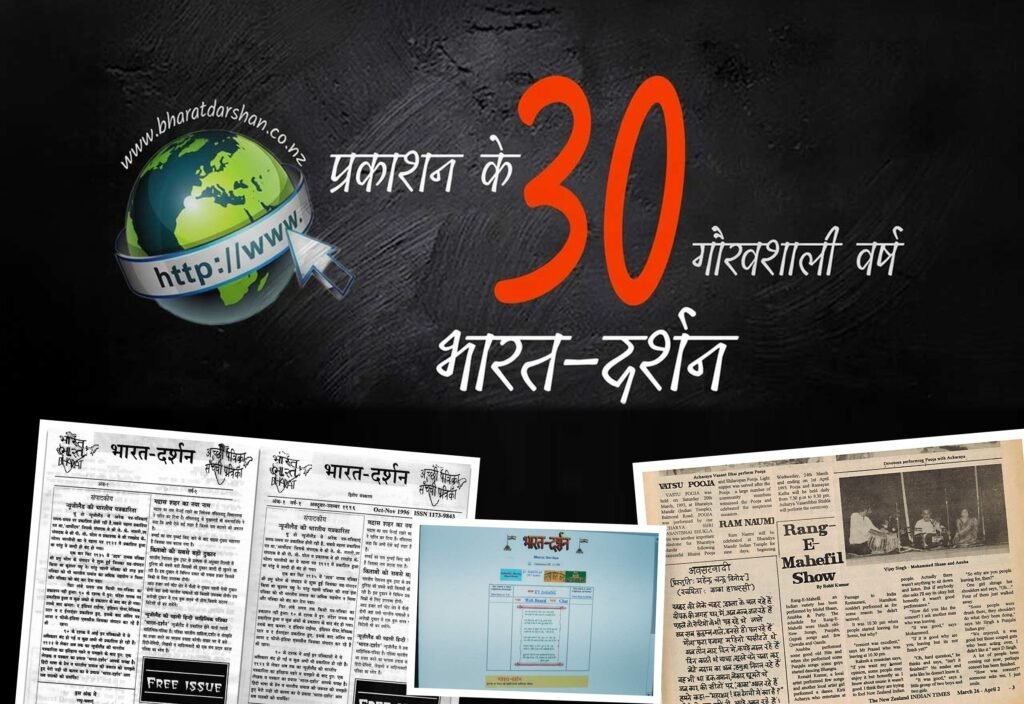
In 1996, Bharat Darshan was born.
Its first issue was dated August-September 1996. Kumar says it sold quickly enough for a second edition of the same issue to be produced.
In those early years, he says, much of the operation rested on him. He collected material, edited it, arranged publication and personally delivered copies to Indian shops and community organizations. “I was young and full of energy due to my love for Hindi,” he said, adding that as “a writer, not a businessman,” he did not think much about profit or loss.
Two friends, Virendra Prakash and Himanshu Shah, later helped with distribution. Prakash took copies around Auckland, while Shah distributed the magazine at weekly markets, asking members of the Indian community whether they read Hindi.
The next challenge was taking Hindi onto the internet.
Kumar says the idea began taking shape in early 1996 when he visited a New Zealand library to learn about and use the internet. One of the first things he did was search for a Hindi magazine.
He could not find one.
If there were no Hindi publications online, he reasoned, “there should be.”
The magazine’s first internet edition appeared in December 1997 on the Xoom platform, before Bharat Darshan moved to its own domain in 1998.
Kumar was also confronting another technological problem: how people could actually type in Hindi.
In 1997, he developed a Hindi typing font called “Bharat Darshan” and distributed it free of charge. A second version, 1.1, followed in 1999.
The magazine’s digital work extended to language education. Kumar says an online “Hindi Teacher” was developed using English as the medium of instruction so that children growing up outside India, as well as people whose first language was not Hindi, could learn the language.
The magazine was also becoming involved in community life beyond publishing.
Kumar says Bharat Darshan helped bring Indian communities together in August 1997 for celebrations marking the 50th anniversary of India’s independence. The event was conducted in Hindi with India’s High Commissioner attending as chief guest.
In 1998, Kumar said, after Auckland resident Genny proposed an event for the Indian community, he suggested a Diwali Mela, which Bharat Darshan organized at Auckland’s Mahatma Gandhi Centre with the support of the Auckland Indian Association. The event grew in popularity, he said, until Auckland City Council took over its organization after 2001. Auckland’s public Diwali Festival has been running with council involvement since 2002.
The magazine’s connections also extended across the wider Pacific.
In 2000, Kumar traveled to Fiji to cover the country for Hindi newspapers and magazines. There, he met several Fijian writers, including the late Vivekanand Sharma, the late Joginder Singh Kanwal and Neelam Kumar.
He says Bharat Darshan subsequently published the work of many Fijian writers, with the aim of bringing their Hindi literature to a wider readership.
Three decades after its first print issue, Kumar says, the magazine’s plans include making high-quality writing and rare Hindi literature available online and encouraging Hindi writers in Fiji, Australia and New Zealand to continue writing.
Kumar also thanked Bharat Darshan’s readers, writers and well-wishers for their support and said the editorial team hoped their support and guidance would continue.
Reflecting on his recent recognition by the Consulate General of India in Auckland, Kumar said his “firm wish” is that, beyond the speeches and ceremonies held to celebrate Hindi, honors like the one he received achieve something truly meaningful for the language.