There has literally been a glut of movies on the 26/11 attacks that besieged Mumbai. From Ram Gopal Varma’s The Attacks of 26/11 and Kangana Ranaut’s recent Bharat Bhhagya Viddhaata and even a couple of web series (I also have no idea about how many came in on regional cinema), we have seen the juice extracted out of the terrible tragedy in constant replays of what happened that night.
By those standards, one could assume Prahaar: The Untold Story of Ujjwal Nikam to be yet another look at the incident, and one would not be blamed for an initial apathy towards it. Which, I think, is what is happening.
But the viewer could not be more wrong!
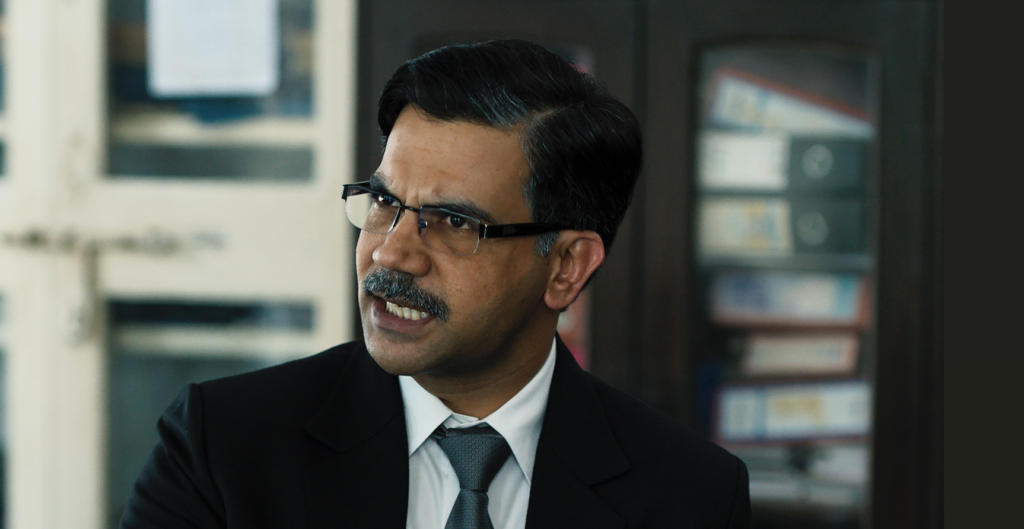
This film focuses instead on the court trial and sentencing of the only terrorist who was captured alive—Ajmal Kasab. And within that, it explores the passion and psychology of the prosecuting attorney—Ujjwal Nikam, hailing from Jalgaon, a small town in Maharashtra. Ujjwal is portrayed here by Rajkummar Rao and Kasab by Marathi actor Lalit Prabhakar.
Advertisement
The film is not Nikam’s complete story as in a classical biopic. This is because the court case is the focus—the ‘Untold’ story or part of his life. So this film delves into his family issues and the challenges he faced simultaneously in his personal life too. It begins with his victory in the 1993 Mumbai bomb blasts case—the one that got him into attention as a star Public Prosecutor and was also linked to enemies of the nation.
At a party celebrating his and India’s victory, Nikam isn’t happy: only the lower rung have been punished, he warns, not the masterminds. There can be more to come.
In a significant dramatization, he gets the news of the 26/11 attacks on the day of his daughter Sharvari (Pranali Ghogare)’s wedding reception. His son, Aniket (Ritvik Rathore), is studying Law in the US. Nikam is naturally appointed Special Public Prosecutor (For the record, Nikam later joined the Bharatiya Janata Party, fought and lost a Lok Sabha election, and was later inducted by President Droupadi Murmu into the Rajya Sabha).
With meticulous missionary zeal, Nikam fights the case and terms Kasab not just as a mass murderer but as an enemy of the nation. He not only painstakingly pieces together all the evidence along with witnesses’ statements but systematically demolishes the fake arguments put up by Kasab and his defense lawyer, Kazmi (Sikandar Kher), starting with the specious claim that the case cannot hold as Kasab is 17 and thus, only a minor!
Kazmi, of course, bears the brunt of public anger, especially from his own community, but has taken up the case when multiple defense lawyers have refused to defend the terrorist. But in the film not only is this highlighted but also is depicted graphically as India’s civilized society and Law’s finest point: Kasab could have just been killed, but in India’s democratic system, even a butcher like him is given a fair trial and an attorney to fight for him. And as Kazmi points out repeatedly, “I am only doing my duty!”
Nikam, on his part, is not keen on hurrying the case. As he puts it, “Justice hurried is justice buried just as justice delayed is justice denied.” This is because of the bigger agenda: he has to conclusively prove that Pakistan, along with the Lashkar-e-Toiba, was criminally involved in the conspiracy. The Indian government has already notified Pakistan and a team of their ace officers and lawyers come down to interrogate the witnesses.
Chaudhary Zulfiqar (Jaideep Ahlawat) is known as the Ujjwal Nikam of Pakistan and the latter begins to respect his Indian counterpart when Nikam fiercely defends an Indian witness Zulfiqar has tried to demolish on technicalities. The two even become friends, and in a moment of candid honesty, Zulfiqar even admits that his country will only follow a certain system and no one will be punished. Later, when the honest Zulfiqar is gunned down in Pakistan, Nikam is shattered.
Nikam’s son Aniket has flown down and asks to assist his father, who is involved day and night in the case, sorting out evidence, but the father loses his cool at one point when he finds his son giving more attention to his mother Jyoti than to the case. A furious Aniket quits, blaming his father for never caring for the family. But then the single-minded Nikam is not only hellbent on proving the case against Kasab but also has a psychological reason from childhood to behave in the way he does with his wife and children. And at the time when Aniket quits assisting him, Jyoti has been diagnosed with a serious illness.
Such high incidents and searing anecdotes make up the brilliant screenplay and dialogues by Sumit Roy, who is also credited with doing the “story” (that is dramatization of real-life incidents). Vishal Tiwari has written the additional screenplay and “story” and Dushyant Arora is credited as additional dialogues writer and researcher.
An unforgettable sequence is of the 10-year-old eyewitness Komal Ahirwar (played by Dior Ranju Varghese). Her breakdown scene and subsequent testimony against Kasab in his very presence is sure to melt the hearts of the most stonehearted viewers and move many to tears.
Yet another sequence that stands out is that of Kazmi’s evening out on Eid with his family when he is severely admonished by a fellow Muslim for representing Kasab. Earlier the same day, Kasab’s wonderment at Eid being “allowed” to be celebrated in India, something he never knew while being mentally and emotionally brainwashed back home, is graphically shown.
At 140 minutes, this is that very rare film I found too short. I wanted the film not to end as it had gripped me so much, affected me so much. Kasab, for example, was never glorified or even whitewashed. But his depiction was human all the same. And Lalit Prabhakar, especially with his expressions and body language, was exceptional.
As for Rajkummar Rao, the actor has played so many real characters by now (this is his seventh with one more on the way) that it is praiseworthy how much energy and dedication he brings into their depiction. He is Nikam to the T—with all his ‘Marathiness’ and ardentness, his contradictions (his softness towards Jyoti and his daughter Sharvari), his intensity in court and with his son, and everything else about him.
As Zulfiqar, Jaideep Ahlawat scores yet another sixer in his standout innings, and if length of role is not an issue (for me, personally, it never is!), he is even better than he was in Drishyam The Conclusion recently. Wamiqa Gabbi is as perfect as anyone could be in the role of Jyoti, and this is another triumph for this perfect star-package actress. A dazzling cameo comes from young Dior Ranju Varghese as Komal. If she ever decides to take up acting as a profession, she will have few equals in her time.
Sikandar Kher as Kazmi, Ashish Vidyarthi as judge Tahaliyani and Ritvik Rathore as Aniket are three more terrific turns. The supporting actors, including veterans Ajinkya Deo and Sandeep Shinde and everyone else, small or big, cop or layman, are perfect.
Vishal Mishra’s only song tries to be in the oh-so-familiar tenor of Teri mitti (Kesari) though the lyrics by Amitabh Bhattacharya impress. But is the BGM by Alokananda Dasgupta that is magnificently non-intrusive and yet makes a mark by elevating a viewer’s diverse emotions to the right pitch.
The film is a massive personal triumph for Marathi director Avinash Killa Arun, showing that his prep and execution as a filmmaker is on par with that of the protagonist he has extolled in his motion picture.
Rating: ****
Maddock Films’ Prahaar: The Untold Story of Ujjwal Nikam Produced by: Dinesh Vijan Directed by: Avinash Arun Written by: Sumit Roy, Vishal Tiwari & Dushyant Arora Music: Vishal Mishra Starring: Rajkummar Rao, Wamiqa Gabbi, Lalit Prabhakar, Sikandar Kher, Jaideep Ahlawat, Ashish Vidhyarthi, Ritvik Sahore, Pranali Ghogare, Dior Ranju Varghese, Ajinkya Deo, Sandeep Varghese & others