The United States-led Quad grouping of four nations including India, Australia, and Japan has announced plans to provide more than $85 million in technical and financial assistance to expand access to trusted artificial intelligence (AI) across the Indo-Pacific. The announcement comes ahead of a Quad leaders’ summit in Manila next month, the first in more than two years.
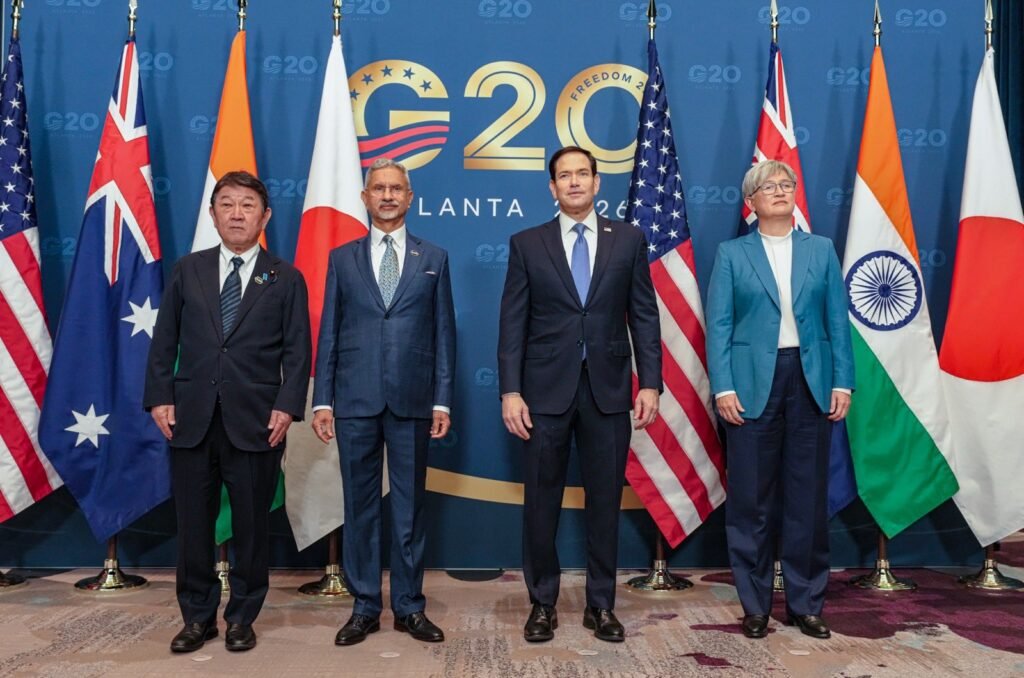
The decision was announced as the four countries’ foreign ministers met in Atlanta on Saturday, their third meeting in six months. The ministers also agreed to strengthen semiconductor supply chains, increase cooperation on critical minerals and address the growing threat of online scams.
US Secretary of State Marco Rubio hosted India’s External Affairs Minister S. Jaishankar, Japan’s Foreign Minister Toshimitsu Motegi and Australian Foreign Minister Penny Wong on the sidelines of the G20 Foreign Ministers’ Meeting.
The joint press release on economic prosperity and security focused on technology cooperation and reducing dependence on a limited number of suppliers for critical materials.
Advertisement
The ministers expressed concern over economic coercion, arbitrary export restrictions and trade practices that disrupt global supply chains. While the statement did not name China, these concerns come amid growing unease over Beijing’s dominance in critical minerals and its export restrictions.
$85 million for trusted AI
The Quad ministers highlighted the importance of AI and initiatives such as Pax Silica to future economic growth. They announced their intention to provide more than $85 million in technical and financial assistance to support access to trusted AI across the Indo-Pacific, including through the Quad AI Accelerator. The initiative comes at a time when countries across the region are trying to build AI capabilities but face uneven access to computing infrastructure, investment and technical expertise.
For India, the announcement offers another opportunity to work with its Quad partners on emerging technologies. New Delhi has been investing in domestic AI capabilities and semiconductor manufacturing while seeking closer technology partnerships with the United States and Japan. However, the statement does not specify how the assistance will be distributed, which countries will receive support or when the funding will become available.
Securing semiconductor supply chains
The four countries also agreed to launch an effort to identify potential chokepoints in semiconductor and AI hardware supply chains before they cause disruptions. Semiconductors are essential to industries ranging from automobiles and telecommunications to advanced computing and defence equipment. Their production depends on complex supply chains spread across several countries.
The proposed effort would allow Quad members to identify vulnerabilities and explore alternatives before shortages affect production. For India, which is seeking to establish itself as a semiconductor manufacturing destination, the initiative could support closer coordination with established technology partners.
$10 million for critical minerals recovery in India and ASEAN
Another announcement with direct implications for India was a US commitment of $10 million to support facilities for recovering critical minerals from electronic waste and scrap materials in India and ASEAN countries. The initiative builds on the Quad Critical Minerals Initiative Framework announced in May 2026.
Critical minerals are used in batteries, electronics, clean energy equipment and advanced manufacturing. Their availability has become an important concern as countries seek to reduce dependence on concentrated supply chains.
The Quad countries welcomed private investment in waste collection networks, processing plants and refineries. They will also explore simpler procedures for moving recyclable materials across borders. For India, recovering minerals from discarded electronics could help develop domestic processing capacity and create opportunities for recycling businesses. The challenge will be attracting sufficient investment to make these facilities commercially viable.
Cyber scams and trusted networks
The ministers also raised concerns about online scams operated by transnational criminal groups, including networks that traffic people and force them to carry out fraud. According to the joint statement, these operations steal tens of billions of dollars annually from citizens of Quad countries.
The four governments pledged to cooperate in dismantling such networks and holding their leaders accountable. On telecommunications, the Quad agreed to identify priority countries for cooperation on trusted 5G and 6G technologies, Open Radio Access Networks and AI-enabled networks. The countries will also continue work on digital identity standards to make cooperation between public institutions and businesses easier.
Business and maritime cooperation
The ministers announced the first Quad Business Leaders’ Forum, bringing together companies, government officials and policy experts to encourage commercial partnerships. Export credit agencies from the four countries will meet in Tokyo on November 18 to explore financing and cooperation opportunities.
The Quad also plans its first exercise under the Indo-Pacific Maritime Surveillance Collaboration initiative during Sea Dragon 2027. A maritime domain awareness symposium under the Quad Maritime Training Initiative, known as MAITRI, is scheduled for early 2027. Both initiatives seek to improve information sharing and maritime surveillance among participating countries.
The challenge now is delivery
The Atlanta meeting comes ahead of the first Quad leaders’ summit in more than two years, scheduled for Manila in November. Confirmed by Secretary Rubio, the meeting will bring together President Donald Trump, Prime Minister Narendra Modi and the leaders of Japan and Australia after a planned summit in India failed to materialize last year. While the Quad has announced several initiatives covering AI, semiconductors, critical minerals and maritime security, many still need funding and implementation plans. The Manila summit offers an opportunity to move beyond announcements, give these initiatives political direction and set a clearer agenda for 2027 and beyond.