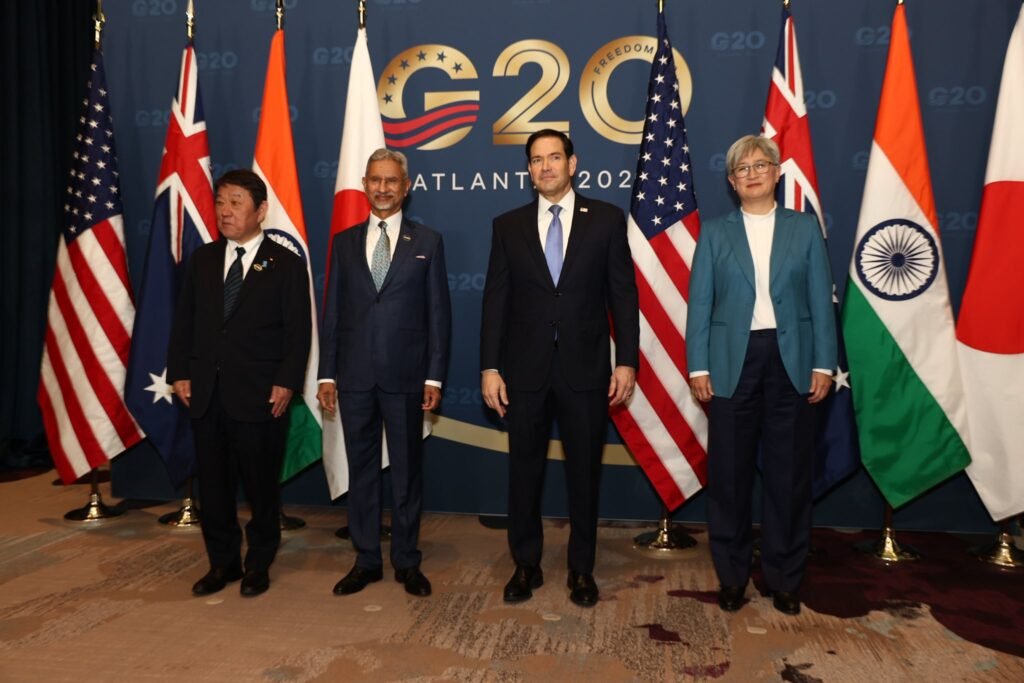
This past week (October 31), the foreign ministers of QUAD countries – i.e., US, Australia, India and Japan – met for the third time this year. The Atlanta meet took place on the margins of a G20 foreign ministerial meet and was hosted by US Secretary of State Marco Rubio.
The joint statement contained (predictable) pledges to work on building reliable global supply chains, expressions of grave concern over “economic coercion” through export restrictions and non-market practices. The QUAD ministers repeated their support for a free and open Indo-Pacific, underscored the importance of economic security in maintaining global stability and prosperity, including through reliable and open global supply chains.
The four ministers also emphasized the “absolute necessity to protect and preserve navigational rights and freedoms in the Strait of Hormuz, the Red Sea, and the Bab el-Mandeb Strait,” and pledged more than $85 million in assistance to support trusted AI technologies across the Indo-Pacific. There was also a promise of a new effort to identify vulnerabilities in semiconductor and related supply chains before they caused disruptions.
The ministerial meet came amid expectations of a QUAD summit on the side-lines of the Association of South East Asian Nations or ASEAN summit (November 16-18) in Manila. U.S. President Donald Trump is expected to attend the ASEAN meeting before heading to China for the Asia Pacific Economic Cooperation or APEC summit (November 18-19). It also comes against the backdrop of Japan being extremely critical of Beijing over its restrictions on critical mineral exports, and the US assembling a coalition aimed at uniting G20 countries concerned about China’s dominance in rare earths and other critical minerals. The Quad joint statement contained no direct mention of China – but nothing unusual there.
Advertisement
Those hoping that these developments together may mean a revival of QUAD may be disappointed. For one, the U.S. under Trump seems to have a special preference for unilateralism and no use at all for multilateral institutions and fora. U.S. foreign policy since Trump came back to the White House has been about cutting individual deals with countries – whether on trade or other matters.
It’s no wonder that the QUAD has slipped way down in the priority list. Given the U.S. pre-eminent position, its power and capacities in the world, it is the glue that holds together groupings like the QUAD. Countries like Japan, Australia and India can pledge to work together and indeed must work together, but even pooling their resources, sadly lack what a QUAD – anchored by the U.S. — can bring to the table.
For another, is Trump’s penchant for cutting deals with the likes of Chinese President Xi Jinping. Trump has met Xi twice this year already and two more meetings are planned before the year is out. Trump’s focus is on managing competition with China. There is talk of a G-2 i.e., the U.S. and China treating each other as equals and managing trade and other frictions. Recently, Trump indicated he wasn’t verse to a G-3 meet i.e., U.S., China and Russia sitting down together for talks. That possibility seems more likely now after Trump spoke to Russian President Vladimir Putin in October and announced a deal on Russian diesel exports to the U.S. How the QUAD fits into either a G-2 or a G-3 world is, at this moment, difficult to predict.
Disclaimer: The opinions and views expressed in this article/column are those of the author(s) and do not necessarily reflect the views or positions of South Asian Herald.