The 24th annual edition of the Asian Achievers Awards, one of the United Kingdom’s most prominent and longstanding celebrations of British Asian achievement in business and society, brought together business leaders, celebrities and sports personalities in London a few weeks ago.
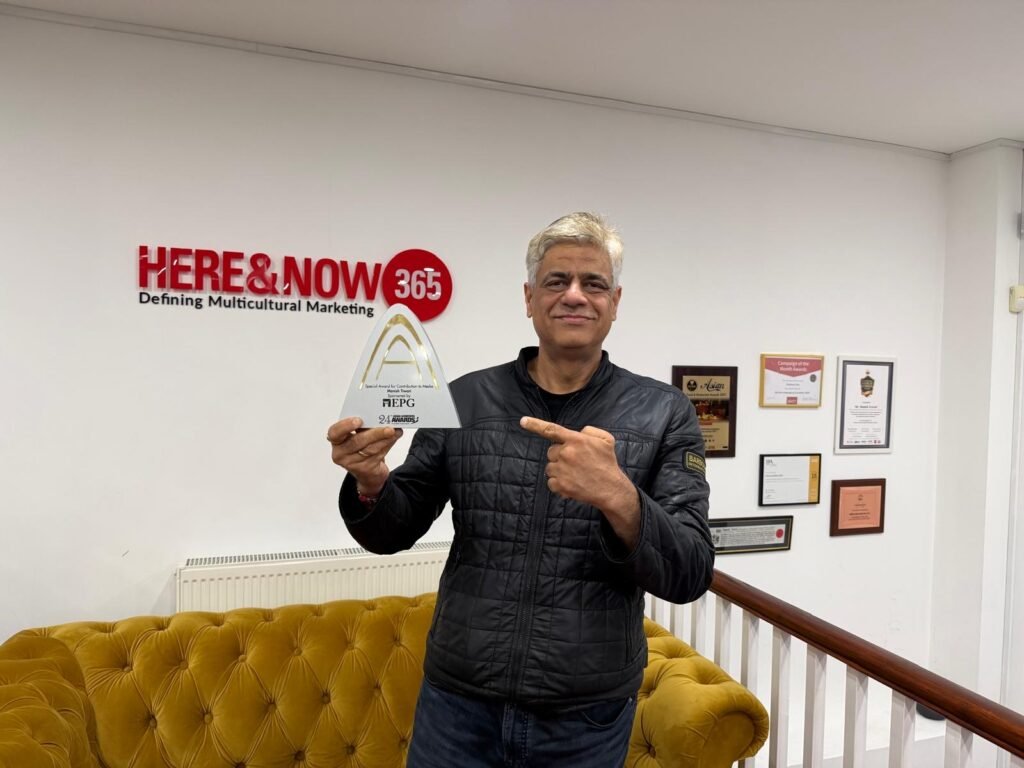
One of the unique aspects of the awards is its longevity, in unearthing British Asian talent across society, for more than two decades. Manish Tiwari, founder and CEO of Here & Now 365, who won the Special Award for Contribution to Media spoke to South Asian Herald in an exclusive interview.
You’re one of the most recognizable names in the South Asian media landscape in the UK. How did your journey begin?
I studied at MICA, the Mudra Institute of Communications in Ahmedabad, one of India’s leading institutions for marketing and communications. It shaped my belief that advertising is ultimately about understanding people: their values, aspirations, identities and the cultural influences that shape their choices. Mani Ayer who was praised by David Ogilvy as the most outstanding individual in Ogilvy network in his seminal book – Ogilvy on Advertising was one of my tutors, who made me understand that triggers which drive consumers are globally the same yet so culturally layered.
Advertisement
When I came to London, I recognized a significant gap. Britain was home to millions of people from the Commonwealth – South Asian, African, Caribbean and other diverse backgrounds, yet mainstream advertising often overlooked them or represented them through stereotypes. I saw an opportunity to change that by making multicultural audiences an integral part of the advertising conversation, rather than an afterthought.
In 2005, I founded Here & Now 365 to turn that belief into action. Twenty years on, we have grown into the UK’s largest independent multicultural marketing and media agency and one of Campaign magazine’s Top 50 UK media agencies. I’m proud of what we’ve built, not simply as a business, but as an agency that has helped reshape how brands understand, engage with and represent diverse communities. As an Asian entrepreneur leading an agency of this standing in the UK media industry, I see our journey as both a personal milestone and a reflection of how far multicultural marketing has come.
Twenty years ago, South Asian brands weren’t at the forefront with the British public. How did this evolve, and why have mainstream brands woken up to the diaspora?
When I started Here & Now 365 in 2005, South Asian brands were largely associated with community media and neighborhood stores. Over the past two decades, that has changed dramatically. The diaspora has grown in confidence, influence and spending power. British Indian households now hold more wealth than white British households on average (London School of Economics, 2025). Meanwhile, Indian businesses have expanded their UK presence: nearly 1,200 Indian-owned companies now operate in Britain, with combined revenue of more than £72 billion (Grant Thornton, India Meets Britain Tracker 2025).
Mainstream brands have also followed the audience and the data. Communities across Britain are younger, digitally engaged and culturally influential, with significant purchasing power. Brands including the NHS, Sky, Lebara, Vitabiotics, Remitly, Tilda and ASDA have recognized the value of engaging these audiences meaningfully.
The biggest shift is that multicultural marketing is no longer a niche consideration or a box to tick on diversity. It is a commercial growth opportunity. Brands that understand culture build stronger connections, greater trust and, ultimately, more lasting customer relationships.
What’s your favorite current campaign?
Right now it’s our global campaign for The Earthshot Prize, the environmental award founded by Prince William in 2020. Each year it picks 15 finalists with breakthrough solutions to the planet’s biggest challenges, and five winners each receive £1 million (about $1.3 million) to scale their work. This year’s awards take place in Mumbai in November, and India has more finalists than any other country. In the run-up, we’re showcasing the finalists on television and outdoor advertising across the UK, the US and India for the first time. The campaign includes digital takeovers at Piccadilly Circus, on the London Underground and in New York’s Times Square, plus broadcasts on leading South Asian channels including NDTV, Aaj Tak, SET UK and B4U Music.
What excites me is the story we’re telling. Too often, India is presented as a place with climate problems. In fact, it has a long tradition of environmental guardianship, from the Chipko tree-hugging movement to Gandhi’s idea that we are trustees of the Earth, not its owners. The Earthshot Prize shows India and its diaspora as a source of solutions, and that’s a message I want audiences in London, New York and Mumbai to see.
What are the main challenges in your business?
The UK economy has been sluggish, and when budgets tighten, multicultural spend is often the first thing questioned, so we must prove return on investment, not just goodwill. Migration has also become politically contentious here, and diversity is sometimes dismissed as “woke.” That’s partly why, in February, we co-launched a white paper with Aston University at the House of Lords documenting the Indian diaspora’s economic contribution to Britain.
Talent is the other challenge: our industry still doesn’t look like the country it serves. We’ve held accreditation from the IPA, the UK’s professional body for advertising agencies, for over 15 years, and 60% of our team are women, but building a diverse pipeline takes constant work.
What or who helps you avoid sleepless nights?
My team, first and foremost. Many of them have been with me for years, and they have the confidence to tell me plainly when something isn’t working. In a business built on cultural understanding, that candor is priceless. It keeps us honest and stops small problems from becoming big ones.
The rest comes down to planning and foresight. I’ve always believed the best way to avoid sleepless nights is to see what’s coming before it arrives. We saw the commercial power of multicultural Britain in 2005, long before most of the industry did. We still try to stay ahead of the curve by reading the data, listening closely to communities and spotting shifts early, whether that’s changing demographics, new media habits or the rising confidence of the diaspora. We plan for the tough years in the good ones, so economic headwinds rarely catch us off guard
What’s next for your business?
North America is an important growth market for us, where we already have an office and are actively running campaigns for clients. With large South Asian diasporas across the US and Canada, we see significant opportunities to bring our expertise in multicultural marketing to more brands and audiences.
We’re also looking to expand into the Middle East, with Dubai as a potential hub for new business. Alongside this, we’re growing our destination tourism portfolio, having delivered campaigns for Costa Rica, Tajikistan, the Kyrgyz Republic, Sri Lanka, Nepal, Kerala and India. Our ambition is to build on our over 20-year legacy and strengthen Here & Now 365’s position as an international multicultural marketing agency.
What else would you like our readers to know?
I believe marketing can drive change. Our film about rough sleeping is used by the NHS to train staff to confront their own biases. For Vatika, our #UnbreakableBonds a Father’s Day campaign, celebrated the relationship between South Asian fathers and their LGBTQ+ children across social media, digital advertising, influencer partnerships and PR. This year we self-funded “The Missing” for International Women’s Day. It highlighted UK data showing around 118 boys born for every 100 girls in Indian-origin families, against a national average of about 105. These are uncomfortable subjects, but marketing should have the courage to start difficult conversations. Our work with The Earthshot Prize has also brought diverse audiences into one of the world’s biggest climate conversations.
Being recognized by the Asian Achievers Awards, which has championed British Asian talent for 24 years, means a great deal. But the real reward is seeing communities that were once invisible in British advertising now at its center.