Join WhatsApp Channel

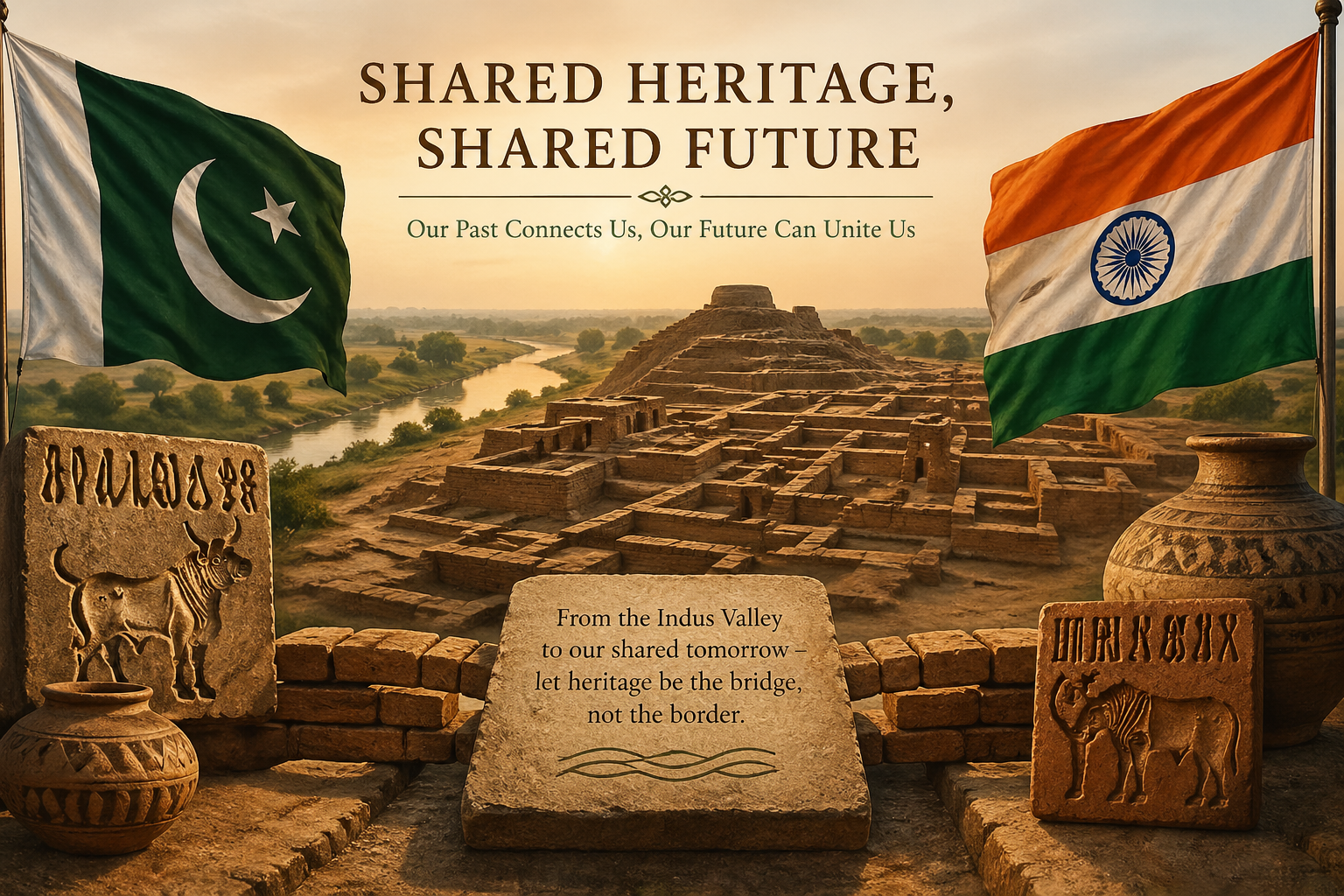
The birth of Pakistan in 1947 marked one of history’s most poignant partitions, splitting the Indian subcontinent into two dominions amid unimaginable violence and displacement. From the outset, a pervasive illusion took root in Pakistan: that India harbored an inherent hostility, bent on undoing the new nation’s existence.
While some Indians, for their part, may have initially viewed the partition with natural grief because it tore apart a shared civilization, there were others who wanted the severance on religious lines to be complete. However, once the lines were drawn, there was no turning back. While the India of 1947 carried forward and built on its multi-racial, multi-cultural, multi-religious, multilingual and secular heritage, Pakistan, born out of a theory which divided people on the basis of religion, chose to become a theocratic Islamic state.
Pakistan: A new contemporary identity but an identity crisis of the roots
Ask any Pakistani on social media, what their ancestors from generations back would have said when asked which country they belonged to, and you are likely to get trolled-with no straight answer in sight.
Perhaps, one of the reasons for Pakistan’s continued quest for a historical identity stems from the fact that no matter how much it tries, there can be no denying or escape from the fact that its ‘history’ before 1947 is inextricably linked to India because it is in fact, the history of India. Naturally, this is very difficult, if not impossible to accept for a country which has long been obsessed with India and defined its ‘being’ as anti-India. Therefore, it continues to search for answers and is happy to accept any, even if contrary to the evidence, so long as they have nothing to do with India. However, by failing to come to terms with the fact that their civilizational heritage between the Indus Valley Civilization (IVC) and 1947 is Indian, Pakistanis continue to display ignorance of their roots simply because they must compulsorily hate India, whether of the present or the past.
While on its contemporary identity there is no denying that Pakistan has evolved into a distinct, self‑aware nation—through its memes, humor, food, and popular culture—shaped by experiences unique to its political and social trajectory since 1947. This is commendable and something Pakistanis can take pride in: a new nation, still grappling with its contradictions, has found its own voice in a way that feels confident, self-assured and very different from 1947 or even 1971. However, geography and history blur while tracing Pakistan’s socio-cultural legacy to the IVC. This happens as the country appropriates the region’s pre-Islamic heritage- once shunned for years because it was Indian or shared with India –and links it to Pakistani culture. The Indus, IVC and the history of the region thereafter is increasingly being framed as the ancient “civilizational spine” of Pakistan in a way that makes it sound like an exclusive property deed, not a shared heritage of the subcontinent. That is where the divergence from historical realism begins.
The IVC and the rich history of the region thereafter is the creation of the people who enabled that culture and ethos to thrive, who nurtured it over ages and who gave it diversity and inclusivity. Were these people not fundamentally different in ideology, nature and character from those who espoused and followed the two-nation theory and carved a separate State for themselves in 1947?
It is Pakistan which selectively whitewashed its history and continuously dissociated itself from the Vedic-Hindu-Buddhist-Sikh and other influences in the region to emphasize a distinct Muslim identity and demonstrate continuity from early Islamic arrivals. Therefore today, it is a refreshing change to see that in order to give depth to its roots, many in Pakistan are ready to bury what it has been teaching its children for the last eighty years. Perhaps this explains why Pakistanis on social media are not only enamored by the ‘diversity’, ‘inclusivity’ and ‘heritage’ of ‘their past’ but are also clamoring to own it, even if it means arguing with the Afghans over Gandhara- a Mahajanapada of Ancient India or marveling over Takshshila –an education center where Chanakya and Panini thrived and which saw its peak during the Maurya and Gupta period, much before Islam’s sunrise in the region.
Pakistan’s recognition of the region’s pluralistic history-even predating Islam is most welcome, regardless of the motivations. However, its efforts to sever that history’s deep linkages rooted in vedic philosophy as borne out from millennia of evidence appears more to do with animosity towards India than an honest appreciation of facts. This raises some reflective questions for consideration. How might a nation whose founding fathers made Islam the battle cry for partitioning India connect with the multi religious ecosystem which prospered before it? How might a nation created due to the perceived necessity of a religious divide embrace the legacy of coexistence that thrived without those divisions? How might a nation which has consciously emphasized its origins in the advent of Islam following Muhammad Bin Qasim’s arrival and elevated him as a symbol of national identity now establish any meaningful linkage with the pluralistic past?
Today, no matter which side you take- arguing that Hindu, Muslim, Sikh or Buddhist influences dominated in different periods or regions of what became Pakistan-you cannot deny that the prevailing ideologies, despite their internal differences and conflicts fostered a melting pot for all, free from religious hatred and demands for exclusivity that rose in the 1930s and ultimately led to Pakistan’s creation. In fact, even before the advent of Islam and for centuries thereafter Buddhists, Hindus, Jains, Zoroastrians, and later Muslims lived side by side, often in the same cities, worshipping in their own shrines, yet sharing the same markets, languages, and cultural rhythms. This lived coexistence did not erase theological differences, but it refused to turn those differences into the basis for territorial separation.
The ideology that gave birth to Pakistan in 1947 is the antithesis of the values and beliefs of all pre Islamic civilizations’ preceding it because it rested on the very claim that such coexistence was impossible and a separate religious nation state was necessary for Muslims. That is what distinguishes the 1947 project from the past. Akbar did not argue that Muslims require a separate country; he reimagined the empire itself as a space where multiple faiths could coexist. Maharaja Ranjit Singh did not claim that Sikhs needed a separate state; he built a Punjabi realm that sheltered Muslims, Hindus, Sikhs, and others. Shivaji did not say that Hindus needed a separate nation; he fought for Hindu political autonomy within a plural landscape. Therefore, the Pakistan of 1947 cannot credibly claim a direct “civilizational” continuity with those pre‑modern polities, because its foundational ideology is itself a radical departure from the ethos of those earlier, more syncretic worlds.
When Pakistanis argue that ‘Pakistan’s history goes back to when humans first decided to build cities’, they are not wrong in the sense that geographically this region was the cradle for human settlement. However, what is misleading is the implied ownership, as if the Indus Valley was waiting for 1947 so that some nation State could be born in the future to claim it. Similarly, if Indians take pride in the continuity of many linguistic, cultural, philosophical and religious traditions running through the subcontinent then they must also accept that Pakistan has evolved into a legitimate, distinct, nation with its own pride, anxieties, and achievements. By physically occupying a region at a particular point in time you may give a territorial dimension to your ideology, but you cannot cloak your ideology with civilizational heritage to give it legitimacy simply because of that occupation, especially when you have all along repudiated every socio-religious and historical idea associated with that region.
Civilizational heritage is not something that can be claimed simply because a new State now controls a particular piece of geography or because a new community has migrated there. It is rooted in continuous practices, rituals, beliefs and everyday life that unfolds for centuries. Irrespective of behavioral, temperamental, emotional or other similarities which one may trace in retrospect or by implication, whatever is considered as ‘Pakistani culture’ today did not evolve through a continuous connect with the past, rather it was imposed as a break from the past either by occupation or conquest or after the acquisition of national identity in 1947. Therefore, Pakistan’s only connection with the IVC is through India.
The region which became Pakistan was an intrinsic part of India- an India which coexisted with Islam even through turbulent times and was later colonized by the British. Since India preceded Pakistan therefore it was not for it to choose its name or change its identity or acquire a new one; that was for the new entity carved out from it to do and which it rightly did. Identities can evolve. Geographies can change. But can roots and history change? Muslims who moved from India to Pakistan or Hindus who moved from Pakistan to India may have naturally evolved with distinct identities of their chosen country, but the historical continuity remains layered, not linear.
With so many people moving across from one side to the other during partition, the country which took birth in 1947 consisted not only of those who were residing there but also those who chose to make it their home. How does someone whose roots were severed from Lucknow in 1947 suddenly discover civilizational heritage elsewhere? How does a Hindu who moved from Lahore to Bareilly discover his ancestral spine elsewhere? We can rationalize, argue or convince ourselves as much as we want by selective presentation, misrepresentation, distortion, and misinterpretation of facts, but will we be ever able to change the facts? Instead of competing with each other even on history and trying to carve out exclusive ownership of civilizations, should we simply not understand each other’s peculiarities, acknowledge each other’s uniqueness, appreciate each other’s similarities and gracefully accept the beauty of our shared past?
Indians must accept—and rightly do—that Pakistanis have a distinct identity which evolved post‑partition and we may no longer be the same people with similar values. Similarly, Pakistanis must accept that prior to their country coming into existence they were a part of India and will continue to share history with it instead of trying to carve out a historical separation in hindsight which shakes their own roots leaving their future generations more confused than ever. Pakistan’s pride should rest on its own achievements, its diaspora strengths, its 1947–2026 narrative—rather than on an over determined claim over a 5,000-year-old pre‑State civilization which it had junked to further its chosen historical narrative. Therefore, yes, Pakistan has a rich and evolving culture that is completely legitimate; no, that culture does not entitle it to claim ownership of the history of the region and treat IVC as its private property nor does it absolve India of the responsibility to accept Pakistan’s post 1947 statehood with intellectual honesty
Indians and Pakistanis in the subcontinent: Mutually assured schadenfreude
Even seven decades after partition, the ghost of animosity between India and Pakistan continues to linger, often fueled by ‘policy & politics’ but certainly accentuated by a toxic cocktail of jibes and jealousy. Amplifying the worst of each other, indulging in one-upmanship, deriving sadistic pleasure from each other’s troubles, feeling miserable at each other’s success and experiencing a twinge of schadenfreude when the other fails – this is what India and Pakistan have reduced each other to, at least on social media. It’s a cycle of pettiness, juvenile behavior and immaturity that reveals a deeper malaise as both nations, blessed with immense talent seem unable to celebrate their own achievements without demeaning the neighbor and sometimes consider simply being better than the other as their achievement.
Social media erupts with name calling and memes mocking the other’s economy, cricket losses, political scandals, infrastructure and governance. Commentators conceive imaginary scenarios and give their ‘opinions’ on the strategies being employed by the other or how their own country has outmaneuvered the other. Even now, as Pakistan plays a major role mediating peace between the United States and Iran amid escalating tensions, Indian social media mocks it as a “fool’s errand” or desperate bid for relevance while Pakistan celebrates it as a success because it is the one mediating and not India. If Indians deride Pakistan’s instability and subservience to the West; Pakistanis lampoon India’s growing “Hindu fanaticism” and irrelevance in West Asia. Hardliners on both sides continue to berate the other in the most extreme language, hunting for every slip‑up or failure and magnifying it into a supposed national character.
Talk shows, newspaper columns, YouTube spaces, and social media threads host those who reduce complex, plural societies into caricatures: “Pakistanis are this”; “Indians are that.” To construe these voices as reflective of the entire country would be totally erroneous. Vast majorities—on both sides—are too busy living, working, parenting, and trying to get by, to obsess over daily hatred mongering. Yet the space these hardliners occupy is so loud that it tempts the saner elements in both Nations to constantly answer back to them. That is a trap which increases the cycle of viciousness. A mature India or Pakistan cannot derive its self‑worth from demolishing another country’s trolls, or from compiling clips of its adversaries’ worst performers. High time we evolve and start owning our successes without needing the other’s failure. Just as one should not define India by its loudest Islamophobes, nor Pakistan by its narrow‑minded religious zealots, one should not accept the need to constantly “justify” oneself in response to them. Pride must come from internal standards—governance, innovation, education, compassion—not from scoring points against the other side’s cranky commentators.
South Asians outside the subcontinent: Mutually assured freudenfreude
This mutually critical syndrome is uniquely sub-continental. Step outside the region, and the script flips dramatically. In USA, UK, Gulf States or elsewhere, Indians and Pakistanis morph into “South Asians,” united against stereotypes and reductive narratives. Diaspora communities organize joint cricket leagues, where a Pakistani bowler high‑fives an Indian batsman post‑match. In Silicon Valley, entrepreneurs from Lahore code alongside those from Lucknow and co‑found startups like Zoomcar or Careem. Children studying abroad are best of friends with those from the other side and full of praise for each other’s families whenever they meet. If families from Karachi haggle over spices with those from Kolkata, Punjabis learn recipes for biryani from their counterparts. Help flows freely—a Pakistani cabbie in London detours to drop an Indian student home safely, or Indian doctors in US hospitals mentor Pakistani interns.
This contrast isn’t accidental; it’s a lesson in sanity. No jibes, no jealousy—just pragmatic solidarity. Why? Abroad, survival demands it. Facing visa hurdles, workplace bias and other challenges we realize that our shared Urdu intonations, Punjabi slurs, love for Chai, fascination of Pakistani dramas and obsession with Bollywood beats far outweigh 1947’s lines. Back home, media and politics amplify divisions for TRP’s and votes. The subcontinent’s insularity breeds contempt. Geographic proximity invites comparison. Echo chambers reinforce biases, algorithms feed us hate. Both sides nitpick juvenile media aberrations—plucking foolish viral clips of Pakistani anchors fumbling facts or Indian reporters sensationalizing trivia, then highlighting them endlessly as “proof of idiocy”. Away from the jingoistic cacophony of the subcontinent, we are least bothered and hate hardly occupies any mind share.
Indians and Pakistanis must realize that as South Asians, together we are heirs to the Indus Valley, Akbar’s syncretism, Chanakya’s wisdom, Ashoka’s Dhamma, Iqbal’s prose, Tagore’s poetry and Vivekananda’s humanism. Is it not striking that those who suffered the horrors of partition, endured its trauma and bore its scars harbor remarkably little or no ill will towards the other side? Is it not striking that even today this disappearing generation recalls shared memories with fondness, nurturing a quiet hope that India and Pakistan might one day learn to coexist peacefully while the younger generation seethes more with angst and division? Is this increased bitterness and widening rift due to the trajectory of our education and social narratives, or from a fractured telling of history? Whatever the cause, Partition was no deliberate verdict or eternal curse; it was an accident of destiny, not a sentence. The present generation had nothing to do with it and need not inherit its weight or carry its baggage into the future. Abroad, we live this truth daily-ditching schadenfreude for shared freude; trading jealousy for joint ventures; rivalry for cooperation; competition for praise and pettiness for grace. Can this be brought back home?
Like it or not, both India and Pakistan are in this journey together and that will not change. How they travel in the future, can. A mature subcontinent- peaceful, prosperous and united in diversity would awe the world.
Disclaimer: The opinions and views expressed in this article/column are those of the author(s) and do not necessarily reflect the views or positions of South Asian Herald.
Related posts:
 U.S.–Arab Engagement Revives Pakistan Military’s Global Standing
 Pakistan’s Ambassador to the U.S. Calls for “Meaningful” Dialogue with India; Highlights Economic Diplomacy and Investment Opportunities
 New Stage Play: When Gandhi and Mohammed Meet
 Meenakshi Lekhi Calls Science and Technology the Bridge for a Stronger US-India Partnership at FIIDS Roundtable