Join WhatsApp Channel

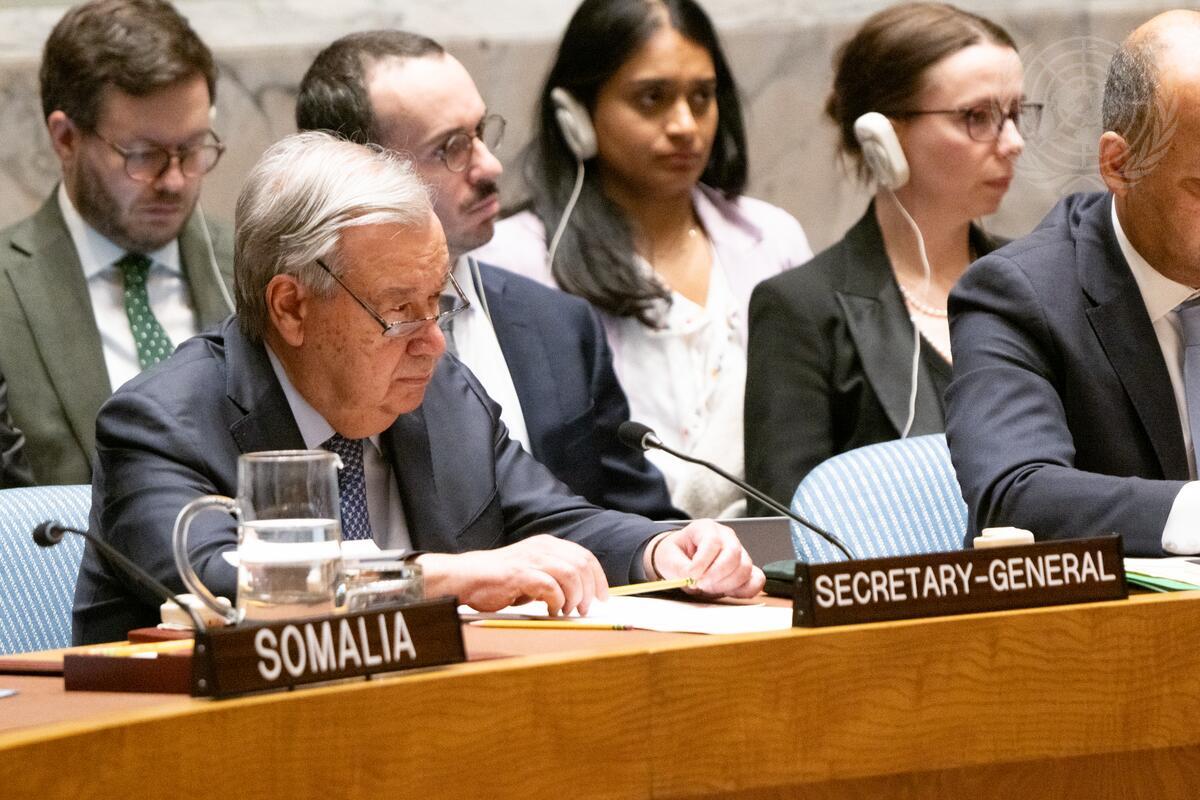
Secretary-General of the United Nations António Guterres has called for strict adherence to international law and an immediate halt to hostilities following military strikes by the United States and Israel against Iran and Tehran’s subsequent retaliation across the region.
Addressing the United Nations Security Council on February 28 during an emergency meeting on the situation in the Middle East, SG Guterres structured his remarks around what he described as “the principles,” “the facts,” and “the way out.”
He said both the use of force by the United States and Israel against Iran and Iran’s retaliatory strikes risk undermining international peace and security. “International law and international humanitarian law must always be respected,” he told Council members.
SG Guterres said he had condemned the initial strikes as well as Iran’s subsequent attacks, which he said violated the sovereignty and territorial integrity of Bahrain, Iraq, Jordan, Kuwait, Qatar, Saudi Arabia, and the United Arab Emirates.
Emphasis on International Law
Turning to what he called the “principles,” the Secretary-General underscored that the UN Charter provides the foundation for maintaining international peace and security. He cited Article 2 of the Charter, which states that all Member States must refrain from the threat or use of force against the territorial integrity or political independence of any state.
“We are witnessing a grave threat to international peace and security,” SG Guterres warned, cautioning that military action in what he described as the world’s most volatile region could trigger consequences that no one can control.
“There is no viable alternative to the peaceful settlement of international disputes,” he said. “Lasting peace can only be achieved through peaceful means, including genuine dialogue and negotiations.”
Situation on the Ground
Outlining what he described as “the facts,” Guterres noted that the situation remains fluid, with multiple unconfirmed reports emerging from the region.
He said approximately 20 cities across Iran, including Tehran, Isfahan, Qom, Shahriar, and Tabriz, were reportedly targeted. In Tehran, large explosions were reported in a district that includes the presidential palace and the compound of Iran’s Supreme Leader.
According to Israeli sources cited by the Secretary-General, several high-ranking Iranian officials were killed. Among them was Iran’s Supreme Leader, Ali Khamenei, though Guterres said he was not in a position to independently confirm those reports during the time of his address.
Iran has closed its airspace and is reportedly experiencing a near-total internet blackout. The Secretary-General said the strikes have caused significant civilian casualties.
He cited Iranian media reports that an airstrike on a girls’ school in Minab, in Hormozgan Province, killed at least 85 people and injured many others. Another school in Tehran was reportedly hit, resulting in two deaths.
Military activity, he said, is expanding rapidly across the region, creating an increasingly volatile and unpredictable situation and heightening the risk of miscalculation.
SG Guterres also cited Israeli sources indicating that 89 people were injured in Iran’s retaliatory strikes on Israel, with impacts reported in the occupied West Bank.
Regional Spillover and Strategic Concerns
Addressing Iran’s targeting of U.S. military assets in the region, the Secretary-General said some of the reported strikes hit civilian areas and infrastructure in Gulf countries. Indirect damage from falling debris was also reported in Lebanon and Syria.
Most Gulf states successfully intercepted incoming missiles, he noted. However, the United Arab Emirates reported that one civilian was killed by debris from an intercepted missile.
In Iraq, there are reports of drone and missile exchanges between the two sides. Guterres also pointed to reports that Iran may be closing the Strait of Hormuz to international shipping, a move that could have far-reaching economic consequences.
The Secretary-General noted that the military escalation followed a third round of indirect talks between the United States and Iran, mediated by Oman. Preparations had been underway for technical discussions in Vienna next week, to be followed by a new round of political talks.
“I deeply regret that this opportunity of diplomacy has been squandered,” he said.
Call for Immediate De-Escalation
Stressing that both the region and the broader international community urgently need a path forward, Guterres called for “de-escalation and an immediate cessation of hostilities.” “The alternative is a potential wider conflict with grave consequences for civilians and regional stability,” he warned.
He urged all parties to return immediately to the negotiating table, particularly on Iran’s nuclear program. He noted reports that the U.S. President had spoken with leaders of Saudi Arabia, Qatar, and the United Arab Emirates, and that Iran’s Foreign Minister had engaged counterparts in Gulf Cooperation Council countries and Iraq.
“Everything must be done to prevent further escalation,” SG Guterres said.
He called on all Member States to uphold their obligations under international law, including the UN Charter, to protect civilians in accordance with international humanitarian law and to ensure nuclear safety.
“Let us act responsibly and together to pull the region, and our world, back from the brink,” he said.