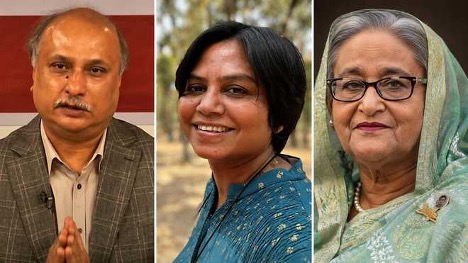
Bangladesh prosecutors have formally charged Sheikh Hasina, two journalists and 38 others, in connection with a 2013 crackdown on a rally organized by the Islamist group Hefajat-e-Islam at Dhaka’s Shapla Chattar, in which 58 people are alleged to have been killed.
The charge sheet, submitted on Monday to the country’s so-called International Crimes Tribunal, names Farzana Rupa, a former principal correspondent and presenter at Ekattor TV, and Mozammel Babu, the channel’s founder and former editor-in-chief.
The two journalists were arrested on May 14 in the case, which involves allegations of crimes against humanity.
Md Aminul Islam, the tribunal’s chief prosecutor, told reporters that Rupa, acting on Babu’s instructions, had produced a documentary for Ekattor TV about the crackdown that falsely claimed no one had been killed at Shapla Chattar.
Advertisement
The case has drawn criticism from press-freedom groups. Kunal Majumder, Asia-Pacific programme coordinator at the Committee to Protect Journalists, said it was “simply unacceptable” to charge journalists with crimes against humanity for doing their work, and called for the charges to be dropped.
The potential consequences are severe. If convicted, Rupa and Babu could face the death penalty, as the tribunal has no sentencing guidelines prescribing specific penalties for individual offences.
The two journalists have also been in custody since August 2024 on separate murder charges related to the mass protests that year. Although the High Court granted them bail in those cases, the Appellate Division of the Supreme Court subsequently stayed the orders. Even if that stay is lifted, the International Crimes Tribunal proceedings could provide a separate legal basis for keeping them in detention.
Hasina, who was forced to leave Dhaka after a student-led revolt in July-August 2024 and subsequently went into exile, has herself faced more than 150 legal cases initiated by the interim government of Professor Muhammad Yunus, which assumed power after her departure.
In one of those cases, the International Crimes Tribunal sentenced her to death in absentia for crimes against humanity related to the suppression of the student-led protests. Hasina has rejected the proceedings as politically motivated, describing the tribunal as a “kangaroo court” and the trial as a “farce.”
The proceedings against Hasina and the journalists have unfolded against the backdrop of a wider reckoning with the political and institutional legacy of her long rule. But the use of criminal and international-crimes proceedings against journalists have also raised concerns that Bangladesh’s post-Hasina transition risks reproducing the partisan use of the justice system that critics had long associated with the previous government.