Join WhatsApp Channel


Rashtriya Swayamsevak Sangh (RSS) Chief Mohan Bhagwat urged members of the Indian diaspora in the United States to fulfill their responsibilities to their “Karmabhoomi,” or adopted land, before serving their “Janmabhoomi,” or motherland.
“We are in America. We live in America. We earn in America. So, we are American. And we should behave true to America. The diaspora, the Bharatiya diaspora, they have a duty to their Karmabhoomi. They must fulfill that. They should be loyal to their Karmabhoomi,” Bhagwat said.
He made the remarks during the “Universal Oneness Celebration,” held Aug. 29 at Madison Square Garden in New York. The event was organized by the American Hindus for Engagement and Dialogue (AHEAD) Forum.
In his keynote address, Bhagwat also encouraged members of the diaspora to contribute to India after fulfilling their responsibilities to their adopted country, though he emphasized that India did not expect or require such support.
“Because Bharat is their Janmabhoomi, if they have an urge to do something and they can do that, after fulfilling their duty to their Karmabhoomi, it is not prohibited,” he said. “Okay. But it is not obligatory. Your Janmabhoomi expects you to live the values it has imparted to you.”
Addressing a gathering of more than 6,000 people from 39 U.S. states, Bhagwat said “pluralism” is a term frequently associated with the United States.
“And when we say Bharat, another word, another phrase, is discussed: unity in diversity. For Bharat, this unity and this diversity are both in its DNA. Nations are not merely geographical entities. In the design of this universe, nations have to carry out a duty,” he added.
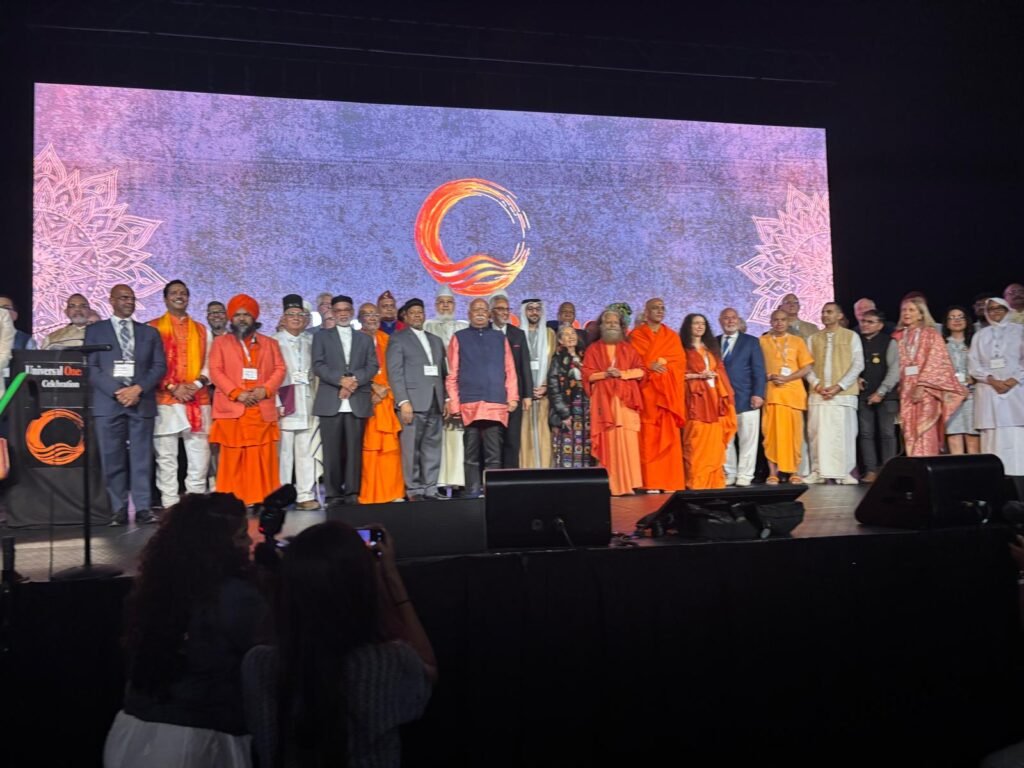
Bhagwat, who became the RSS’s sixth Sarsanghchalak in 2009, reflected on India’s role in promoting the principle of unity in diversity.
“We are one, and due to diversity, that oneness is decorated. So, diversity has to be celebrated, has to be respected, has to be accepted,” he said.
Bhagwat emphasized that economic success should not be the sole measure of a person’s life.
“How much we earn is not important. How much we distribute is important,” he said. “You think of a career. Is a career only money? Is a career only material happiness?”
He also encouraged people to support one another. “We have to care for each other. We have to care so that my life is sustaining life. I sustain others. I live and not merely let live. Make others live. That is the message,” he said.
Discussing the importance of belonging, Bhagwat said, “In spite of different bodies and everything being different, there is something within that is the same. We belong to each other.”
He argued that people can move closer to God when they think and act in the right way.
“If you think in the right way, you can go closer to God. If you think in the wrong way, you can go closer to the animal kingdom. So, the direction is important,” he said. “A person who shapes his life according to the right direction becomes a responsible citizen of the Kingdom of God. There is one specialty that makes human beings different from animals: thinking. If human beings think rightly, they can sustain the whole world.”
To illustrate the human capacity for compassion, Bhagwat described a hypothetical situation in which a hungry person watches someone eat a full meal.
“Without avoiding his gaze, without driving him out, and without giving him a single particle of food, try to eat. You cannot do it. You can try, but you will not be able to do it, because we are human beings,” he said.
Bhagwat then used doughnuts as an example to argue that material pleasure provides only temporary satisfaction.
“We have all material happiness, but this cannot satisfy us permanently,” he said, before asking how many doughnuts a person could eat at one time.
A person might consume as many as 50 doughnuts in one sitting, he said, but would eventually be unable even to look at another one and would ask for it to be taken away. The doughnut itself had not changed, he noted, but the person’s desire for it had.
By the following morning, however, the same person might be ready to eat doughnuts again, Bhagwat said. “So, material happiness is transitory. It cannot satisfy,” he added, arguing that even an abundance of material comforts may ultimately fail to provide lasting fulfillment.
Related posts:
 Film Review: Bhagwat Chapter 1; Raakshas is Atmospheric Thriller
 New York Mayor Zohran Mamdani Announces Opposition to RSS Program in Madison Square Garden
 Mohan Bhagwat Launches Anthem on 100 years of RSS
 ‘I promise to be a President for all Americans. You can always trust me to put country above party and self’