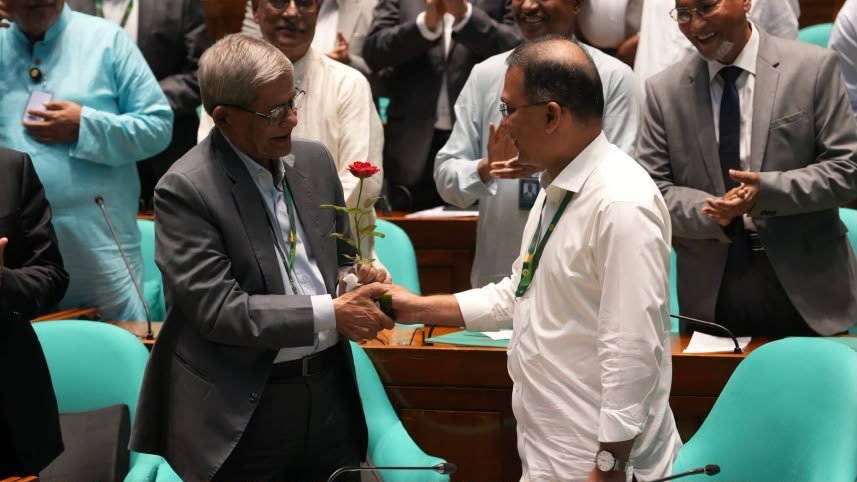
Mirza Fakhrul Islam Alamgir has formally assumed office as President of the People’s Republic of Bangladesh, following his election by the Jatiya Sangsad (Parliament) earlier this week. His inauguration at Bangabhaban marks a significant milestone for the nation and for the people of his home constituency, Thakurgaon.
President Alamgir, 78, secured 255 of 343 votes cast by lawmakers, defeating opposition candidate Oli Ahmed, who received 88 votes and was backed by an eleven-party alliance led by Bangladesh Jamaat-e-Islami and the National Citizen Party. The vote, overseen by Chief Election Commissioner A.M.M. Nasir Uddin, marked the first contested presidential election in Bangladesh in 35 years. The presidency became vacant after Mohammed Shahabuddin resigned last month on health grounds.
President Alamgir’s public life began during his student years at the University of Dhaka, where he earned Bachelor’s (Honours) and Master’s degrees in Economics. He served as General Secretary of the S.M. Hall unit and later as President of the Dhaka University unit, taking an active part in the historic 1969 Mass Uprising.
In 1972, he joined the Bangladesh Civil Service (Education Cadre), teaching Economics at Dhaka College and later serving as Professor of Economics at Thakurgaon Government College until 1986. His administrative career also included a term as Deputy Director at the Directorate of Inspection and Audit, work with the Bangladesh National Commission for UNESCO, and service as Private Secretary to the Deputy Prime Minister in the early 1980s.
Advertisement
He went on to a long career in representative politics, first as Chairman of Thakurgaon Municipality and later as a Member of Parliament for Thakurgaon-1. He held several key executive portfolios, including State Minister for Agriculture, State Minister for Civil Aviation and Tourism, and Minister for Local Government, Rural Development and Cooperatives. He has served as Secretary General of the Bangladesh Nationalist Party (BNP) since 2011, and has long been regarded as a transparent, principled and courteous figure in Bangladeshi politics.
Ahead of the parliamentary vote, President Alamgir spoke publicly of his hopes for the country, describing a vision of a prosperous, welfare-oriented Bangladesh in which ordinary working families and marginalized communities can meet their basic daily needs. His remarks were widely carried by state media ahead of the ballot.
Voting for the presidency took place in the chamber of the Jatiya Sangsad, with Acting President and Speaker Hafiz Uddin Ahmed casting the first ballot, followed by Prime Minister Tarique Rahman and other members of Parliament. Of the 350-seat legislature, 349 lawmakers were eligible to vote after balloting in one constituency had been suspended; 343 ultimately cast ballots. The BNP, which returned to government following elections held on 12 February, holds a two-thirds majority in Parliament.
Under Bangladesh’s constitution, the presidency is a largely ceremonial post, with executive authority resting with the Prime Minister and Cabinet. The President nonetheless serves as head of state and commander-in-chief of the armed forces, and plays an important constitutional role during periods of political transition.
Mirza Fakhrul Islam Alamgir was elected President yesterday, Thursday, in an open vote of Members of Parliament. Under Article 70 of the constitution, lawmakers have no scope to vote outside their own party’s decision, meaning that with the ruling BNP holding more than a two-thirds majority in Parliament, victory for the party’s candidate was effectively assured beforehand. Even so, because a rival candidate was in the race, voting proceeded yesterday as scheduled. The last time a presidential election in Bangladesh went to an actual vote was in 1991, the same year the parliamentary system of government was reinstated.
President Alamgir’s tenure begins amid continued national conversation about institutional reform. While parliamentary governance proceeds under the existing constitutional framework, the aspirations of the post-July movement – including calls for deeper structural changes such as bicameral mechanisms and stronger institutional checks and balances under the July Charter – remain subjects of active public discussion.
Well-wishers and colleagues across the political spectrum have extended congratulations to the distinguished University of Dhaka alumnus, expressing best wishes for his health, leadership and success as he guides the republic forward.