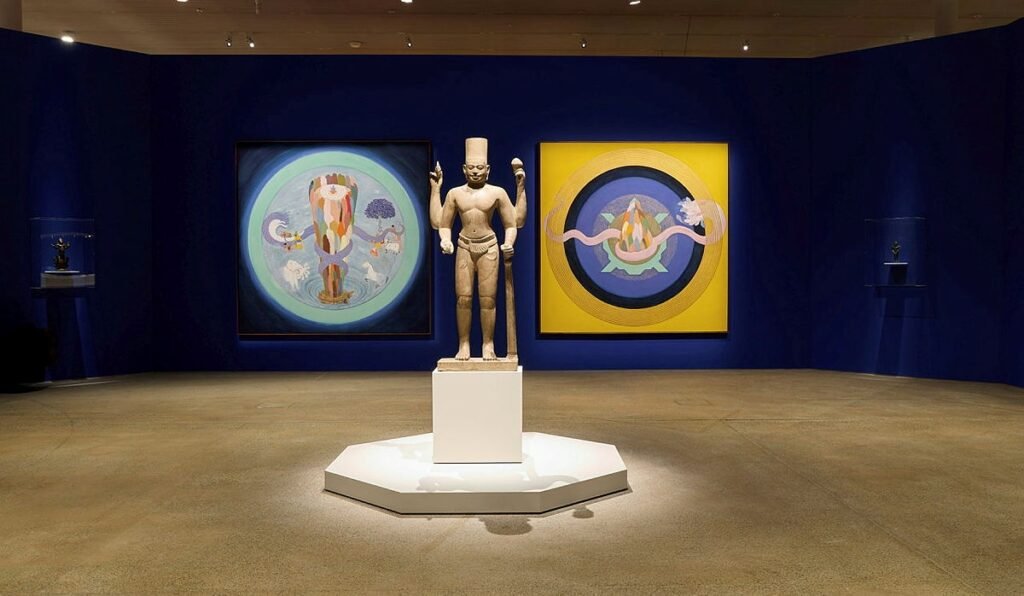
The word “avatar” is familiar to many Australians, but a Sydney exhibition explores its roots in Hindu traditions. Avatar: Forms of Vishnu at the Art Gallery of New South Wales brings together nearly 200 works spanning 1,500 years, examining how artists have depicted Vishnu and his manifestations.
Co-curator Chaitanya Sambrani spoke to South Asian Herald in Sydney on September 29, 2026, about the exhibition, whose works range from a sixth-century piece to paintings created this year. Drawn from collections in Australia, India, Cambodia, the United Kingdom and Switzerland, they offer perspectives across different periods and regions.
Sambrani, Associate Professor in Art History and Curatorial Studies at the Australian National University (ANU), co-curated the exhibition with Melanie Eastburn, Senior Curator of Asian Art at the Gallery, and the two institutions developed it over more than three years. It is the first Australian exhibition devoted to Vishnu, a Hindu deity associated with preserving order in the world, and ANU describes it as the Gallery’s largest presentation of South and Southeast Asian art in more than 20 years.
As Australia’s connections across South and Southeast Asia deepen, Avatar adds another dimension: cultural understanding. It asks what it means for Australians to encounter traditions that may be unfamiliar to some but belong to the inheritance of many communities within Australia itself.
Advertisement
For visitors new to the subject, Sambrani offered an everyday analogy.
“Vishnu is the mechanic,” he said.
Vishnu keeps the world running, he explained, and when it breaks down, he comes back to do an overhaul.
“You don’t have to be a believer to understand,” Sambrani said. “You can think about this in terms of a preservation, a force that preserves, that keeps the world turning.”
Then there is the title. Long before it named a gaming character, a profile picture or a blockbuster film, “avatar” was the Sanskrit avatāra, literally “descent.” It describes the boundless taking on a bounded form: the divine stepping into the world in a shape the world can meet.
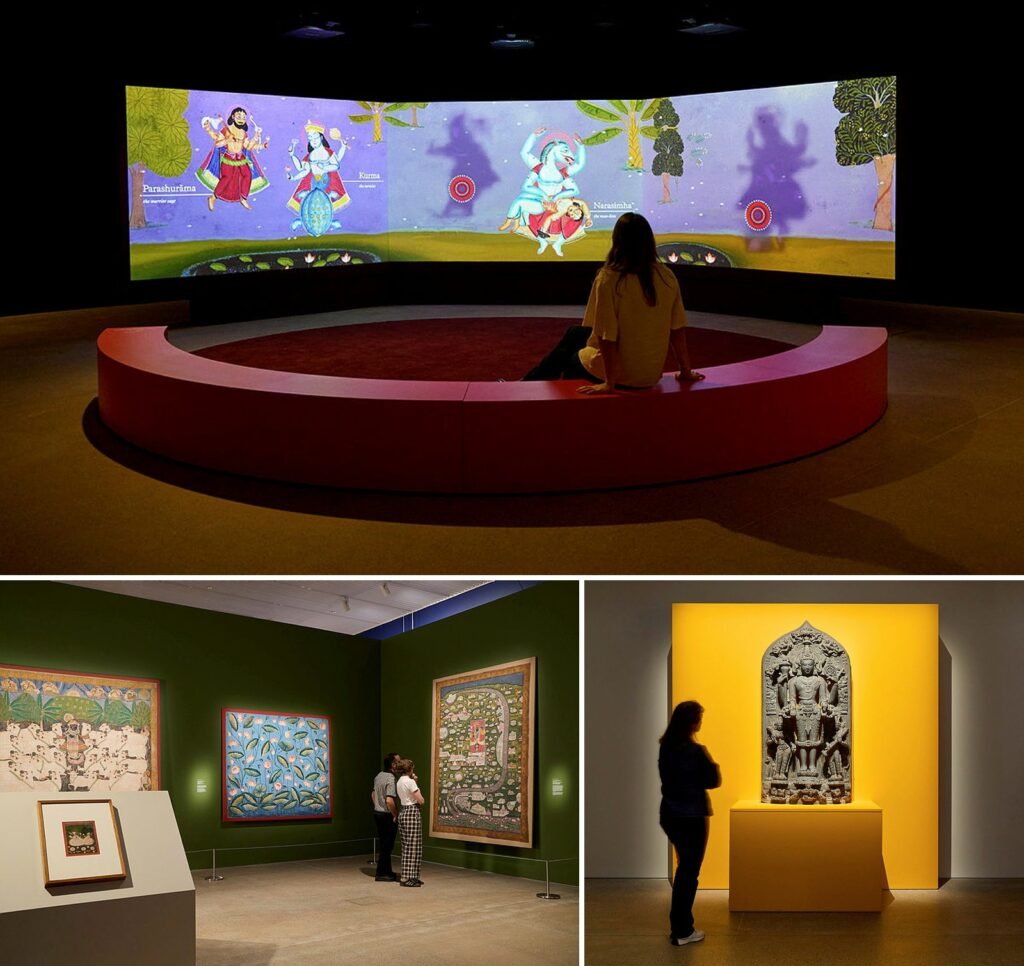
“The fact that the word has so much currency makes it possible for people to make an immediate association,” Sambrani said. He and Eastburn considered around half a dozen titles before settling on this one.
A Gallery for a Changing Australia
Sambrani describes Australia as being in a period of “demographic transition,” with growing South and Southeast Asian communities changing who the country’s cultural institutions serve. That matters at the Art Gallery of New South Wales, a publicly owned institution.
For some visitors, the figures and stories in Avatar will be entirely new. For others, they have been part of family, cultural or religious life for generations. One person may see a sculpture as an extraordinary historical object, while another sees an image carrying living religious meaning.
Sambrani compared this to showing a painting by the Italian master Caravaggio in India, far from its European religious and cultural context, before audiences with a different frame of reference. Museums have long navigated that tension, he said, because much pre-modern art was made for religious and architectural settings rather than modern galleries.
He does not believe beauty and belief can be neatly separated. He said he is not someone who regularly goes to a temple to worship, but he visits museums often and described that, metaphorically, as his “form of worship.”
A Tradition That Never Stood Still
What interests Sambrani about the exhibition’s 15 centuries is not only the age of the works but their differences. Stories changed as they moved between regions and generations. Matsya, the fish form of Vishnu, was depicted differently in Kashmir, Bundelkhand, Rajasthan and Bengal.
“These traditions are not frozen,” Sambrani said. “They are not singular. They are not … completely fixed in time and space. They are dynamic.”
Artists and storytellers kept reinterpreting them across places and periods. “Those innovations keep the tradition alive,” he said. “The reason that they remain dynamic and they remain open is the reason for their longevity.”
Why It Matters Now
The Gallery has staged major South Asian exhibitions before, including Goddess: Divine Energy in 2006. Two decades later, Avatar arrives in a markedly different Australia.
For Sambrani, who has taught art history since 1995, such exhibitions are also about maintaining what he calls “historical consciousness” amid competing ideas about what history means and who it is for. What matters, he said, is sustaining dialogue “across cultures, between cultures.”
“We have currents from so many places that have come and informed us,” he said. He described his work as sharing some of the “joy and magic” of that inheritance while “maintaining knowledge and sharing it,” an argument that reaches beyond any single faith or community.
The Story That Stayed With Him
Asked which story had stayed with him after more than three years on the exhibition, Sambrani chose Samudra Manthana, the Churning of the Ocean.
In the ancient story, opposing forces join to churn the cosmic ocean in search of amrita, the nectar of immortality. But the churning yields more than they seek: before the nectar emerges, so does poison.
Sambrani jokingly called it a “slightly mad enterprise” and a “great, fascinating tug of war between two opposing sides.”
The story holds an enduring idea: the nectar may not come without confronting the poison. The churning brings both to the surface, and what matters is persisting through the turmoil without losing sight of what the churning was meant to find.
Contemporary artist Desmond Lazaro brings the story into the present in Samudra Manthana, Churning of the Ocean of Milk, one of two large paintings created especially for Avatar.
“That’s truly something we have to learn lessons from,” Sambrani said.
“Avatar: Forms of Vishnu” is on view at the Art Gallery of New South Wales in Sydney until October 5, 2026.