Join WhatsApp Channel


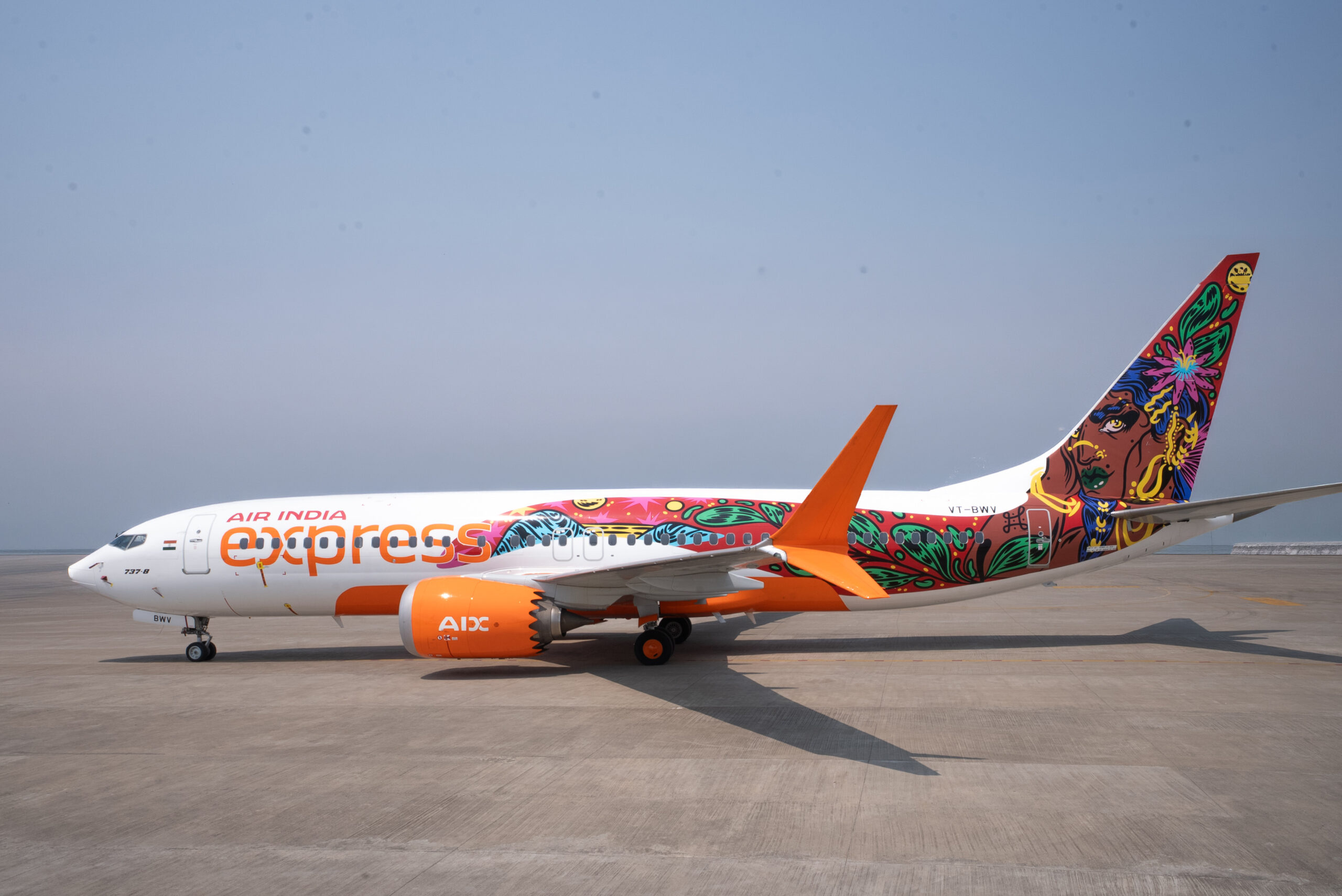
In an industry where branding often stops at logos and cabin interiors, Air India Express is pushing the idea several thousand feet higher—literally. Its latest unveiling, a fully art-wrapped Boeing 737-8, signals not just a design shift but a broader attempt to reimagine how culture, travel and identity intersect in modern aviation.
Christened The Flying Canvas, the aircraft is being described as India’s first full-fuselage contemporary art wrap—an ambitious extension of the airline’s “Tales of India” initiative, which seeks to embed indigenous art and storytelling into its rapidly expanding fleet.
At the center of this experiment is Osheen Siva, a multidisciplinary artist known for blending mythology, futurism and questions of identity. Her artwork transforms the aircraft into what the airline calls a “moving cultural installation”—a phrase that, while evocative, also captures a deeper shift underway in how Indian brands are beginning to engage with contemporary art.
The livery features a stylized Tamil figure—rooted in memory yet oriented toward the future—layered with motifs that evoke lineage, continuity and transformation. It is not merely decorative. Instead, it positions the aircraft as a narrative surface, one that carries stories across borders as much as passengers.
From tail art to full-body storytelling
Air India Express is no stranger to art-led branding. For years, its aircraft tails have doubled as miniature galleries, drawing from the works of Raja Ravi Varma, classical dance traditions such as Kathakali and Bharatanatyam, and visual interpretations of India’s architectural heritage.
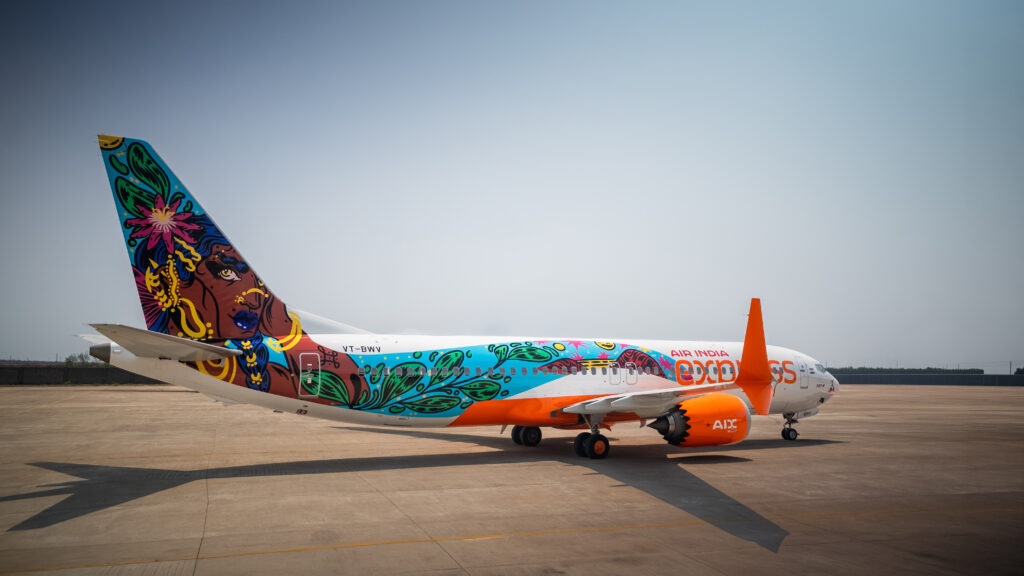
But the shift from tail art to a full aircraft wrap marks a qualitative leap. It transforms the plane from a symbolic nod to culture into a fully immersive object—visible not just at boarding gates but across skies and cities.
The move also builds on the airline’s 2023 brand refresh, which introduced “Tales of India,” a design language rooted in traditional crafts like Kalamkari, Bandhani, Kanjivaram and Banarasi textiles. Each aircraft became a distinct story; The Flying Canvas turns that idea into something closer to a travelling exhibition.
Art beyond galleries
The project is anchored in a multi-year partnership with the Kochi-Muziris Biennale, an institution that has, over the past decade, played a key role in democratizing access to contemporary art in India.
For the Biennale, the collaboration represents an extension of its founding philosophy—taking art out of enclosed spaces and into everyday life. In this case, that “everyday” includes airports, runways and flight paths spanning more than 60 destinations.
There is also a subtle but significant shift here: contemporary Indian art, often confined to elite gallery circuits, is being repositioned as something more accessible, even public-facing. An aircraft, after all, is one of the most visible and mobile canvases imaginable.
Branding in a crowded sky
The timing of the launch is not incidental. India’s aviation sector is expanding rapidly, with airlines locked in intense competition not just on fares and connectivity but on experience and identity.
In that context, design becomes strategy. By foregrounding culture, Air India Express is attempting to differentiate itself in a market where hardware—aircraft, routes, pricing—can be quickly replicated, but storytelling cannot.
There is also a broader alignment with the Tata Group’s repositioning of aviation assets, where brand identity is being sharpened to reflect a more confident, globally resonant India.
A travelling metaphor
For passengers, the impact may be immediate but subtle—a striking aircraft on the tarmac, a sense of something distinctly Indian yet contemporary. For the airline, however, the stakes are larger.
The Flying Canvas is not just about aesthetics; it is a statement about how India wants to be seen—and how it sees itself. Rooted in tradition, yet unafraid to reinterpret it. Local in inspiration, global in movement.
As the aircraft begins its journeys across South Asia, Southeast Asia and the Gulf, it carries more than passengers and cargo. It carries an evolving idea of culture—one that is no longer static, but in motion. At 35,000 feet, that idea may finally have found its most expansive canvas yet.